Installation2026
Unfinished Bloom
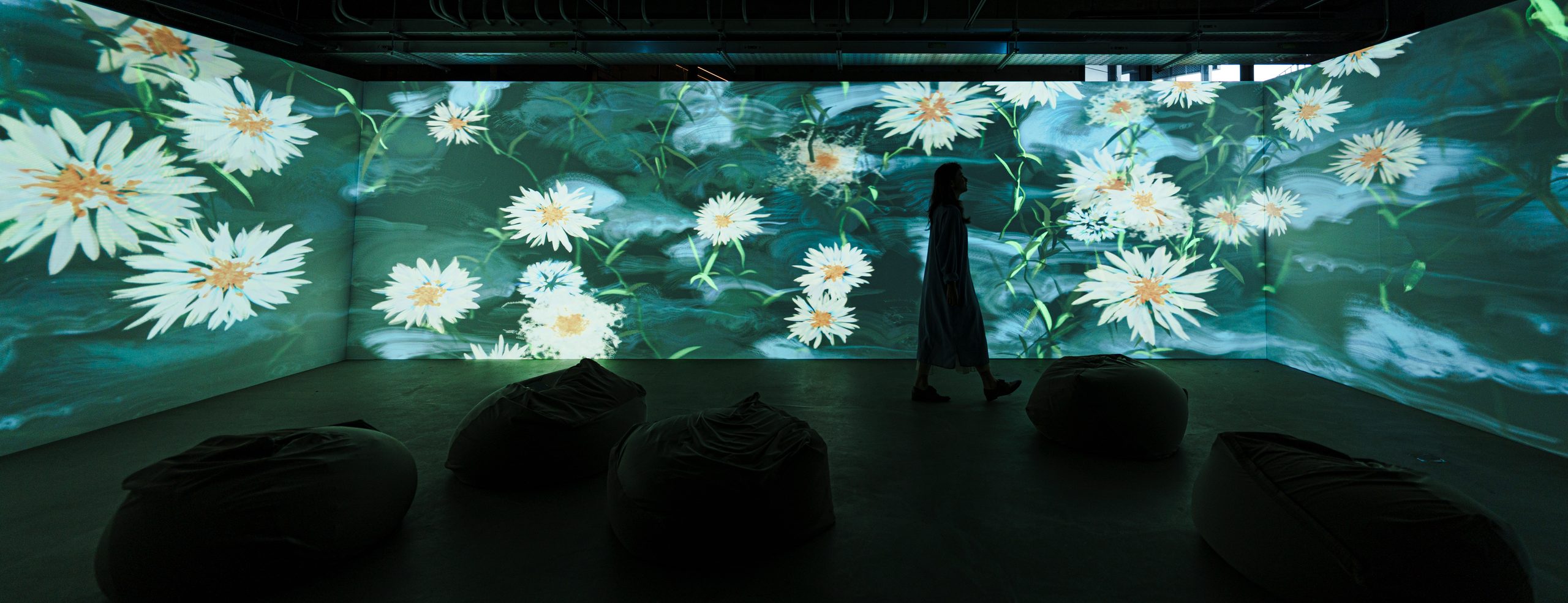
Photography: Chao-Ming Huang (Lidio). The same room growing different flowers at different moments. Click to enlarge.
Contents & work details
- Archive year
- 2026
- Type
- Installation
- Artist
- Che-Yu Wu 吳哲宇
- On view
- 24 April to 15 August 2026
- Venue
- Gallery A3, New Taipei City Art Museum, Yingge
- Exhibition
- The museum’s first-anniversary flower exhibition; Gallery A3 was titled Generative Flowers
- Form
- A U-shaped projection across three walls, four projectors blended into one 7680 × 1200 picture
- System
- A p5.js and WebGL brush system computed live on one computer in the gallery, nothing pre-rendered
- Flowers
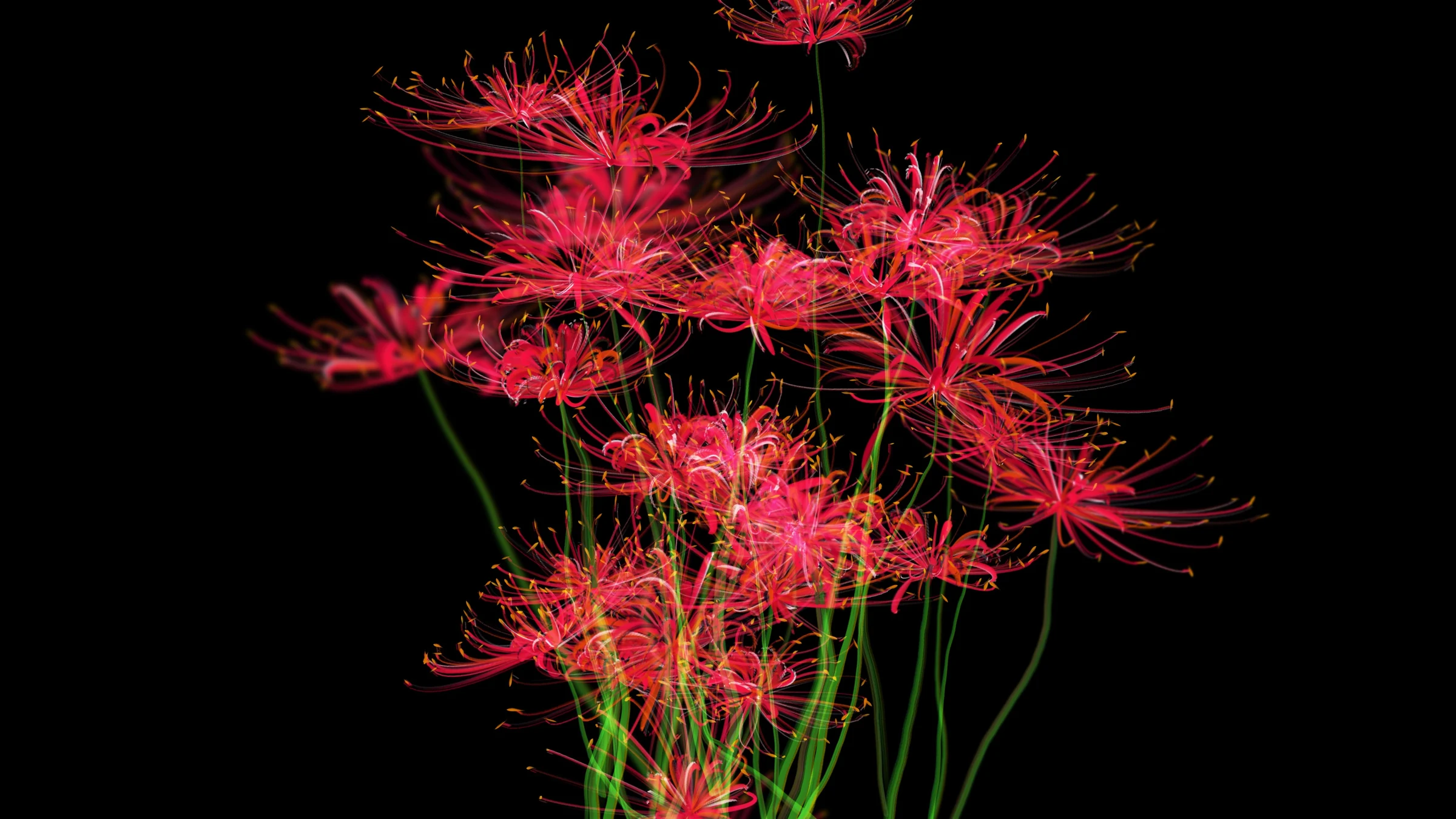
- Spider lily, colourful flower, poppy, violet, sunflower and white daisy, six kinds in turn
- Sound
- Three of Che-Yu Wu’s own pieces on a loop
- Artist
- Che-Yu Wu
- Exhibition page
- Dates and exhibition record
Overview
Unfinished Bloom is Che-Yu Wu’s real-time generative work at New Taipei City Art Museum, shown in Gallery A3 from 24 April to 15 August 2026 as part of the museum’s first-anniversary flower exhibition. Three walls of the gallery join into a single U-shaped projection, and a single computer computes without pause, growing a field of flowers in oil-like brushstrokes on a dark ground: flowers appear one by one, their strokes trembling and scattering and sometimes gathering back into a whole flower, until after a while the picture fades and another kind of flower begins again. Nothing is pre-recorded. When the exhibition ends and the computer is switched off, none of the flowers it painted is kept on any hard drive.
The work grew out of the generative flowers he has been writing for years. The more precise the system became and the more lifelike its flowers, the more he felt something of the original was lost, so he turned back to the way Van Gogh lets a brushstroke stay a brushstroke and made the approach to nature itself the work. That is where the “unfinished” of the title sits: the flower grows in its own way, the system grows in its own way, and the work stays in the gap where the two miss each other. Everyone who walks into the gallery sees a different set of flowers.
I prefer those rough brushstrokes, so I started thinking about how, when Van Gogh painted his Impressionist works, some of his flowers come apart and he lets a brushstroke be a brushstroke. And sometimes the strokes gather again into a more abstract, whole flower.
The closer the likeness, the less of the flower
Che-Yu Wu has been writing generative flowers for years. In June 2024 his daily sketches turned to a run of flowers, daisies, sunflowers, poppies, violets and spider lilies, their strokes moving from noise through watercolour to the texture of oil paint, and he later rewrote the brush engine once more for The Coffee Dreamscape. As the system grew more precise and the flowers more lifelike, he said in an interview on 14 April 2026, the realisation came like the invention of photography: the more closely mathematics and physics computed a flower, the more of its original flavour was lost.
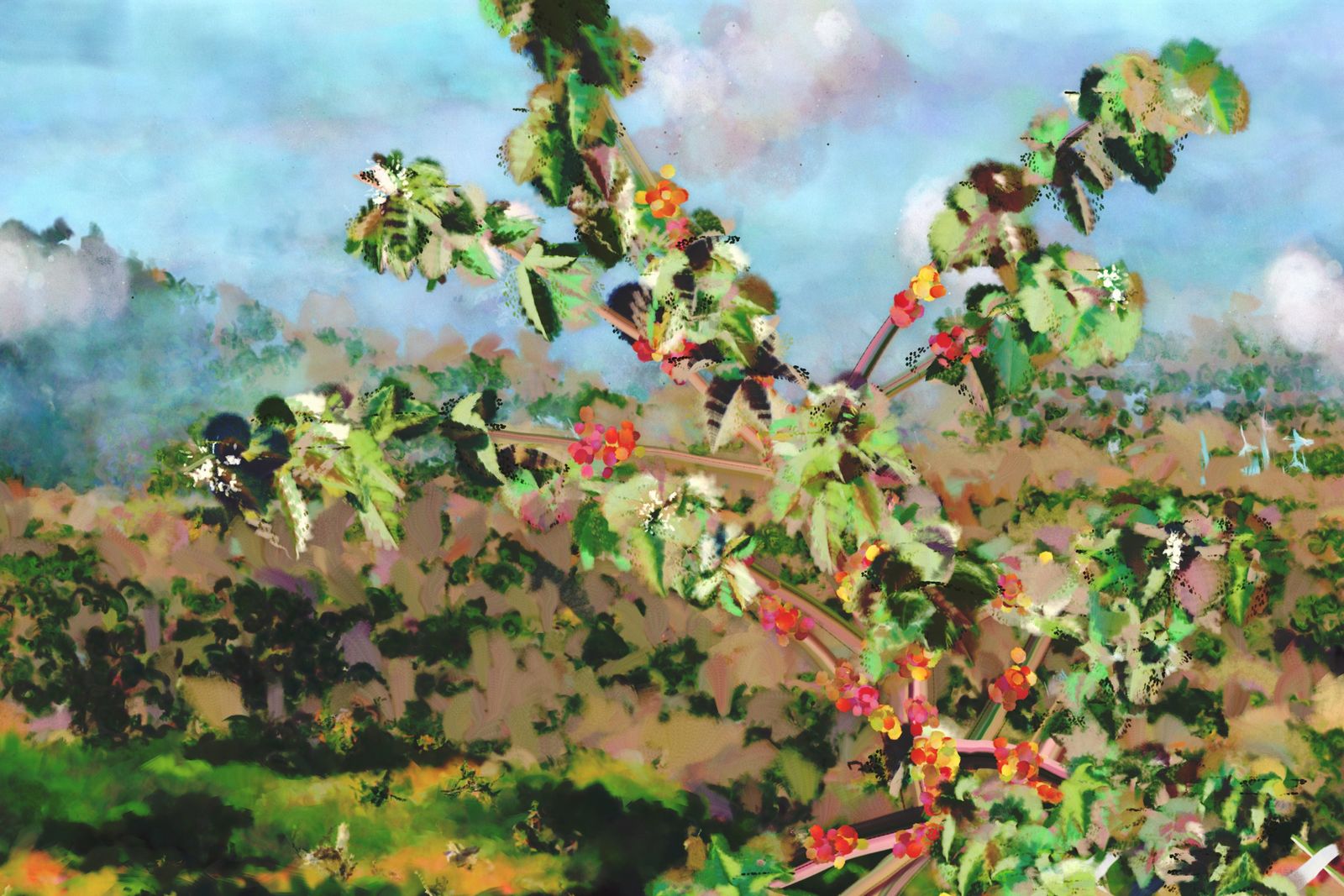
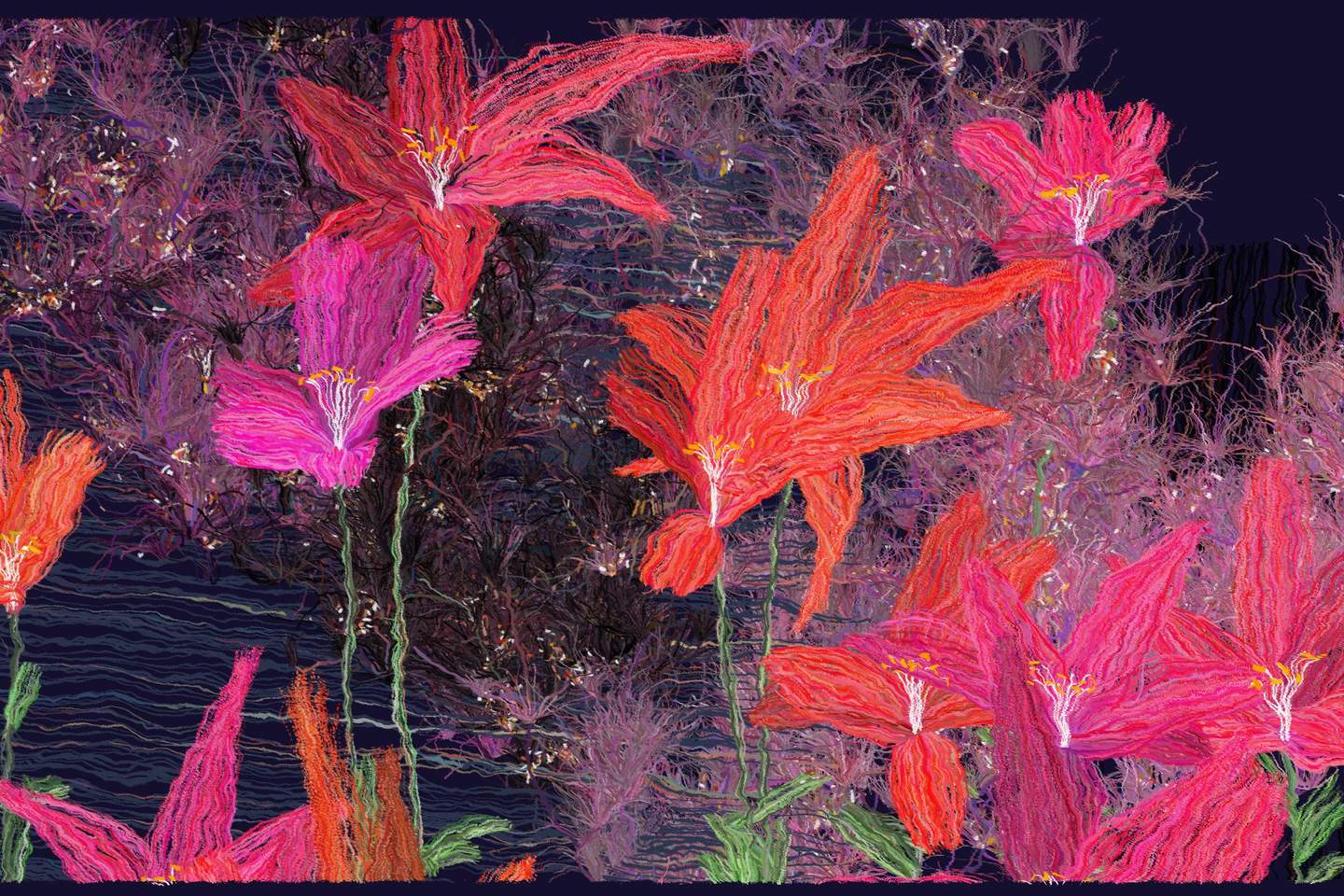
He turned back to Van Gogh. In the Impressionists the flowers come apart, a brushstroke stays a brushstroke, and sometimes the strokes gather into a flower more abstract and more whole. He tuned the system of Unfinished Bloom towards this: petals are built stroke by stroke, each stroke trembles around its own path and towards the end scatters and leaps away, so that whole flowers and scattered strokes share the picture at once.
One computer, six kinds of flower
The computer in the gallery runs a web program written in p5.js and WebGL, held full-screen by Electron and fed through a splitter to four projectors that blend into one 7680 × 1200 picture across three walls. The picture has fifteen layers of depth: at the bottom a cloud of strokes like a city, each layer above drifting slowly on its own, the flowers sharpest in front and softening towards the back. Flowers emerge from the dark, staggered over the first twenty seconds, each flower slightly shifted in hue from the next.
Six kinds of flower take turns: spider lily, a many-coloured flower, poppy, violet, sunflower and white daisy, several of them transplanted from his daily sketches of 2024. At the end of each round the picture fades out over a second and a half and the next kind grows back out of the dark. According to the work statement, the colours are swatches taken from thirty groups of elements associated with New Taipei. In the program green was removed, because green flowers looked wrong. Sound runs in a separate window, so the music does not break when the picture regrows, looping three of his own pieces, Summer Migration, The Bull and the Sudden Rain and Blue Horizon. There are no sensors in the room. The flowers do not change because someone walks in; only time changes them.
- 01
Dark
The last round fades out over a second and a half; the next kind is chosen
- 02
City cloud
A cloud of strokes is laid down on the bottom layer
- 03
Staggered growth
Flowers emerge over the first twenty seconds across fifteen layers of depth
- 04
Trembling strokes
Each stroke trembles around its path as the camera breathes
- 05
Scattering
Towards the end strokes scatter and leap, whole flowers beside scattered strokes
- 06
Fade
The picture fades and the next round begins
From the last version of the program in the work’s repository (22 April 2026). Sound loops in its own window and does not restart with the picture.
Two worlds
From the evening of 21 April into the early hours, he rewrote the whole engine at home into a version that could run for months in a gallery. On the 22nd he moved in, connected the splitter and the four projectors, and found that what he saw on his laptop and what appeared on the wall were two different worlds: petals that looked coarse at home were too fine to see on the wall, and colours that looked fluorescent at home were just right. That day he stood in front of the projection and retuned stroke size, colour, blur and density one by one, the sunflower through several rounds.
While it is being watched
In the interview of 14 April he described the work as a conversation between two kinds of growth: the flower grows within her own life, and the system has its own life and growth too. In the second interview a week later he talked about the audience: the picture never stops, its speed quickens, slows and pauses, the cycle itself varies, so that visitors do not always find a full picture and are drawn in, wanting to see what happens next. What he hoped they would carry out of the room was a sense of “I didn’t catch it, it’s still growing”.
The run ended on 15 August. As the work was made, once the computer is switched off the flowers it painted are kept nowhere; the photographs and film on this page are how they looked at the moments someone happened to record them.
When the audience leaves and no one is looking at them, the painting is gone for good. So the projection does not exist either. To be seen is to exist. So when you are looking at this work, it is alive, and only you hold that moment.
- 01
June 2024
A run of daily sketches of flowers
- 02
29 October 2024
Colorful Flowers, later the base of this work
- 03
2024 to 2025
The brush engine is rewritten for The Coffee Dreamscape
- 04
31 March 2026
First conversation with the museum about the flower exhibition
- 05
14 April 2026
First interview: the philosophy of the work
- 06
17 April 2026
Projection fixed: three walls, four projectors
- 07
21 April 2026
Second interview; that night the engine is rewritten for the gallery
- 08
22 April 2026
Installation, retuned in front of the projection
- 09
24 April 2026
Opening
- 10
15 August 2026
Closing
Dates follow meeting notes, interviews, the engineering log and the commit history of the work’s repository.
The description at the time
Original text: the work statement on the MONOLAB website (2026), kept verbatim
這是一件即時演算的生成式作品。
展場中有一台電腦持續運算,當觀眾走進展廳,花才開始存在。
作品以 30 組新北代表元素為起點,從中摘取色票,延伸出一道有機的顏色光譜,在深邃的背景中緩緩綻放成一片數位花海。沒有兩個觀眾看見同一朵花,即使同一個人走出展廳再走回來,花海也早已是另一個狀態。該展演並非預錄的影片,也不是被壓縮成一幅固定的畫,而是一個被觀看的當下才完整的活系統。
當展期結束、最後一位觀眾離開、電腦被關機的那一秒,這些花不會保存在任何硬碟裡。它們只會把最後的印象留在觀眾的腦中,就像平行宇宙裡的生命,每一次出現都已經不再是同一個。當有人看著這件作品的時候,它就是活著,且只有當下的觀者能擁有瞬間;當沒有人看著的時候,這件作品就算是消失了。
吳哲宇長期研究植物構型與生成式筆刷系統,從噪聲、水彩到油畫質地。然而就像攝影術被發明的那一刻,當系統把花畫得愈像,反倒愈失去了原本的味道。
他回到梵谷的印象派,看見一種熟悉的韻律:花朵會散掉,筆觸就是筆觸,卻有時會聚合成更抽象的完整花朵。在完整與散落之間,存在著生命,那是無機物試圖逼近有機的過程。但愈逼近,他愈發現:無論如何都碰觸不到自然的完美細節。
於是他放下抵達的執著,把接近的過程本身當成作品。《未竟之花》是兩套生長系統彼此對話的現場:花有花的生長,在她自己的生命體裡綻放、開展、凋謝;系統有系統的生長,在演算法的邏輯裡重現、模擬、逼近。作品存在的位置不在任何一方,而是在這兩種生長交會、錯開、又彼此試圖觸及的那條縫隙裡。
這就是「未竟」。
不是缺陷,是設計;不是還沒完成,是永遠不該完成。
- 自由時報PressThe flower exhibition at New Taipei City Art Museum
- 聯合新聞網(經濟日報)PressFlowers translating the everyday city, now on view
- YAHOO 新聞(互傳媒)PressFlowers translating the everyday city (syndicated)
- 自由時報PressArts page: the flower exhibition
- 自由時報AnniversaryThe museum’s first anniversary weekend
- 聯合新聞網AnniversaryThe anniversary programme continues
- InterviewDialogue: interview I, the philosophy of the work
- InterviewDialogue: interview II, visual jazz
- ExhibitionExhibition page: dates and record
- ExhibitionMONOLAB exhibition record
- BeforeWhere the brush engine grew: The Coffee Dreamscape
- FlowersThe same line of flowers: The Flower of the Other Shore
Clippings are the outside record, notes our own interviews, tags the pages of the exhibition and the series. Every one opens.
Credits
- Artist
- Che-Yu Wu
- Production
- MONOLAB
- Music
- Che-Yu Wu, Summer Migration, The Bull and the Sudden Rain, Blue Horizon
- Presented at
- New Taipei City Art Museum, first-anniversary flower exhibition
Context & sources
Exhibitions, research & collaborations
Contact the artist