Installation2023
Shape of Mind
Tap to enlarge.
Contents & work details
- Archive year
- 2023
- Type
- Installation
- Artist
- Che-Yu Wu 吳哲宇
- First version
- 13 October 2023, daily sketch 231013 Shape of Mind
- Second version
- 10 January 2024, white on black
- Code
- p5.js; the plotter versions exported as vectors with p5.js-svg
- Shown at
- He, She, It: Residing in Multiple Universes, the second Digital Creation and NFT Open Call Exhibition
- Dates
- 20 March to 6 June 2024
- Venue
- Yi-sin Gallery, 4F, NCCU Art & Culture Center (Wenshan, Taipei)
- Installation
- Seven black-and-white prints on board; a pen plotter (iDraw) drawing live on A4 paper
- Role
- Exhibition advisor and invited artist, with Newyellow
Overview
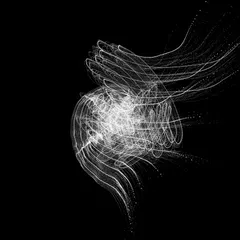
Shape of Mind is a daily sketch Che-Yu Wu made on 13 October 2023. On every frame the p5.js code places two hundred and fifty points along an upright axis. How far each point sits from the axis is set by Perlin noise, then stretched and shrunk by a slowly turning angle, so that from the side it looks like clay being thrown on a wheel. The axis itself also turns, and the whole picture shrinks a little more with each frame, so the paths of the points pile up into a disc: regular rings at the centre, which he likens to weaving and to a circuit board, and around them, strands of line that never come back in.
From 20 March to 6 June 2024 the work was shown in the Yi-sin Gallery on the fourth floor of the National Chengchi University Art & Culture Center. Seven black-and-white prints hung on the wall, and on a white plinth in front of them stood a pen plotter. On the opening day he rewrote the code as continuous lines that a pen could draw in one stroke. From then on, staff of the centre loaded a different variant of the algorithm each day, and the plotter drew it on A4 paper with a single pen for half an hour to an hour. The finished sheets were laid one after another on the floor beside the plinth.
What Shape of Mind is really exploring is whether, from the machine’s point of view, from the algorithm’s point of view, we could come infinitely close to drawing something like the human mind.
After an argument
The title comes from an argument. On 21 March 2024, the day after the opening, Che-Yu Wu explained the work to students during a livestreamed class of his generative art course at National Yang Ming Chiao Tung University: “I was arguing with my partner at the time, and I thought, I really don’t want to have feelings. If I could think about things completely rationally, with no emotion at all, how good would that be.”
He tried to sort the thoughts of the mind into a strictly rational shape, and left around it the tangled lines that could not be made rational. A few days later, at a lecture at National Taiwan University, he put the work as a question: whether a machine, an algorithm, could come infinitely close to drawing something like the human mind.
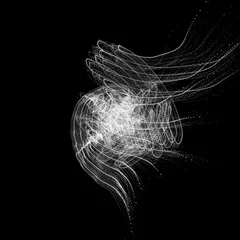
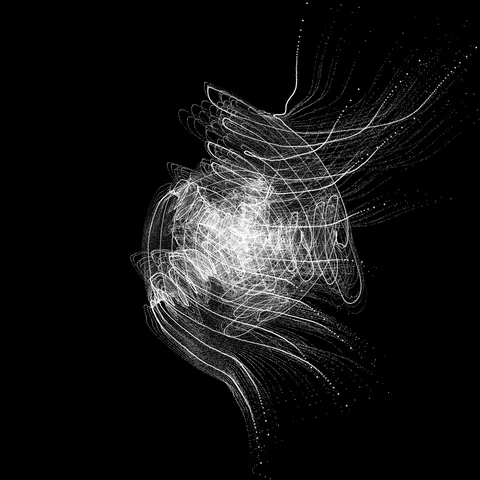
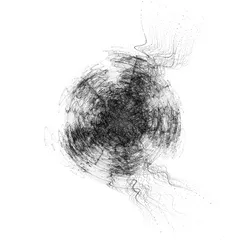
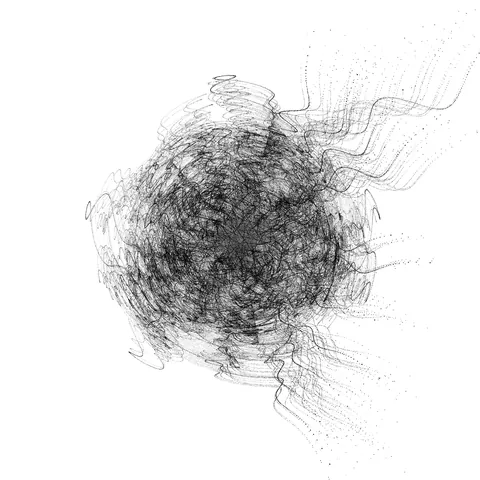
The source images sent for printing: the four white ones from the code of 13 October 2023, the two black ones from the second version of 10 January 2024. The centre printed the seven pieces on show in four sizes, mounted on thick board. Tap to enlarge.
On the wheel
There is no heart shape in the code, and no outline drawn in advance. On each frame, every one of the two hundred and fifty points multiplies three layers of Perlin noise to decide how far it sits from the axis, and every point sixty pixels apart is drawn with a heavier stroke. As the axis turns with time, those heavier points leave rings on the picture. The scale of the whole picture keeps falling with the frame count, so the later a point is drawn, the closer it is pushed to the centre, which is why the centre is the densest.
The second version, written on 10 January 2024, turns to white points on black, with less sway, faster rotation and two fine white specks scattered beside each point. Neither version fixes its random seed, so every time it is opened a different disc grows.
You know how, when you throw a pot, you put your hand on the clay and let it turn along your hand, so it becomes something like a spiral. But if at the same time you change or rotate the axis in the middle, this is what you get.
Cropped from the 5,000 × 5,000 pixel source images, about four tenths of the width each.
White and black
For the exhibition, Che-Yu Wu wrote a short text for each version on the Art & Culture Center’s artwork form. The white ground is the first version of October 2023, the black ground the second of January 2024.
White: Trying to hold on to a rational reality, thoughts tangled. If the mind were etched into an emotionless circuit, could one see through attachment and let go?
Black: Countless thoughts flow and weave into a mind. We draw our own existence with the traces of time.
One pen, drawing it again
The plotter was Che-Yu Wu’s idea. When the NCCU Art & Culture Center first discussed the exhibition with him in October 2023, he already wanted a plotter drawing the work on site. The picture on screen is built up point by point, frame after frame, and a pen can only draw lines, so on the opening day he rewrote both versions: the positions a point at one height passes through over three thousand frames are joined into a single curve, sixty-three curves to a sheet, saved as vector files with p5.js-svg.
He left the centre a one-page instruction sheet: check that the pen is clamped and the paper taped down, open the work’s link, wait for the picture to appear and press the space bar to save an SVG, place it in Inkscape within an A4 area, then send it from the iDraw extension. The plotter took turns with four programs: the two line versions of Shape of Mind, and plotter versions he made of two earlier daily sketches, 200802 Tangled and 230124 Chain Drawing.
- 01
Rewritten as lines
Points at one height joined into one curve, sixty-three to a sheet
- 02
Saved as SVG
p5.js-svg, saved with the space bar
- 03
Fitted to A4
Scaled in proportion in Inkscape
- 04
Sent
The iDraw extension, one pen
- 05
Half an hour to an hour
A different variant each day, the sheets laid on the floor
Real speed, recorded in the gallery on 12 April.
The photographs of 20 March were taken by Che-Yu Wu on his phone on the opening day; the rest are a record of the gallery on 12 April. Tap to enlarge and read the captions.
The gallery at NCCU
The exhibition was the NCCU Art & Culture Center’s second Digital Creation and NFT Open Call Exhibition, under the theme He, She, It: Residing in Multiple Universes, part of the digital art series of the 24th NCCU Art Residency Program. In October 2023 the centre invited Che-Yu Wu and Newyellow to be its digital art advisors; the two helped select the students’ submissions and also showed work alongside NCCU students and staff as invited artists. Nine of the eleven exhibitors came through the open call, with photography, watercolour, digital work and programming.
On the evening of 24 April 2024, Newyellow and Che-Yu Wu gave the talk Experience and Guide of Digital Creation at the Digital Art Center on the second floor, then took the audience up to the fourth-floor gallery to see the show.
Afterwards
The exhibition closed on 6 June. Two years later, on 25 April 2026, Che-Yu Wu looked back on it at a MONOLAB digital creation salon, and what he talked about was the plotter that kept on drawing.
Because the machine cannot get close to the human mind, it keeps drawing different depictions of the mind, and we just let it draw and draw, and threw them on the floor, on the floor, a bit like a machine artist going mad.
- LivestreamGenerative Algorithmic Interactive Art, session 4: the plotter and Shape of Mind
- LectureGenerative Art lecture at NTU, part 2
- Sketch231013 Shape of Mind
- Sketch240110 Shape of Mind 2
- Sketch231013 Shape of Mind lines, the plotter version
- Exhibition pageDigital Creation Open Call Exhibition: He, She, It
- Lecture pageLecture: Experience and Guide of Digital Creation
- OnlineOnline gallery
Notes are our own livestream, lecture and sketches; tags are the organiser’s and the platform’s pages. Every one opens.
This work grew out of the “Shape of Mind” family: 5 daily sketches, 2023-10-13 to 2024-03-20. 4 of the links are forks.
Credits
- Concept and code
- Che-Yu Wu
- Exhibition
- NCCU Art & Culture Center, He, She, It: Residing in Multiple Universes, 2024
- Printing, installation and daily operation
- NCCU Art & Culture Center
- Plotter
- iDraw, provided by MonoLab
- Photography
- Installation photographs of 20 March: Che-Yu Wu
Context & sources
Exhibitions, research & collaborations
Contact the artist