Installation2026
The Last Input — Before the End
Contents & work details
- Archive year
- 2026
- Type
- Installation
- Artist
- Che-Yu Wu 吳哲宇
- Premiere
- 4 July 2026, C-LAB, Taipei
- Showcase
- 22 to 24 October 2026, C-LAB (two performances and a post-show talk on 24 October)
- Sound field
- 49.4-channel spatial sound field (49 surround speakers and 4 subwoofers)
- Medium
- Piano and controller input, a live-computed digital world, sixteen MIDI tracks, spatial harmony
- Residency
- 2026 IRCAM Sound Off: emerging artist residency
- Presented by
- C-LAB × Taiwan Sound Lab
- Co-presented by
- IRCAM–Centre Pompidou, France
- Supported by
- Ministry of Culture, Taiwan
- Performance photography
- 林亞蓁, commissioned by C-LAB
Overview
The Last Input is an immersive sound performance built around the act of letting go. It asks what meaning remains in the last input a human presses by hand, at a time when artificial intelligence can generate everything.
Dressed in a white lab coat as a mad scientist of creation, the artist uses a piano and controllers to feed sound and parameters into a world within a 49.4-channel spatial sound field. Land is born; plants and strange creatures sprout one after another; then two rival AI species appear: the City, which keeps building upward in an attempt to hold order, and the Virus, which keeps spreading, mutating and eroding.
Both are driven by language models; they remember, learn and make their own decisions. Order is built again and again, and again and again it is scattered by chaos, while new life also grows out of that chaos. Civilisation evolves through this cycle of failure and rebuilding, like a cosmic clock ticking forward one notch at a time as entropy rises.
When the last input is pressed, the artist takes off the white coat and withdraws to become an observer. From then on the organic workings of this world, its survival and its collapse, are handed back to its own chaos, heading somewhere not even its maker can foresee.
Two kinds of input
Two kinds of input drive the work. The knobs on the lab desk set the laws by which this world runs: humidity, wind speed, and the speed at which time flows. The keys of the electric piano throw variables into the world: a single note plants a seed, and a chord calls up a flock of birds or raises the City by another storey. Harmony also decides the fortunes of this world. Consonant chords make the City prosper, while dissonance builds up, little by little, into decay, until the Virus seeps in from the edge.
Chaos and life
Che-Yu Wu has been fascinated by simulating and computing ecosystems since childhood. As he sees it, life is born out of chaos: only when a world has gathered conditions complex enough, with order and disorder pulling at each other again and again, can something that breathes and multiplies emerge. The work brings this process into performance. The moment the Virus is born, and the direction it spreads from, are decided entirely by the conditions the world has gathered by itself, and which note set off the chain reaction can never be traced back afterwards.
“What fascinates me is this: once my system is built, if it produces some complexity or behaviour beyond me, then that thing is the work itself. So I simply designed it into the theatre. Halfway through I say, I give up control; whatever happens next, I watch it as an observer.”
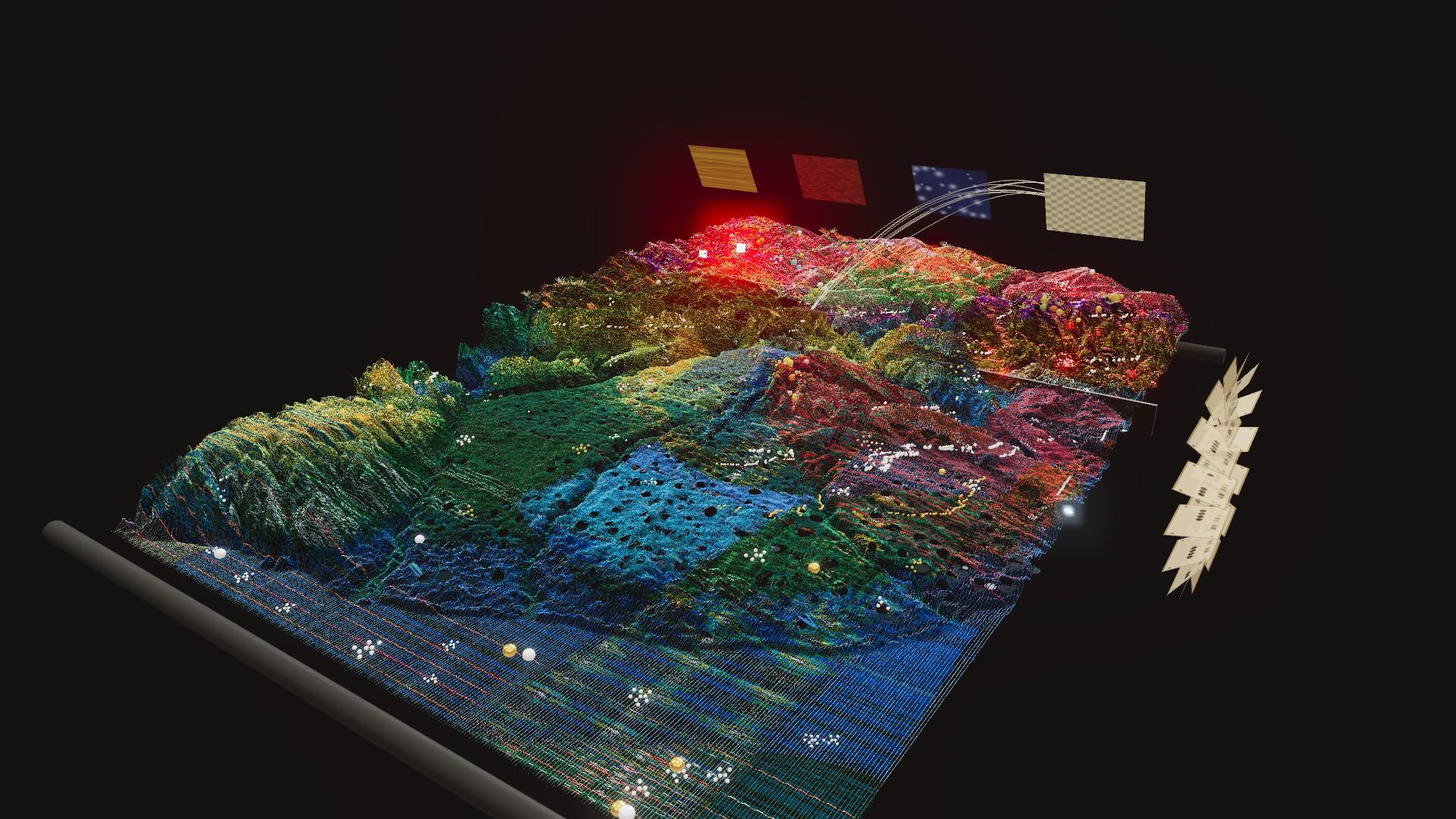
Things really live in this world. Every tile is rendered live by the performance system: the same playing gives the same picture; different playing, a different world.
On stage
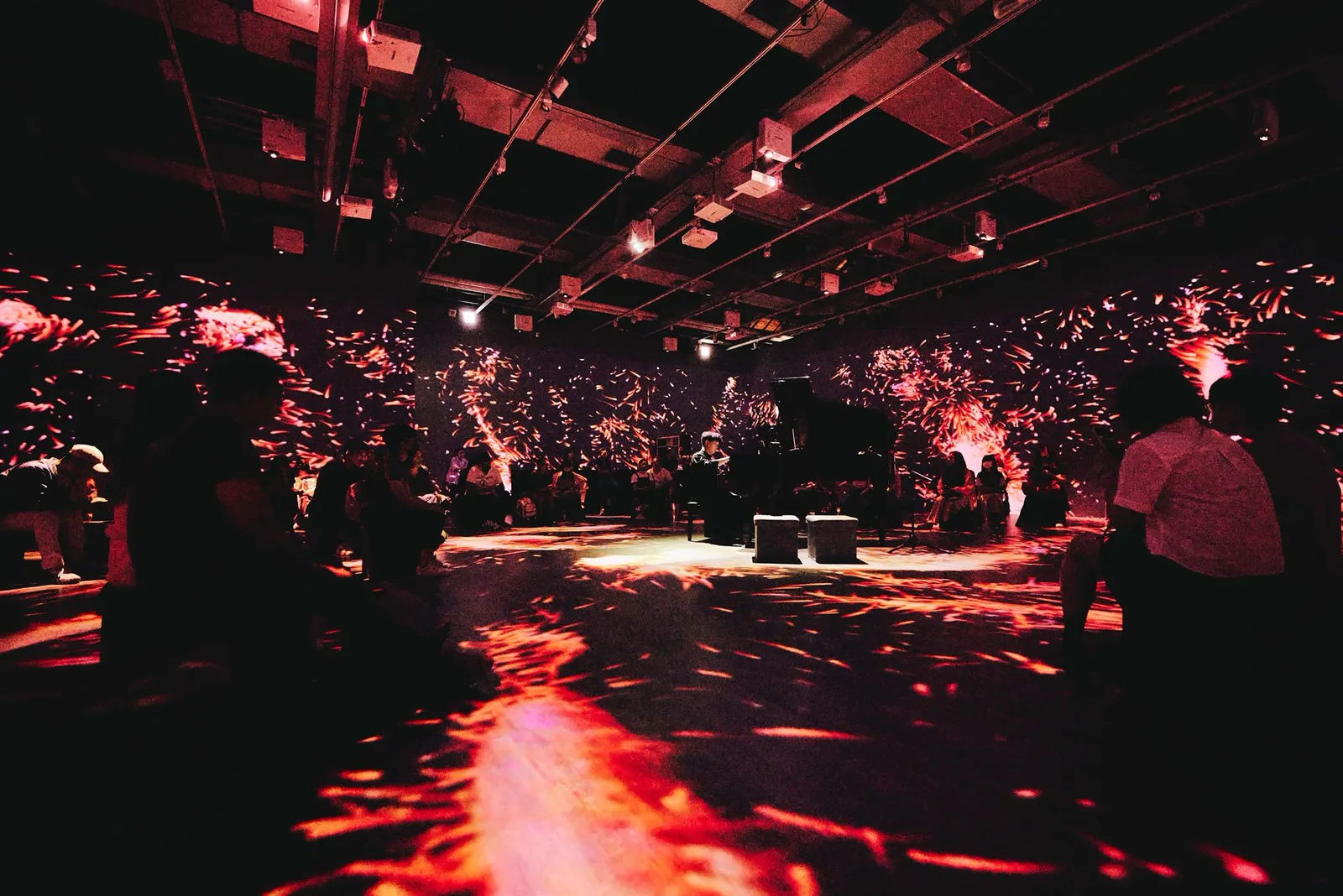
The performance opens with the artist in a white lab coat at the piano, watching the world he has created with a researcher's curiosity. He plays a few notes, new creatures appear on the land, and he pulls the camera closer so the whole room can watch: a horse lowering its head to drink, small insects darting through the grass. When laughter rises from the audience he lets the image linger a little longer, and in that moment everyone in the room is watching a world being born.
In performance order: before the start, the genesis terminal, creation, terrain, plants, the City, the end; the last two are the post-show talk and the group photo. Photography: 林亞蓁, commissioned by C-LAB. Click any image to enlarge.
Audio-Visual Audio
Most audiovisual performances begin with the image and then set sound to it; this work reverses the order. The artist first uses musical performance to build a living simulated world, and the sound is what that world naturally makes as it runs: a horse makes a drinking sound only when it reaches the water, and the City roars only once it has grown tall. He calls this logic Audio-Visual Audio: the playing gives rise to the world, and the world then joins the performance with its own voice.
The performance begins with a line of commands: the terminal boots, allocates a 22 by 22 terrain lattice, connects the 49.4-channel speaker array, then waits for hands. At the end the same wireframe cube is drawn once more.
- 01
Genesis
- The hum of genesis: noise carves the first light
- First life: one geometric bird, the signature tone
PerformerTurns a knob; the land rises
WorldTerrain grows out of white noise
- 02
Terrain
- Land and climate: relief, ruggedness, day, rain, wind
- The first seed: from the desk to the piano
PerformerPresses the first key
WorldA single note lands as a plant
- 03
City
- The stacking of civilisation: chords feed buildings
- The richer the harmony, the taller the city
PerformerImprovises, desk and piano in turn
WorldFlocks, beasts, towers stack upward
- 04
Virus war
- Virus birth: corruption crosses a threshold
- Panic and rescue: consonance heals
PerformerPlays faster, trying to save the city
WorldThe virus spreads, mutates, attacks
- 05
Letting go
- The Last Input: the final input
- Autonomy: a ladder war between two species
- The virus speaks
PerformerStops giving input; withdraws to observe
WorldThe system runs itself; the outcome is computed
- 06
Survivors
- Darkness and silence
- Epilogue: something outside the cycle
PerformerListens with the audience
WorldSomething has survived
- Order: the City
- Chaos: the Virus
- Outside the cycle
- Brighter frames are the three signature moments
From the premiere to October
The Last Input premiered on 4 July 2026 at the C-LAB Sound Off workshop showcase, in a version of about ten minutes. For the October showcase the work expands into a full version of about twenty minutes, with its sound redesigned by KIVΛMKII; two performances and a post-show talk take place on 24 October.
- 01
Keys and knobs
88-key MIDI controller and 8 knobs
- 02
Input analysis
note = seed · chord = flock consonance = growth · dissonance = decay
- 03
A living world
terrain, plants, creatures city vs virus, computed live
- 04
Sixteen MIDI tracks and positions
ambient / event / narrative layers the spatial coordinates of every object
- 05
Sound and space
Ableton Live as pure sound source Spat spatial harmony
- 06
49.4 channels
49 surround speakers and 4 subwoofers sound arrives from where things are
Auditory perspective: what the camera looks at is what you hear (proximity, on-screen energy and visible density feed back to the sound)
Sixteen tracks, three layers
| Layer | What sounds | How |
|---|---|---|
| Ambient | Buildings, virus, plant families, the bird | Breathes with the state of the world: the taller the tower the higher the note, up to fourteen at once; trees and palms low, shrubs mid, grasses and reeds high, flowers as colour |
| Event | Topping out, infection, collapse, impact, flocks, seeds, birdsong, ground creatures | One-shot sounds the world throws up: a seed’s velocity is audible; ants high, horses mid, the elephant in the sub-bass |
| Narrative | The blessing, the hand, shutdown, the typewriter | Cues on the timeline that always land: the four-voice blessing enters seventy milliseconds apart, and shutdown is a single trigger |
The sound sources and spatial rack follow no timeline of their own: whatever event the world emits, they sound.
Rehearsal footage
Credits
- Concept, system and performance
- Che-Yu Wu
- Sound design (October 2026 version)
- KIVΛMKII
- Presented by
- C-LAB (Taiwan Contemporary Culture Lab) × Taiwan Sound Lab (TSL)
- In collaboration with
- IRCAM–Centre Pompidou, France
- Supported by
- Ministry of Culture, Taiwan
- Residency
- 2026 IRCAM Residency Programme for Emerging Artists
- Technical guidance
- Wen Hong-Kai | Taiwan Sound Lab
- Spatial audio
- Tsang Ching-Hsuan | engineer, Taiwan Sound Lab
- Musical feedback
- Chen Chia-Hui | composer
- One-to-one mentoring
- Johannes Regnier | IRCAM
- Theatre feedback
- Huang Ling-Hsuan | lecturer
- Performance photography
- 林亞蓁, commissioned by C-LAB
- Performance video
- C-LAB
- System imagery
- MonoLab
Context & sources
Exhibitions, research & collaborations
Contact the artist