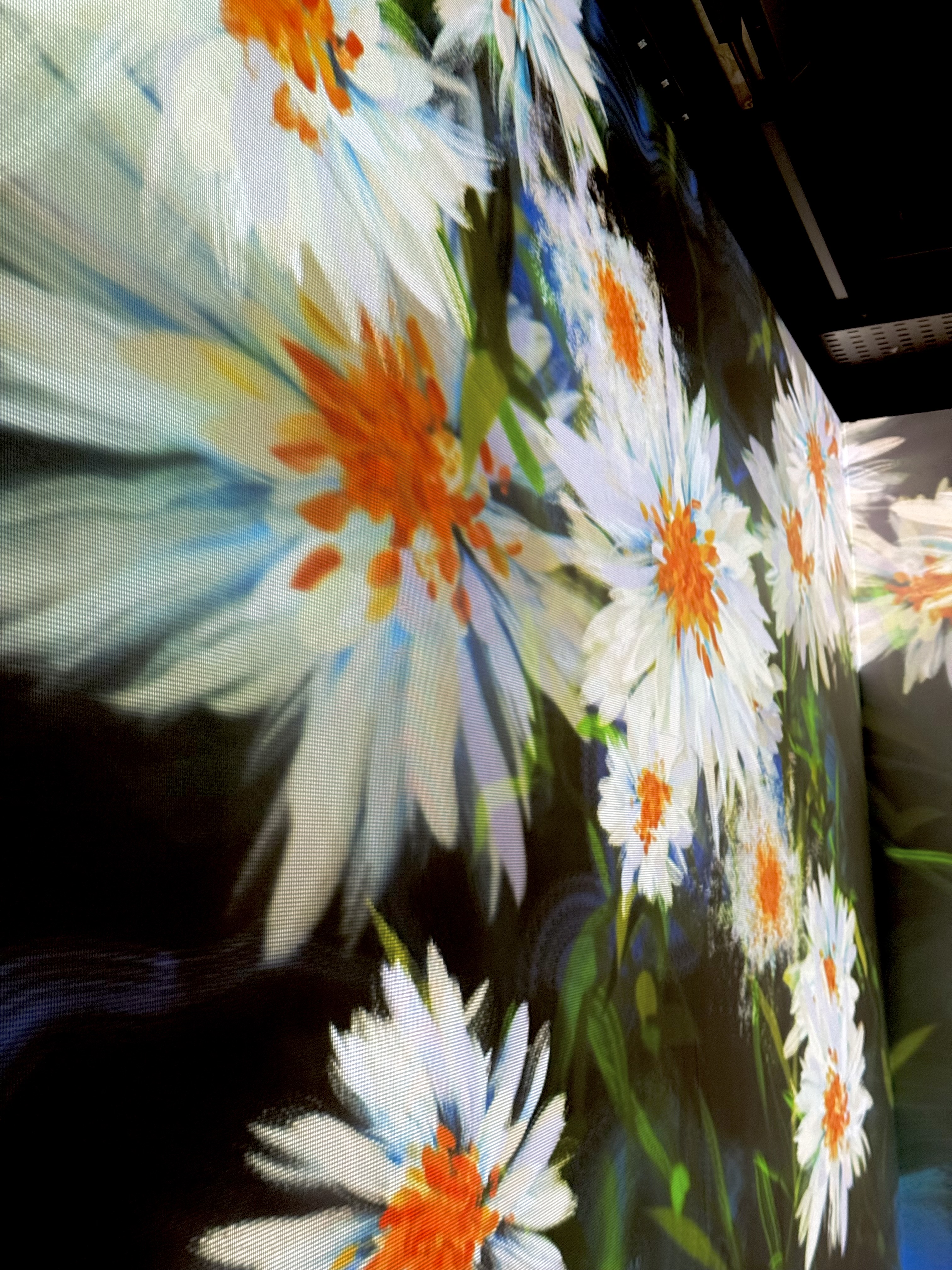
Installation2025
The Coffee Dreamscape
At the opening, July 2025. Photographs courtesy of Starbucks Taiwan.
Contents & work details
- Archive year
- 2025
- Type
- Installation
- Artist
- Che-Yu Wu 吳哲宇
- Opened
- On permanent view since 25 July 2025
- Venue
- Starbucks Reserve™ DREAM PLAZA Taipei (Xinyi, Taipei)
- Location
- The terraced seating area
- Commissioned by
- Starbucks Taiwan
- Picture
- 9600 × 2160 pixels, computed live at 30 frames a second (p5.js)
- Dimensions
- 15.5 × 2.8 m
- Two acts
- Coffee Landscape / Coffee Dreamscape
- Live inputs
- Taipei’s time and weather, people in the seating area, the last twenty minutes of orders
- Made
- March 2024 to July 2025
Overview
The Coffee Dreamscape is a real-time generative painting on the wall of the terraced seating area at Starbucks Reserve™ DREAM PLAZA Taipei. It paints an imagined Costa Rican coffee estate in p5.js, computed live at thirty frames a second: the sky takes its colour from Taipei’s time of day and weather, and the coffee trees tend to grow near where people are sitting. About every twenty minutes the estate is swallowed by a sea of dark bubbles, which slowly brighten into the colours of the drinks the café has sold most recently.
From the start, Che-Yu Wu and the commissioner agreed the work should stay quiet, and should never make anyone feel that doing something would trigger a response. Where people sit changes the odds of where a tree grows; what they order changes the colour of the next sea. Most people never know. They drink their coffee in front of it and talk with friends. He wanted it to hang like a painting at home, something no one would swap out lightly, growing into the room and into the memories of the people who pass through. Every night the picture resets, and the next day it begins again from a blank canvas.
A painting that does not look like a screen
Technically the wall is an LED panel, but the work is made so that it does not look like a screen. Che-Yu Wu treats it as a sculpture in the room: the painting and the terraced steps form one three-dimensional place, as quiet as a painting at home, never asking for attention and never swapped out with the season. As he put it in an interview in October 2026: “If you took it down, it would feel a little strange. You would feel that something was missing from the space.”
Sitting down is enough
Nobody in front of the wall has to do anything. A camera the café already had tells the work only whether each person is sitting towards the left or the right; in the next landscape, about six in ten coffee trees grow near where people are, and the other four are left to chance. In the second act, the strokes nearest to people are stirred and drift upwards. The drinks ordered over the last twenty minutes decide which two sets of colours the sea is drawn from.
He calls all of this nourishment: everyone’s presence and every small movement water this dream of a coffee field together. What changes is a probability. The picture never answers any one person on the spot.
This is a living, moving artwork that keeps going. The weather now, the time, the places where people sit down, all of it becomes part of something eternal.
Two acts: the estate and the dream
Each cycle lasts twenty minutes. For the first fifteen comes Coffee Landscape, a picture of where coffee comes from: a dreamt estate of terraced fields, far mountains, clouds and coffee trees heavy with red cherries. For the last five comes Coffee Dreamscape: dark bubbles rise out of the landscape, cover the mountains and the trees, then brighten into the colours of the drinks and drift upwards into a sea that recalls Seurat’s dots.
The first act is figurative, the second abstract. Each new section is painted over the last, so the strokes of the previous act stay underneath, and the two acts keep passing back and forth between the real and the dreamt.
A portion four tenths of the picture’s width, rendered locally from the work’s code.
A local render of the work’s code, forty-five per cent of the wall’s width.
One wall, from morning to night
The sky changes colour through seven periods of Taipei’s day, warming to gold in the evening, with stars and a moon after eight at night. The weather changes only the amount and colour of the clouds, and the rain. The six images below are final renders from 15 July 2025, ten days before the opening.
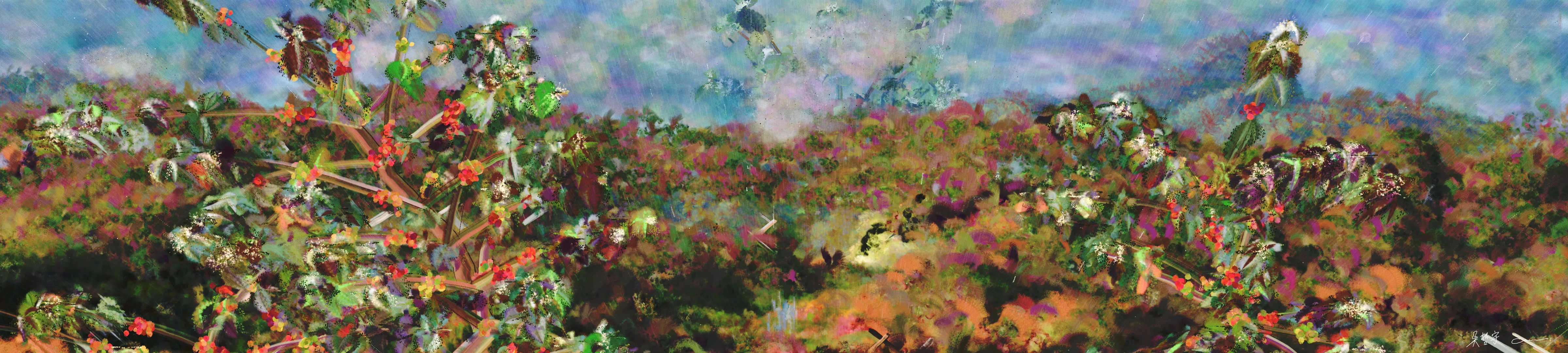
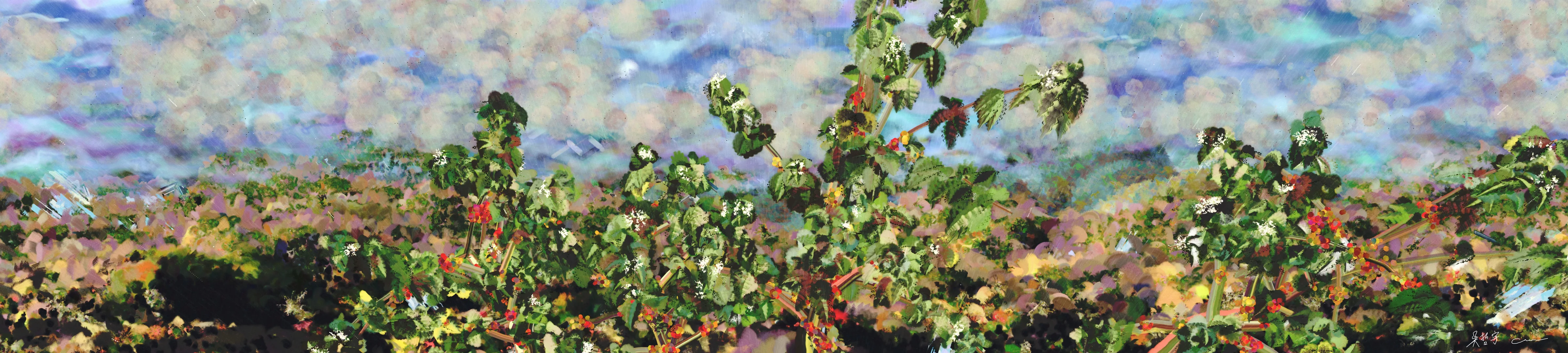
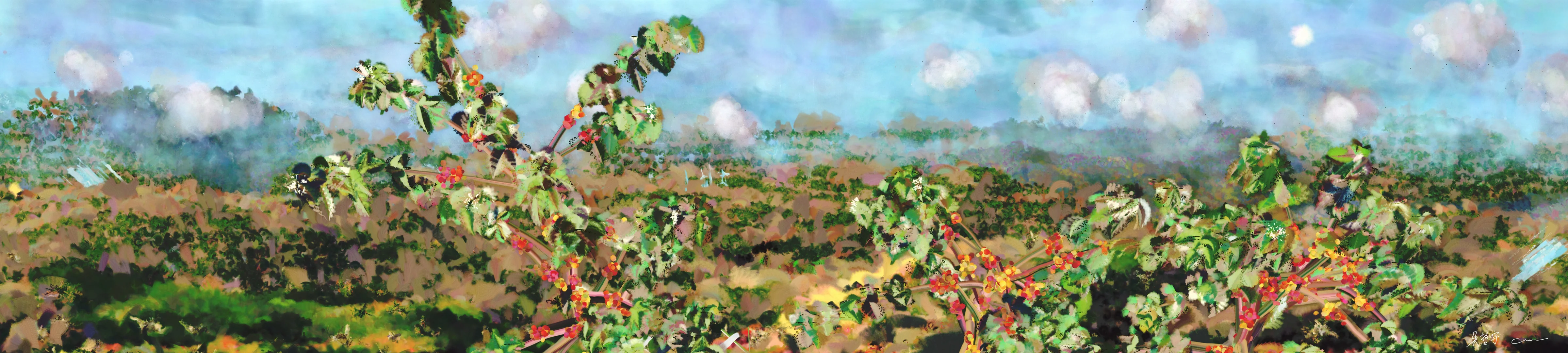
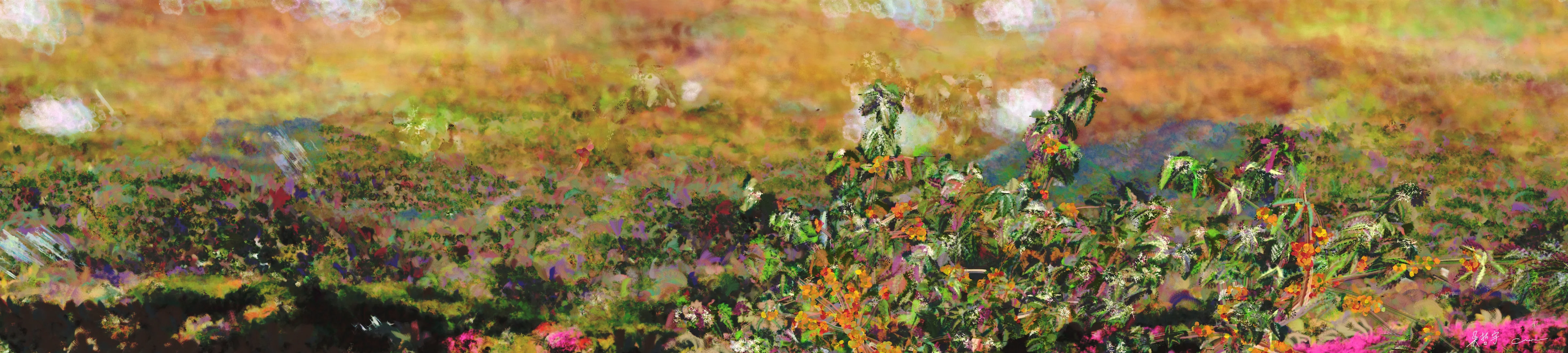
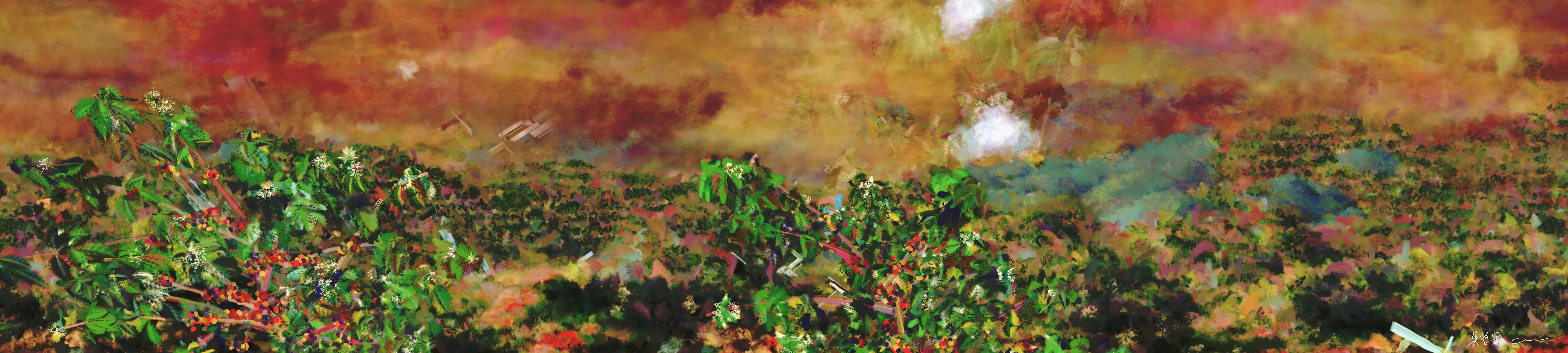
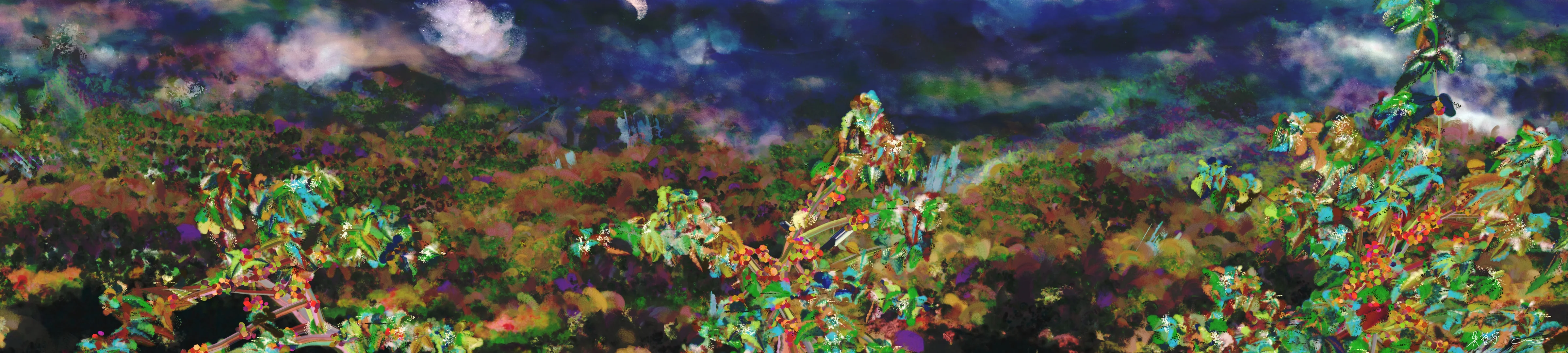
The first four from the final renders of 15 July 2025 (9600 × 2160), the night sky from a test render of 9 July. Each is one stretch of the wall at full height. Tap to enlarge.
What the work is listening to
There is deliberately no explanation in the café; here the backstage is laid open. The work listens to four things at once. Each changes only part of the picture, and some only show when the next section is painted.
Four inputs, each changing one part
| Input | What it changes | When it shows |
|---|---|---|
| Taipei’s time of day | The colour of the sky; stars and a moon after 8 p.m. | Each time a section is painted |
| Taipei’s weather | How many clouds and what colour; rain when it rains | The next landscape |
| People in the seating area | In the first act about six in ten trees grow near people; in the second, strokes near people drift upwards | Trees in the next section; strokes at once |
| Orders from the last twenty minutes | The palette of the second act, drawn from the two best-selling groups in proportion to cups | The next second act |
Orders are read as drink names and cup counts only.
Same random seed, same time and weather; only the seating changes. Rendered locally from the work’s code with set positions.
Same random seed and seating; only the last twenty minutes of orders change. Rendered locally from the work’s code with demonstration orders.
Same time and seating; only the weather changes. Rendered locally from the work’s code.
- 01
Reset before dawn
Restarted every day, from a blank canvas
- 02
Coffee Landscape × 6
A new picture every 2.5 minutes, painted over the last; fifteen minutes in all
- 03
Coffee Dreamscape × 2
A palette drawn for each; five minutes in all
- 04
Back to the landscape
About forty cycles in a day of opening hours
How people are counted
People are counted with a security camera the café already had. Its picture is first corrected to a view of the seating, then passed to person detection several times a second. For each person found, the work receives a single number: where they are from left to right. It does not identify anyone and does not know who is who.
- 01
One camera
The café’s existing security camera
- 02
Correction
Turned into a view of the seating
- 03
Detection
Finds each person in the picture
- 04
Position only
Each person becomes one left-to-right position; nobody is identified
- 05
Into the painting
The odds of where a tree grows, and where strokes drift
Backstage
This is the work’s internal dashboard in the café; it is never shown on the wall. It lays out on one page what the work is listening to: how many people are in the seating area, how many cups of each drink in the last twenty minutes, which two palettes the next sea will be drawn from, and Taipei’s weather. The two images below were reshot with demonstration data, with the camera panel replaced by a diagram.
Demonstration data; the camera panel is a diagram, not camera footage.
The finest work, performances and theatre put away every technical detail that does not matter, because we do not need people to think we are impressive.
Sixteen months
In March 2024 Starbucks set out four directions: the work should last and change with time and temperature, its images should make sense to anyone and feel like coffee, it should extend the store environment, and ideally it should let customers take part. Che-Yu Wu’s proposal grew out of his flower brush works. In June the first coffee tree, on a black ground, appeared in his daily sketches. In July came Fantom Sea, the forerunner of the second act. In September he borrowed the idea of a music sequencer, so that the coffee trees, the terrain and the sea are painted on separate tracks at once. The first item on his October to-do list reads: make the landscape less abstract, more literal.
In November and December he was on a residency in Paris, where he built a dynamic watercolour and three-dimensional brush-stroke system, which he brought back into every scene. In spring 2025 the mountains changed: the terrain is now computed in three dimensions first, the direction of the light then decides the colour of each stroke, and only then is the stroke laid down. He describes this work as using rational means to approach a deeply emotional state. On 16 July 2025 the picture lit up on the café wall for the first time; it opened on 25 July.
He says time was the hardest part: the picture had to hold from morning to night, with Taipei’s current weather and time poured back into it. What pleases him most in the finished work is the sky and the terraced coffee fields.
Renders and tests from each stage, in date order. Tap to enlarge.
Where the brushwork comes from
The brushwork has its own history. Che-Yu Wu’s brush works began with flowers, painting the gradients of petals like oil paint, then sunflowers, shaking the strokes as they rendered, up to the red spider lilies of 14 June 2024; three days later the same strokes painted the first version of the coffee tree. Another source is Matt DesLauriers’s Meridian: he bought the book in which the artist describes the series, to learn how light can be translated into the texture of a brush. Further back are Monet and Van Gogh.
Photographs: Che-Yu Wu. Tap to enlarge.
From the trial opening on 21 July to 8 August 2025. Photographs: Che-Yu Wu. Tap to enlarge.
The people on the steps
After the opening, his family and friends often sent him photos as they passed the café. At first he could not tell what they were photographing; then he saw that the pictures were full of people sitting on the steps, eating and talking with friends. Most of them did not know the work was responding to them. Half of him was glad it had truly become part of the space, half sorry that he could not tell anyone how it works.
The picture resets every night, and the people on the steps are different every day. In the interview he asked: “Does the sky we saw as children feel the same as the sky we see now?”
Documentation
Original work record
Original text: Starbucks Reserve™ DREAM PLAZA Taipei, artwork page
Coffee is the doorway to dreams.
In this digital dreamscape, mountains and skies intertwine.
The fragrance of memory rises with the colors of emotion,
and every cup of coffee becomes a bubble,
holding moments and feelings that cannot be replicated.
When you gaze into The Coffee Dreamscape,
you are not looking at a still image.
It shifts with time and space,
reshaped by people, choices, and emotions
constantly generating, repainting, and blooming.
- Official pageArtwork page: The Coffee Dreamscape
- StudioWork page
- FilmDocumentation film
- TAIWAN NEWSReportStarbucks Reserve DREAM PLAZA Taipei opens on 25 July with five new bars and nine artworks
- 今周刊ReportTen highlights of the Dream Plaza Starbucks
- TATLER ASIAReportEight highlights of the Starbucks Reserve store at Dream Plaza
- 玩美DAILYReportStarbucks Reserve DREAM PLAZA Taipei opens
- TRAVELER LUXE 旅人誌ReportTaiwan’s first Starbucks flagship opens at DREAM PLAZA in Xinyi
- COFFEE GEOGRAPHYReportStarbucks Unveils Its Largest Flagship Store In Taiwan
- 遠見雜誌ReportA Lunar New Year coffee outing: Starbucks takes art beyond the cup
Clippings are the outside record, notes our own pages and film, tags the venue’s official page. Every one opens.
This work grew out of the “3D Particle Collider” family: 22 daily sketches, 2024-06-03 to 2024-07-15. 21 of the links are forks; 21 are private, shown but not linked.
 private240612 Brush Clouds2024-06-12
 private240708 Coffee Dream - 2-3 Mountain2024-07-09
 private240708 Coffee Dream2024-07-08
 private240617 Coffee Tree v22024-07-09
 private240617 Coffee Tree v12024-06-17
 private240710 Flowers 102024-07-10
 private240616 Flowers 82024-06-16
 private240702 Sea2024-07-02
 private240625 Mountains2024-06-25
 private240619 Flowers 92024-06-18
 private240614 Flower of the Other Shore2024-06-14
 private240612 Flowers 7 - Brush System2024-06-12
 private240611b Flowers 6 Layers2024-06-11
 private240715 Orchid 2D Test2024-07-15
 private240611b Flowers 62024-06-11
 private240611 Flowers 52024-06-10
 private240608 Flowers 42024-06-08
 private240607 Flowers 32024-06-07
 private240607 Flowers 22024-06-06
 private240604 Coffee Tree v0.72024-06-04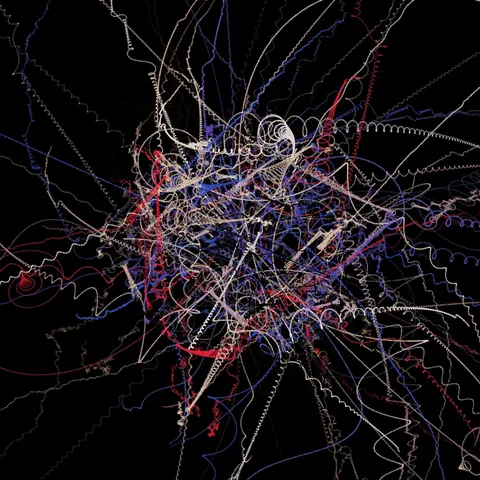
 private240603 3D Particle Collider2024-06-03
Credits
- Concept, algorithms and system
- Che-Yu Wu
- Commissioned by
- Starbucks Taiwan
- Produced by
- MonoLab
- Project lead (2024–2025)
- Wade Zhu
- LED display
- Samsung, integrated by 全陽股份有限公司
- Photography
- Che-Yu Wu; opening photographs courtesy of Starbucks Taiwan
- Venue
- Starbucks Reserve™ DREAM PLAZA Taipei
Context & sources
Exhibitions, research & collaborations
Contact the artist