Installation2025
The Eternal Garden in a Bottle
Contents & work details
- Exhibition year
- 2025
- Type
- Installation
- Artist
- Che-Yu Wu 吳哲宇
- Form
- An immersive generative ecosystem with a live score for performance; Paris prototype (2024) and the full Pier-2 version (2025)
- First performance
- 6 and 7 December 2024, Open Factory at CENTQUATRE-PARIS, six half-hour shows over two days
- Full version
- 21 to 26 October 2025, Warehouse B10, Pier-2 Art Center, Kaohsiung; immersive concerts nightly at 19:00 from 23 to 26 October
- System
- Ecosystem (p5.js / TouchDesigner) → distorted score → improvising musicians → sound analysis (low, mid, high) → back into the ecosystem; a Rosetta Stone writes a poem every minute
- Chapters
- Spring, Summer, Autumn, Winter, Utopia; 45 controllable parameters and 14 seasonal states (Pier-2 version)
- Visitors
- Ten instruments in the gallery and a phone page for pinching a sprite into the ecosystem; the live score on an LG transparent display
- Online
- The Paris ecosystem and score can be opened directly, a new world every time (self-hosted since September 2026)
- Residency
- TAICCA’s Taiwan–France immersive-content residency with CENTQUATRE-PARIS Villa Formose Immersive, 5 November to 20 December 2024
Overview
In 1960 an Englishman named David Latimer put a spiderwort into a glass carboy, watered it one last time, sealed it, and did not open it again for more than fifty years: inside, the plant made its own rain, dropped its own leaves and ate them back. This work is an attempt to build such a bottle in the digital world. Inside runs an ecosystem of its own: temperature, humidity, wind, day and night and four seasons; grass grows, cows eat it, bugs and predators chase one another, and the gas from well-fed cows warms the sky. Every number in the ecosystem is sent to a second place, where it becomes twisted lines and notes, a score generated in real time; musicians read it and improvise, and their sound is sampled and fed back into the bottle: the violin’s high frequencies heat the virtual sun, the cello’s low ones make the rain heavier. To the left sits a poet like a Rosetta Stone, who every minute, in the voice of an ancient poet, writes a poem in praise of the world in front of it.
It was born in Paris in the winter of 2024: I fought for a residency with TAICCA and CENTQUATRE-PARIS, wrote the ecosystem and the score in p5.js in front of an L-shaped screen in Les Ecuries, and played six shows over two days, myself at the piano, Anne on violin, Jean-Philippe on cello. A year later MONOLAB turned it into a theatre: five-surface projection in Warehouse B10 at Pier-2 in Kaohsiung, the score moved onto LG’s transparent display, visitors picking up ten instruments and pinching their own sprites into the ecosystem on their phones, and musicians interpreting what each season might be across five chapters, from spring, summer, autumn and winter to Utopia. Every performance is a birth and a passing, and no two are the same.
A bottle that breathes on its own
The nineteenth-century Wardian case carried ferns across the sea from London to Sydney; Latimer’s bottle kept one plant alive for half a century. What I wanted was not to seal nature away but to let a system find its own balance inside chaos. The ecosystem has weather: temperature, humidity, wind speed, clear or cloud or rain, sunrise and sunset, a thousand frames to each season. It has life: grass, trees, fruit, bugs, predators, cows. Cows eat the grass; grass grows with sunlight and humidity; bugs get eaten; the ratio of oxygen to carbon dioxide shifts with all of it. It never stops, and every run grows into a different shape.
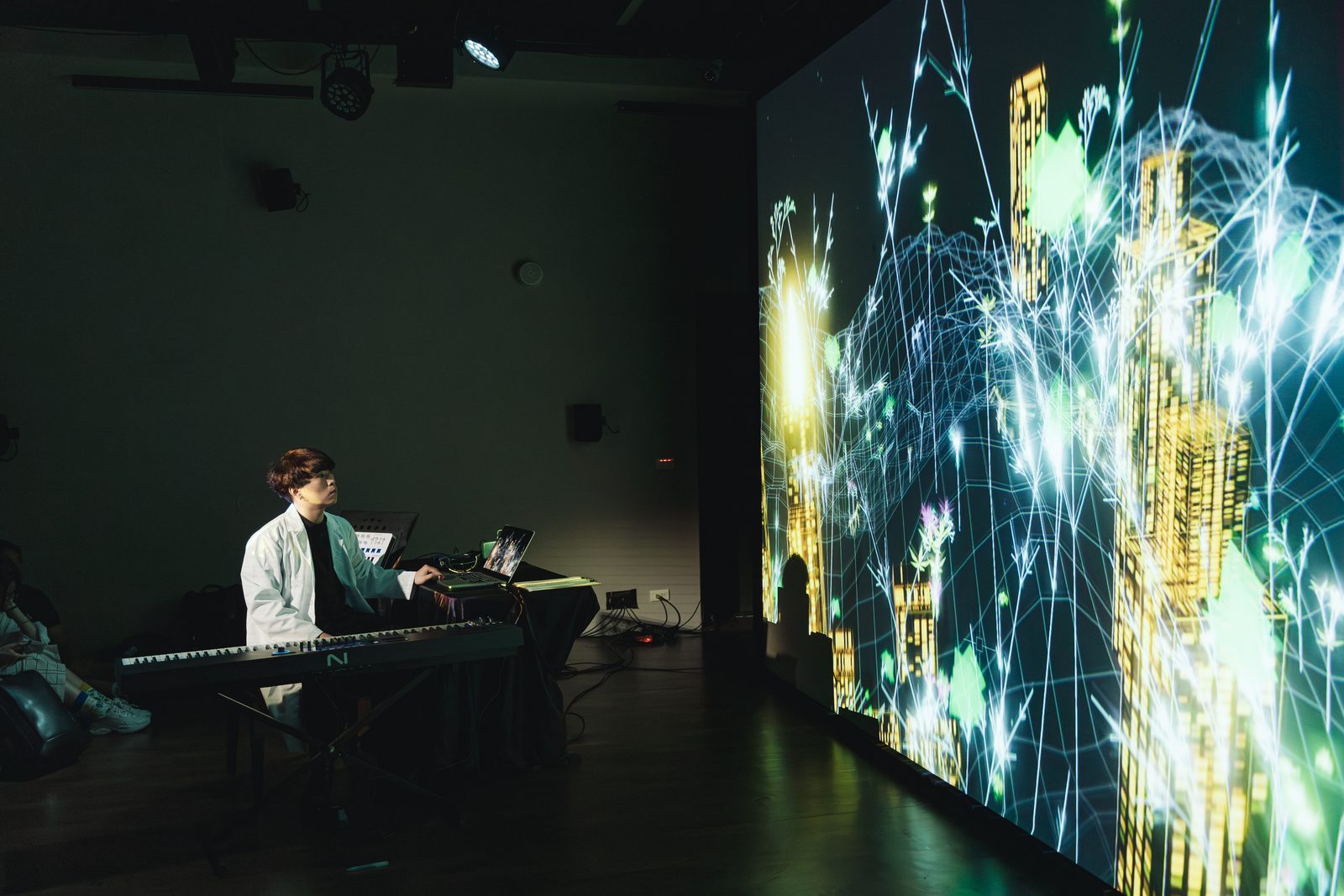
The second screen is the score. The ecosystem’s temperature, wind and populations are drawn as lines: when it is hot the lines go wild, and past a threshold the notation slides from classical to modern and on into an almost empty sparse passage. The musicians do not play the score; they improvise first and take cues from the page that keeps growing in front of them, and I added key signatures so they could tell at once when a section had changed. Their sound is captured and split into low, mid and high bands and into timbre: the lows govern temperature, the mids the wind, the highs the weather. The third screen is the Rosetta Stone: a poet watching the world evolve, changing voice every minute, Li Bai, Du Fu, Bashō, Dickinson, Neruda, Tagore, eighteen of them taking turns. The three screens close into a circle, and the circle is the work.
- 01
Ecosystem
Temperature, humidity, wind, day and night, four seasons; grass, trees, bugs, predators, cows, computed every frame
- 02
Score
Numbers drawn as twisted lines and notes: the hotter the wilder, and past a threshold the notation changes
- 03
Musicians
Improvise first, then take cues from the page as it grows; key signatures mark the change of section
- 04
Sound analysis
The room is captured as one track and split into low, mid and high bands and timbre; thresholds trigger the next layer
- 05
Back into the bottle
Lows push temperature, mids turn the wind, highs change the weather; beside it the Rosetta Stone writes a poem every minute
Jupiter’s Great Red Spot: chaotic in every part, stable as a whole; a performance is such a system.
Paris: the first version in front of an L-shaped screen
I had meant to build the world in a game engine; there was not enough time, so I stood the concept up in p5.js first, and the first prototype of the score was written at the Centre Pompidou. On 21 November the line-up was settled: the budget stretched to three people, myself at the piano with violin and cello; the technical meeting on 26 November confirmed that the dome could not be built and only an L-shaped screen would go up. 6 December was the professionals’ day, about thirty people a show; on 7 December the doors opened to the public, five to ten a show; each began with five minutes on the project and then twenty-five minutes of performance. The musicians asked whether the poems on screen should be in French; I would not have been able to read them, so they stayed in English. The 104 brought in a film crew and recorded two hours of interviews.
Pier-2: five walls, a transparent screen and ten instruments
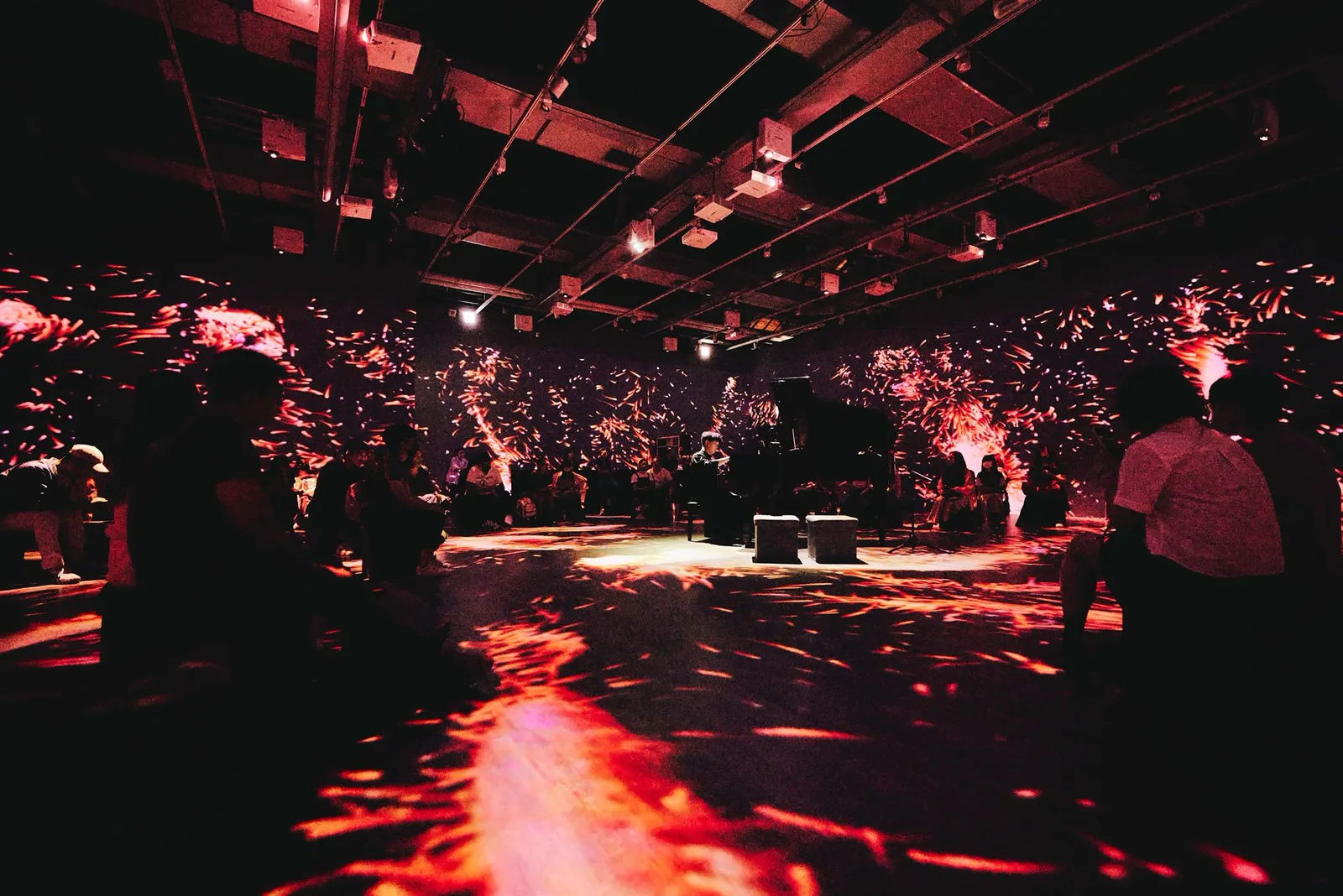
The full version was produced by MONOLAB. Hsiao Tzu-Chiang laid the ecosystem across the left, centre and right walls and the floor in TouchDesigner, ten projectors, the walls at 6528 by 1200 and the floor at 3000 by 3000; the daytime exhibition ran a thirty-minute loop called Dream Reality, and only the evening concerts ran the living system. The score and the dashboard moved onto LG’s transparent OLED: a pane of glass standing beside the piano, lines floating in the air with the growing garden behind them. Visitors picked up ten instruments in the gallery, hand bells, wood blocks, shakers, and their sounds entered the bottle and shifted its balance; they could also pinch a sprite of their own on a phone, choosing its shape, colour and trinkets, and drop it in. Over four concert nights the piano led the improvisation and the musicians relayed through the chapters from spring to Utopia; the takings from the charity tickets went to the WildOne Wildlife Conservation Association.
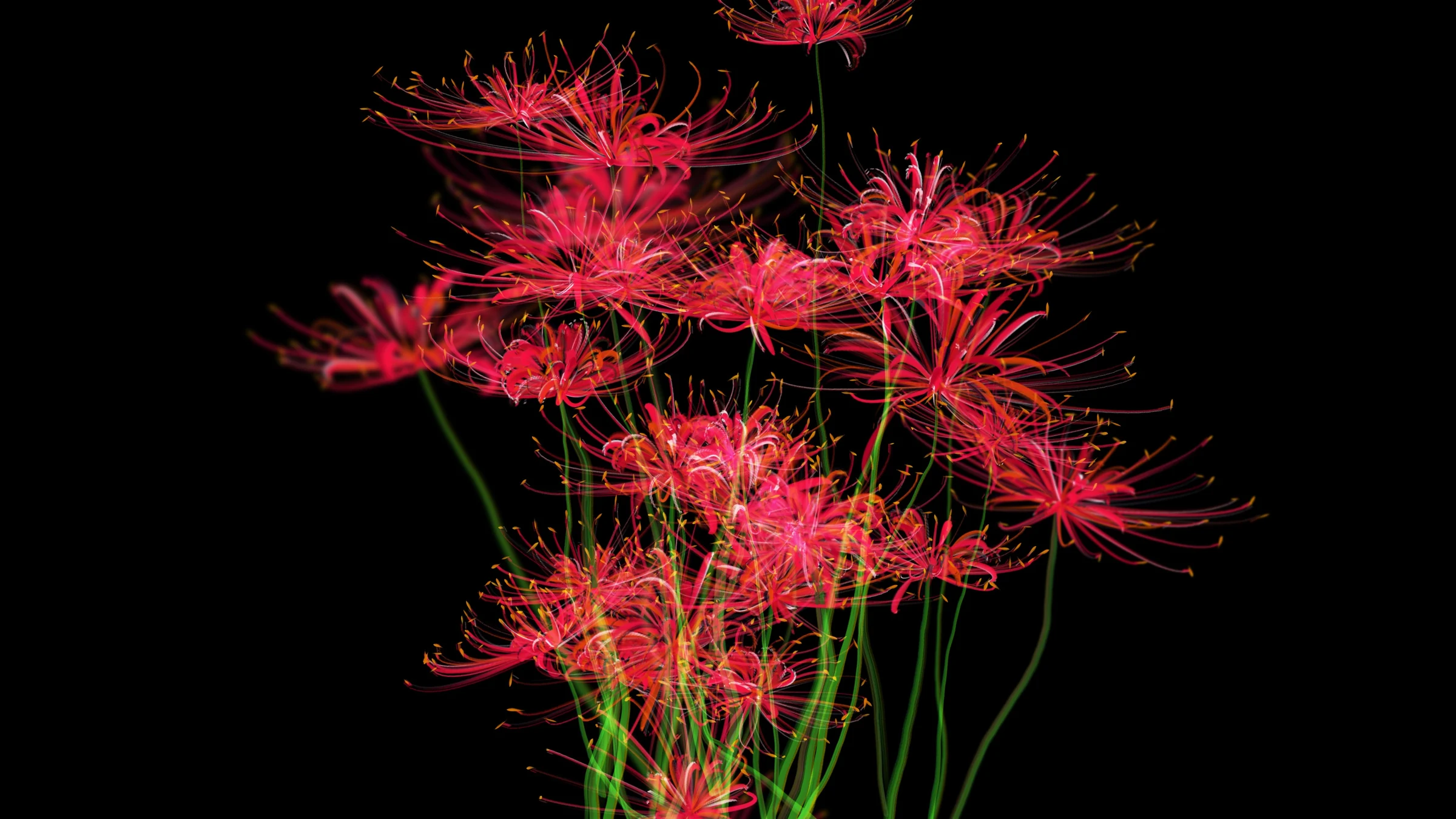
The floor picture (30 s)
October 2025, Warehouse B10, Pier-2 Art Center, Kaohsiung. Photography Cheng Wen-Kai and Chen Wei-Yu; MONOLAB documentation. Click to enlarge.
Three films
- 01
September 2024
The proposal, Infinite Algorithms and Digital Life in Unstable Systems, in four modules: La Brain, Rosetta Stone, Experimental Score, Senses
- 02
5 November 2024
Arrival at CENTQUATRE-PARIS; the score prototype written at the Centre Pompidou
- 03
21 November 2024
Line-up settled: piano, violin, cello; the L-shaped screen confirmed on the 26th
- 04
6 to 7 December 2024
First performances at Open Factory, six shows over two days; two hours of interviews recorded on the 7th
- 05
February to June 2025
The concept film and the 25-minute full performance go online; the residency report is finished
- 06
August 2025
MONOLAB fixes the design: a curved timber wall, a white silica-sand floor, five-surface projection
- 07
21 to 26 October 2025
The full version at Warehouse B10; immersive concerts nightly from the 23rd; the LG transparent display from the 24th
- 08
13 November 2025
Charity-ticket takings donated to the WildOne Wildlife Conservation Association
Original work record
Original work statement from MonoLab
“The Eternal Garden in a Bottle” unfolds across five chapters—Spring, Summer, Autumn, Winter, and finally Utopia.
Each chapter’s light rhythm, ecological behavior, and sonic expression are generated in real time. The system continuously computes and reshapes the environment: light, color palettes, species populations, and environmental tempo all shift according to the sonic interactions of both performers and visitors. The audience enters a world that breathes, grows, and flows.
The musicians’ improvisational performances are transformed into signals that influence the ecosystem—plants sprout, flocks of birds rise, and life forms shift in response. At the same time, the ecosystem’s feedback generates abstract scores that become new material for the musicians’ improvisation. These abstract scores are presented through LG’s transparent display technology, extending the boundary where the virtual and physical intertwine.
Through this cyclical exchange between humans and the system, the digital ecosystem sustains itself, making each performance a unique ecological rhythm shaped by musicians and audience alike.
Visitors can also interact directly with the installation. Ten specially curated instruments allow simple gestures to influence the growth and decline within the ecological bottle. An interactive webpage further invites visitors to create a personalized spirit creature and release it into the ecosystem, contributing sound and movement as part of the ongoing digital cycle.
The exhibition space enhances this immersive experience through a curved wooden wall that extends an organic contour, evoking the feeling of standing inside a bottle. White silica sand reflects projected imagery with greater clarity and fluidity, responding to the idea of an ever-shifting ecosystem. Together, light, sound, texture, and form create a multisensory environment—one that can be seen, heard, and felt.
The Eternal Garden in a Bottle extends artist Che-Yu Wu’s 2024 work, transformed by MONOLAB into an immersive interactive performance.
The piece draws inspiration from David Latimer’s 19th-century Wardian case—a sealed glass ecosystem capable of sustaining itself.
The artist reimagines this concept as an algorithmic experiment for the digital age. Each life cycle is composed of generative plants, flowers, trees, and organisms, driven by 45 controllable parameters and 14 seasonal rhythms, presenting the natural flow of light, sound, and time.
Stepping into the exhibition is akin to entering a digital terrarium, breathing alongside the musicians.
Sound, light, and audience interaction become nutrients for the ecosystem, propelling digital life to grow and fade in continuous cycles.
Each performance becomes a rebirth—revealing the shifting boundary and evolving symbiosis between humans and systems.
- FilmThe concept film (4 min 28 s): the system in the artist’s words
- FilmThe full Paris performance (25 min 40 s)
- FilmThe Pier-2 documentation (2 min 40 s)
- LiveOpen the ecosystem (Paris version, p5.js)
- LiveOpen the distorted score (Paris version, p5.js)
- ExhibitionExhibition page: twenty-four photographs, credits and visitor information
- VenueThe exhibition on the Pier-2 site
- TicketsConcert tickets
- Official recordMONOLAB exhibition record
- ThinkingRound eleven of twelve: from Algorithmic Verses to the full version
- BeforeThe show before: Algorithmic Verses, the border of dreams and solitude
- BeforeThe catalyst: Flower of the Other Shore
Notes are our own films and pages, tags the exhibition and ticket pages; every one opens.
Credits
- Artist, music, piano
- Che-Yu Wu; music by Che-Yu Wu and Rodolphe Macabéo
- Paris premiere (2024)
- TAICCA’s Taiwan–France immersive-content residency with CENTQUATRE-PARIS Villa Formose Immersive; Anne, violin; Jean-Philippe, cello; ecosystem, score, Rosetta Stone and OSC bridge by Che-Yu Wu
- Pier-2 full version (2025)
- Produced by MONOLAB; supported by the Taiwan Creative Content Agency; producer Chu Te-I; project manager Huang Hsiao-Lan; project executive Chiu Yu-Yun
- Visual design and development
- Hsiao Tzu-Chiang (TouchDesigner); web development Huang Tzu-Hsuan; character design Lin Chia-Ju; key visual Chen Yu
- Photography
- Stills Cheng Wen-Kai and Chen Wei-Yu; video Lin Chia-Ju and Li Wei-Liang
- Engineering and scenery
- Scenery Xinye Horticulture; hardware and sound Lusheng Co.; projection Guanjia System Design
- Equipment and partners
- LG (transparent OLED); Benshi Wine Selection, DÉJÀ VU
- Special thanks
- Yao Mei-Ju, Chang Chen-Ni
Context & sources
- Live: the Paris ecosystem (p5.js, a new world every time)
- Live: the Paris distorted score (p5.js)
- The full Paris performance, 25 min 40 s (YouTube)
- The concept film, 4 min 28 s (YouTube)
- Pier-2 Art Center: exhibition information
- MONOLAB exhibition record
- Creative notes: Twelve rounds before the talk (Chinese original) →
- Original work source
- The Eternal Garden in a Bottle · 2025 →
Exhibitions, research & collaborations
Contact the artist