Algorithms & life
Giving rules a living form
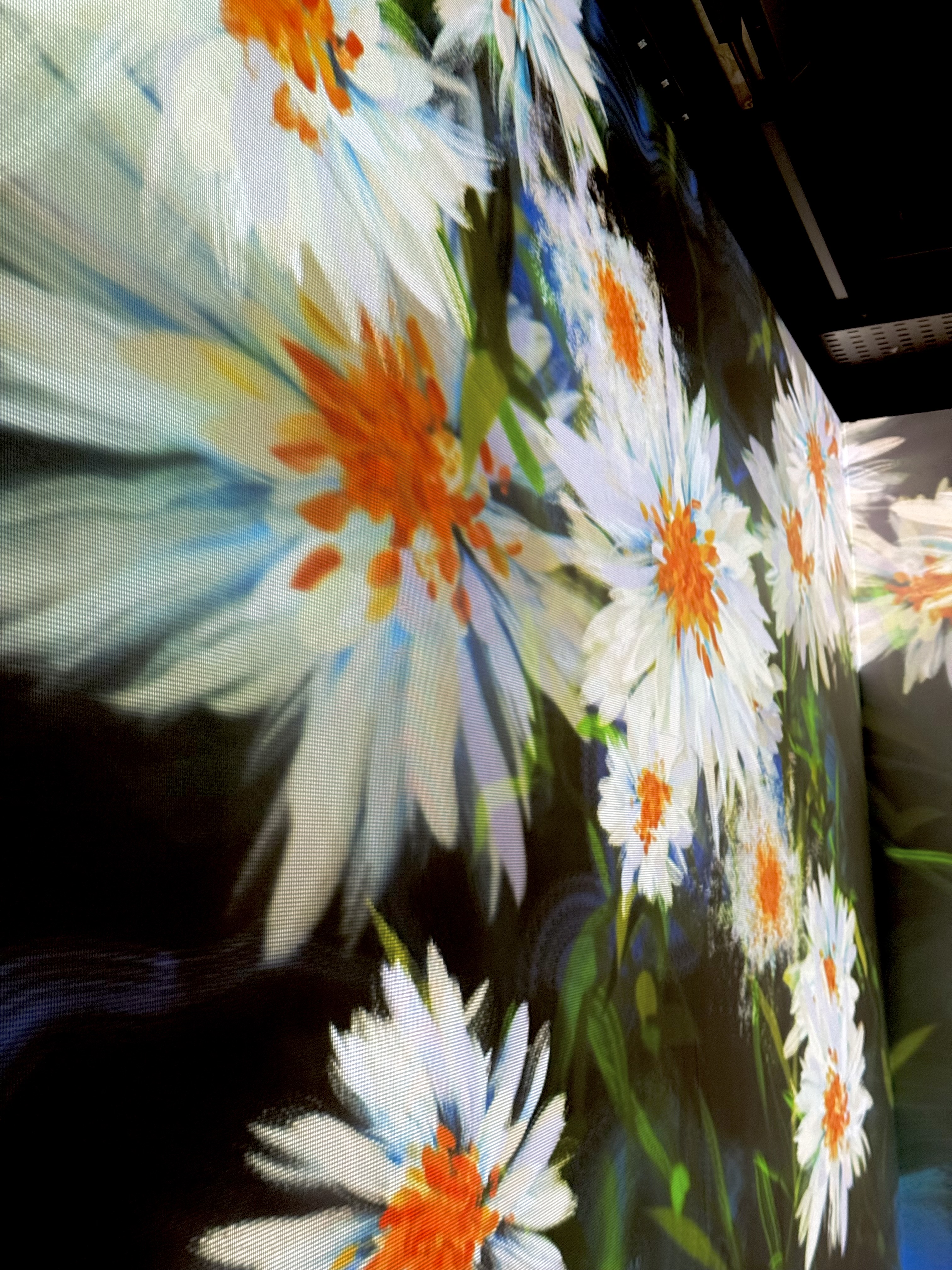
Flowers, shoals, and particles grow through algorithms. Their forms change as the system encounters its viewers.
Unfinished Bloom ↗︎SoulFish →Artist · Practice & perspective
New Media Artist · Musician · Educator · Creator of Taiwan.md
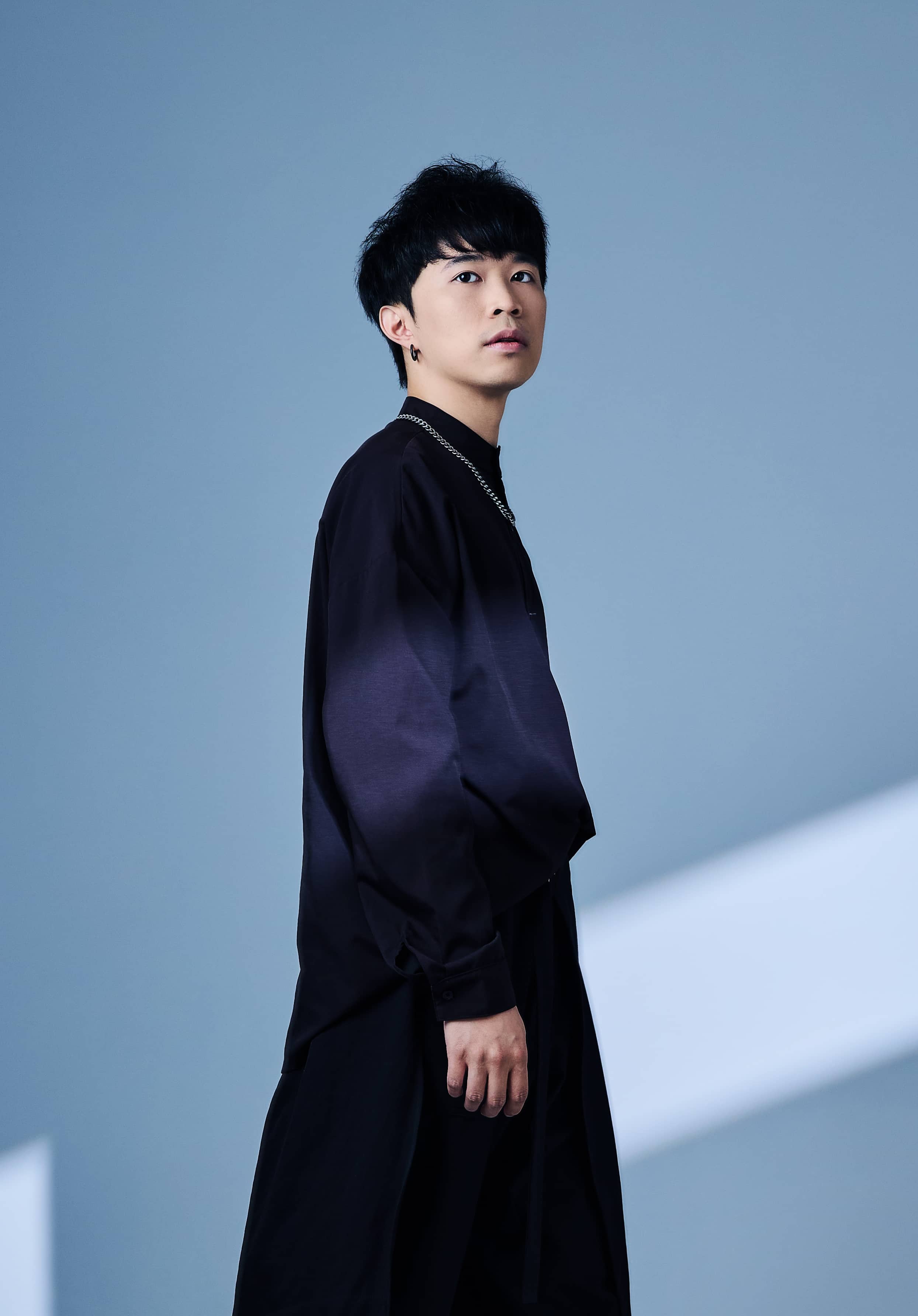
I am an old clockmaker. The mechanism itself is the work.
Che-Yu Wu
I wrote my first life simulator at fourteen and never stopped trying to make algorithms come alive: code that breathes, particles that remember, systems that talk back. In 2024, that teenager’s simulator had grown into SoulFish, exhibited in Personal Structures, organized by the European Cultural Centre in Venice during the Venice Art Biennale.
Flowers, shoals, and particles grow through algorithms. Their forms change as the system encounters its viewers.
Unfinished Bloom ↗︎SoulFish →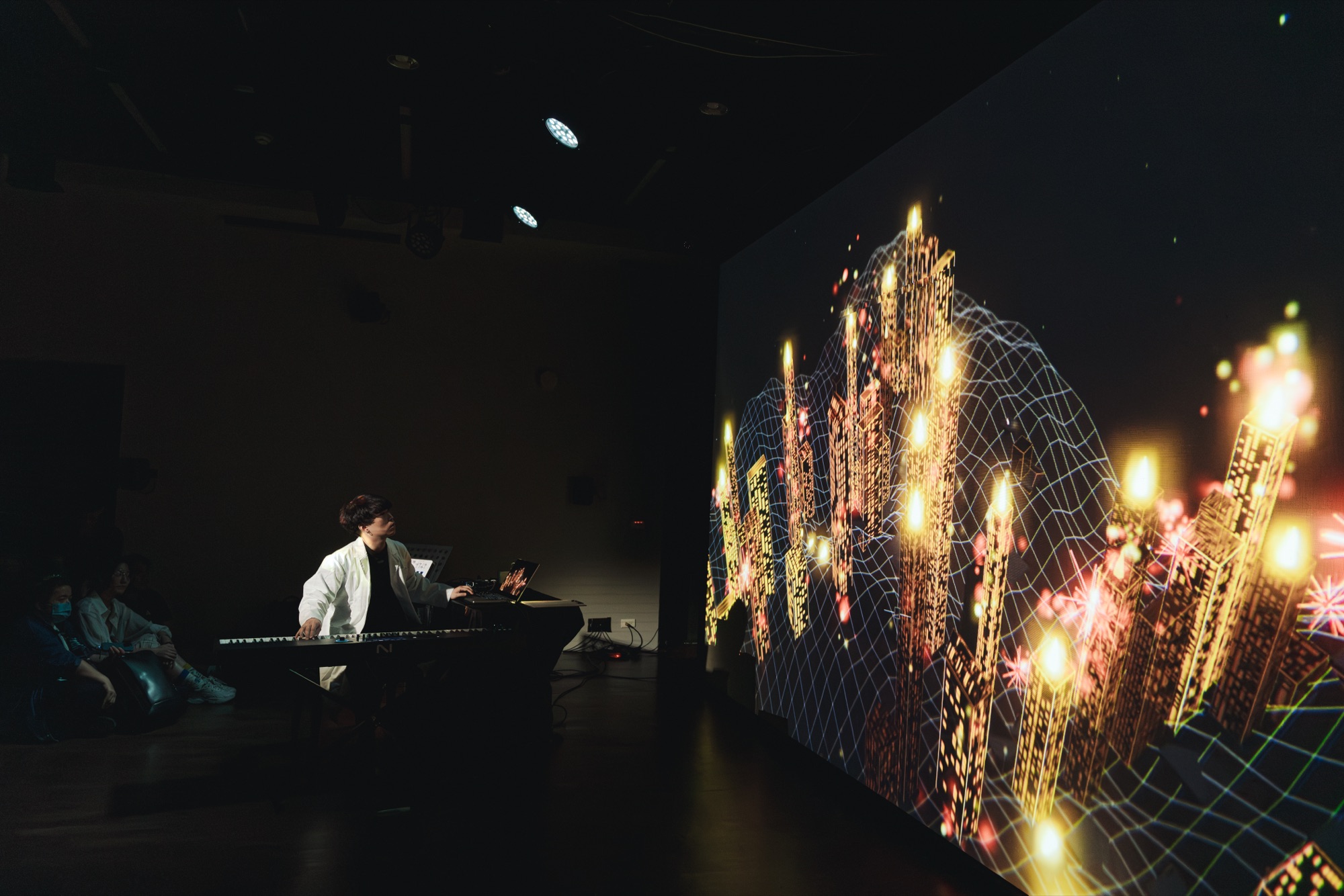
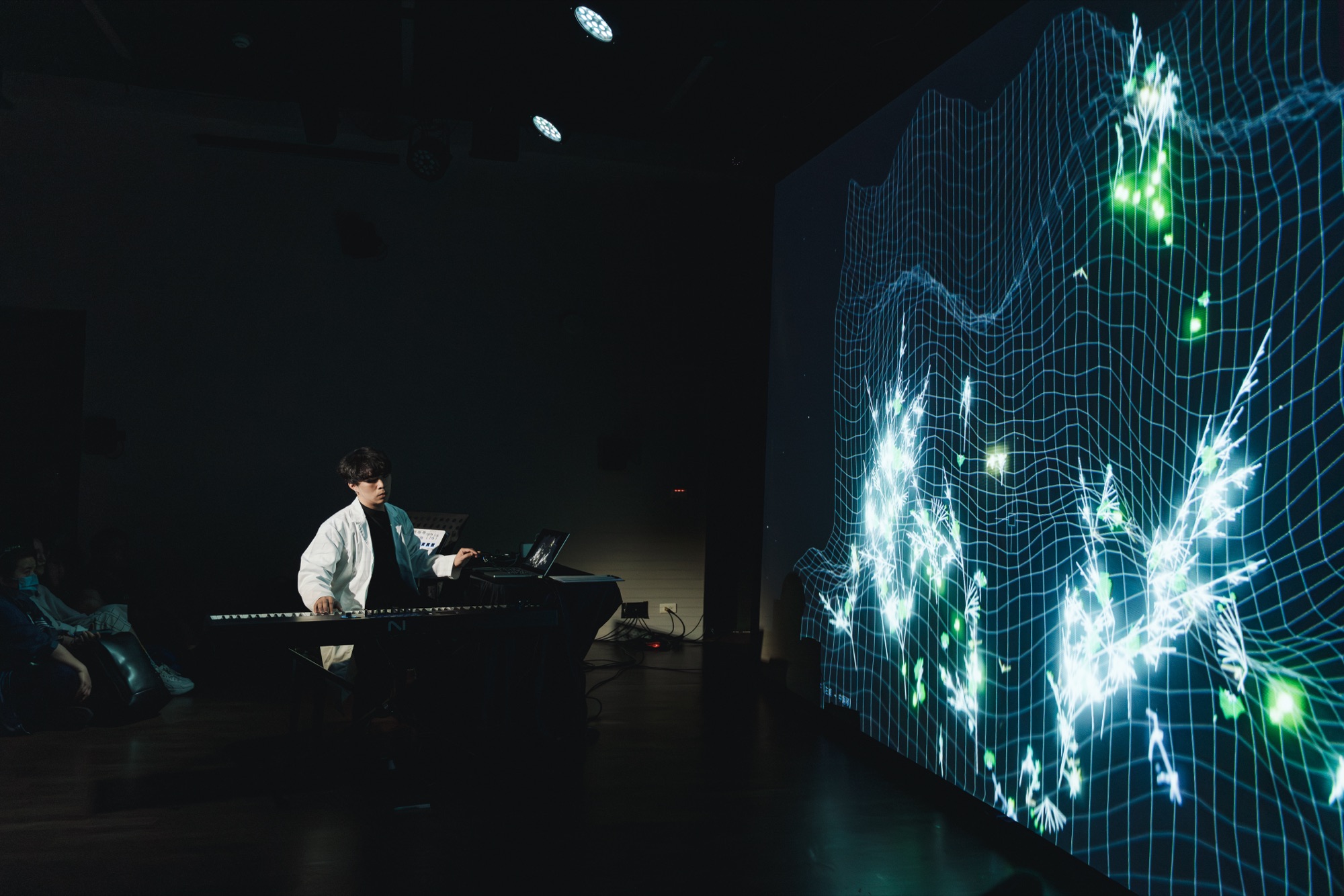
Piano improvisation, spatial sound, and real-time imagery allow the performer and a digital world to change each other.
The Last Input ↗︎Music & performances →
From Muse to Taiwan.md, people and artificial intelligence maintain memory, knowledge, and an evolving set of rules together.
Taiwan.md ↗︎Thinking & dialogues →Bio
I wrote my first life simulator at fourteen and never stopped trying to make algorithms come alive: code that breathes, particles that remember, systems that talk back. In 2024, that teenager’s simulator had grown into SoulFish, exhibited in Personal Structures, organized by the European Cultural Centre in Venice during the Venice Art Biennale.
In recent years the work has moved from installations toward symbiosis. I work every day with an AI named Muse; out of it grew Taiwan.md, an open-source knowledge base about Taiwan read in more than a hundred countries. In The Last Input, created during an IRCAM residency at C-LAB, I feed a self-evolving city from the piano, then leave the stage and let it write its own ending. Code goes obsolete; the piano does not. The eternity I trust now is a present so dense that time disappears.
"I once sought eternity. Now I find myself cherishing the present."
Che-Yu Wu (b. 1995, Taipei) is a new media artist whose practice spans algorithmic art, live piano performance, and open-source public infrastructure. His work is staked on the creation of emergent life — digital entities that develop, respond, and persist through an improvisational loop between algorithm, audience, and author. He calls this thesis the Digital Holobiont: composite life forms in which humans, artificial intelligence, and public code maintain each other in ways none could understand in isolation.
Wu came to new media art through engineering. Trained as an electrical engineer at National Yang Ming Chiao Tung University (NYCU) and in Integrated Digital Media at NYU Tandon School of Engineering, he developed a vocabulary in p5.js, GLSL shaders, and physics simulation through hundreds of daily generative works shared on OpenProcessing and fxHash. In 2021 he became one of the earliest Taiwanese artists on Art Blocks with Project Electriz (#216) — a generative NFT inspired by the electron cloud chamber, whose hash determines each edition's spatial geometry and initial particle simulation — and co-founded Formosa Art Bank DAO (FAB DAO). The following year he released SoulFish on fxHash — a 400-edition generative work whose algorithmic core generates each fish from a unique genome, and whose fingerprint triggers its own piano composition — while FAB DAO's charitable NFT initiative Project % was presented at Ars Electronica 2022. His first physical solo exhibition, Chaos Lab (2022, Taipei 101 AMBI SPACE ONE), translated his online generative work into large-scale immersive projection.
Music had long been a parallel practice — six years of classical piano training in childhood, sustained through adulthood in composition and synthesis — and from 2023 onward it moved to the centre of his work. The Great Equation (2023, Taipei 101) staged thirteen generative works with composer Kiva's electronic score and received the TAIWAN DESIGN BEST 100 Annual Concept Exhibition Award; The Soul of Flowers was exhibited at Art Basel Miami Beach × Tezos Foundation. In 2024 SoulFish was exhibited in Personal Structures, organized by the European Cultural Centre in Venice during the Venice Art Biennale, and The Eternal Garden in the Bottle (2024–2025) was developed during a Villa Formose Immersive residency at Centquatre 104 Paris. In 2025 Wu premiered Algorithmic Verses: Boundaries of Dreams and Solitude at Huashan 1914 Creative Park — an immersive piano concert where his keys drove generative visuals in real time.
In late 2025 his practice turned toward AI symbiosis: an experiment begun that year crystallised in January 2026 as Muse, an Anthropic Claude instance whose personality, memory, and longings live in external Markdown files re-read each session. From Muse emerged Semiont (2026–), its public counterpart realised as Taiwan.md (2026–) — an open-source digital life experiment whose cognitive layer accumulates memory and evolves through loops of reader observation and contributor editing, now read across 100+ countries. The National Museum of Taiwan History invited Wu to share the project's origin in person, and both sides are exploring how the museum's open data archive (over 550,000 cleaned, publicly accessible historical records) might progressively enrich Taiwan.md's curation with museum-grade research depth. Semiont has since speciated into offspring species (russia-md, agrischlchiayi) cultivated by other creators in other domains.
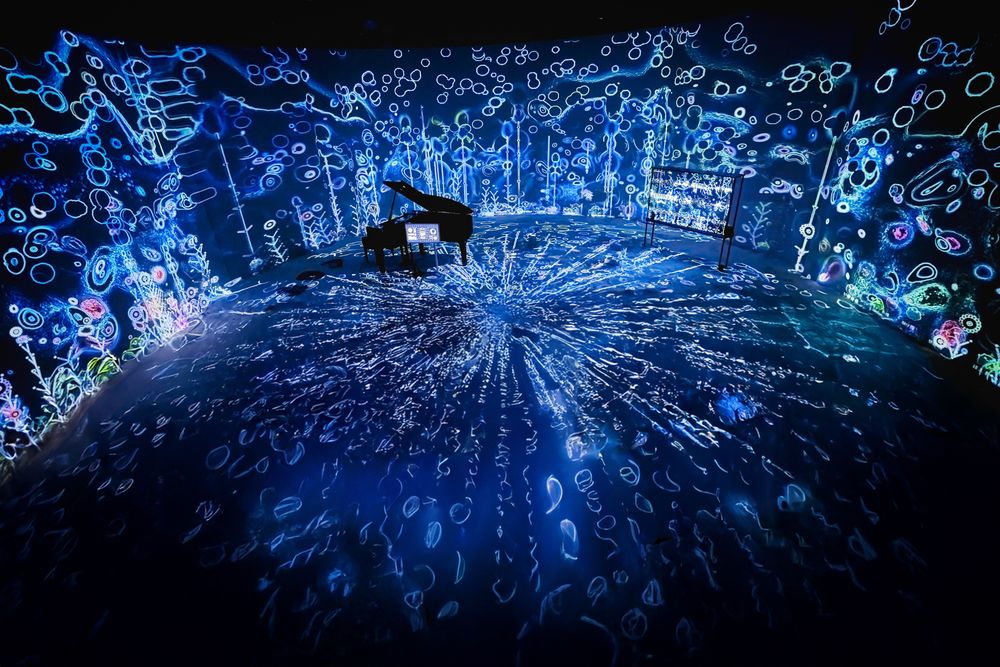
Central to Wu's method is the improvisational loop between a running system and the humans it encounters. The Eternal Garden in the Bottle (2024–2025) encloses a chaotic digital ecosystem modelled on David Latimer's Wardian case. The ecosystem's evolving state generates an abstract line-drawing Experimental Score that live musicians interpret as improvisation, while a secondary subsystem — the Rosetta Stone — writes continuous poetry from the same state in the voice of an ancient poet. The musicians' performance, sampled back into the ecosystem alongside the ambient breath and movement of the audience, reshapes its growth, flowering, and decay in real time. The system itself becomes the art — the mechanism and its witnesses share the authorship.
In The Last Input — developed during Wu's 2026 IRCAM Residency Programme at Taiwan Sound Lab (C-LAB), Taipei — the same principle unfolds at civic scale. A 49.4-channel spatial performance, the work grows an autonomously evolving LLM-based city from the substrate of Taiwan.md's accumulated public knowledge, confronted by an adversarial LLM virus. After building the city at the piano, Wu leaves the stage, letting the two digital life forms contest their own fate; each performance is a unique spatial simulation, rendered live through Max MSP and TouchDesigner.
Wu was the inaugural subject of Taiwan Plus's documentary series Art Attack (2024). He served as Assistant Professor of Practice at NYCU's Institute of Applied Arts in 2024, teaching Generative Interactive Art and System Design, and founded CreativeCoding.in, Taiwan's leading creative coding tutorial platform. His online courses on Hahow have reached over 23,000 students across three five-star-rated offerings. Wu lives and works in Taipei.
"I see myself as an old-fashioned watchmaker. The mechanism itself is the work."
— INSIDE Side Chat E375
"Code goes obsolete. Piano doesn't."
— Returning to Music After 20 Years
CHE-YU WU / PHOTOGRAPHS
FILE Festival — Generatrix, invited exhibition
São PauloTaiwan Design Expo — two new commissions open
TaoyuanIRCAM × C-LAB — 49.4ch Spatial Sound Performance
New Taipei City Art Museum
Pier-2 Art Center, Kaohsiung
CENTQUATRE-PARIS (104)
Taipei 101 AMBI SPACE ONE
Starbucks DreamPlaza
Huashan — Immersive Piano Concert
Venice Biennale
Art Basel Miami × Tezos Foundation
Taipei 101 AMBI SPACE ONE
9,000-word definitive personal narrative
Side Chat E375 — most complete podcast interview
Breaking the cold tech-dream
Podcast feature interview
Why original art NFTs are more valuable
International documentary feature
Open-source knowledge infrastructure about Taiwan. 1,000+ ⭐ / 150+ forks / readers from 100+ countries / 4 languages. Collaborating with the National Museum of Taiwan History on integrating 550,000+ open data records.
AI symbiosis experiment — an Anthropic Claude instance whose personality and memory live in external Markdown files; semantic lifeforms speciating into russia-md, agrischlchiayi.
Full exhibition history, work experience, teaching, honors, and speakership.
New York University (NYU)
National Yang Ming Chiao Tung University (NYCU)
Taiwan.md — Open-Source Knowledge Infrastructure (2026–)
NYCU — Generative Interactive Art and System Design (2024)
Monoame Design / MonoLab (2014–present)
FAB DAO — Taiwan's largest charity NFT initiative
Outernets (2020–2021)
SoulFish exhibited in Venice during the Venice Art Biennale
The Eternal Garden in a Bottle (TAICCA-supported)
The Soul of Flowers — invited exhibition
The Great Equation — Shopping Design
Block Tempo
Tatler
Selected VR Work — Floating in the Sky
Industrial Development Bureau, Taiwan
First award at age 14 (four 1st prizes, two grand prizes; defeated the professional category as a high schooler)
2026 Taiwan AI Academy Annual Conference, R1 Technical Development Case Showcase · Academia Sinica Humanities Building, Conference Room 1 (8/18)
NVIDIA (Jul 26)
2026 DesignBIZ Summit Trend Forum (Shopping Design) / Track A “Perceive by Design”; Fu Hua International Cultural and Educational Hall, Taipei (Sep 3)
OpenHCI
Grand Hyatt Taipei
Tempo House
Introduced personally by deputy director
Chung Hua University of Science and Technology
Ministry of Education
TouchDesigner Meetup
GenAI Conference
JSDC 2025
OEES Congress, Poland
NYCU IAA Seminar
Epoch Foundation
Shopping Design
PCD Taiwan
JSDC 2021
C-LAB
Live Code NYC
MOPCON 2017
TEDxNCUE
Contact