Installation2026
The Last Input
Contents & work details
- Archive year
- 2026
- Type
- Installation
- Artist
- Che-Yu Wu 吳哲宇
Overview
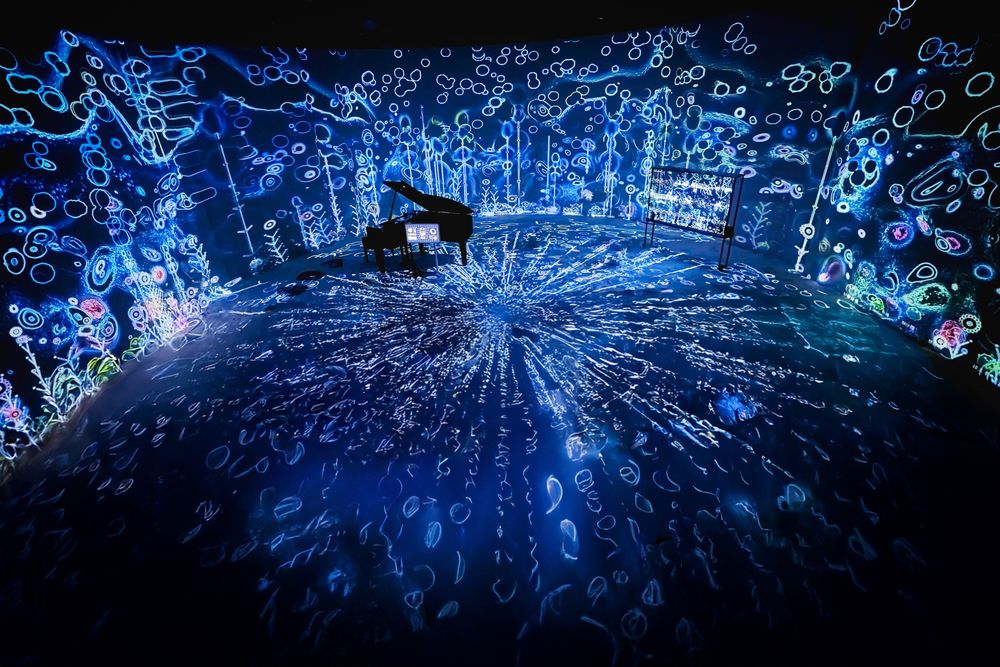
A performance of piano, a live generative world and spatial sound asks what remains of a final, irreversible human input.
Work and viewing
A City and a Virus interact through their own growth logics. Notes and chords change the world, while the audience hears the movement of life, order and erosion within a spatial sound field.
Original work record
Original text: cheyuwu.com/exhibition/the-last-input/
When artificial intelligence can generate everything, what meaning is left in the last input a human presses by hand?
The Last Input is an immersive spatial sound performance built around the act of letting go. It asks what remains of the last input a human presses by hand, once artificial intelligence can generate everything.
Within a 49.4-channel sound field, it grows a living digital system from two AI species that expand and contend with each other: a City that struggles to hold order, and a Virus that keeps spreading, mutating, and attacking. Both are driven by real-time algorithms, each with its own logic of growth and attack, rising and falling against one another as the performance unfolds. The artist feeds the City sound and parameters through piano and control surfaces, and the sound is generated live as spatial harmony.
The City's sound arrives from fixed directions, a symbol of order; the Virus seeps in from every side, a symbol of decay that is everywhere. The system is computed live, and the details differ with every performance: this digital life form's single, unrepeatable, complete existence.
This isn't a story about being replaced by artificial intelligence. Intelligence is already abundant; what this piece cares about is a different kind of scarcity: the capacity to let something end with weight. One input that can't be taken back comes closer to being real than generation that can always run again.
In the performance I sit at the piano in a white lab coat, like a scientist. The coat stands for starting from zero: studying the world I created with fresh curiosity. I play a few notes and new creatures appear on the terrain, so I pull the camera closer and let the whole room watch together: a horse lowering its head to drink, small insects scurrying through the grass. Laughter rises from the audience, and I let the image linger a little longer. In that moment, everyone in the room is witnessing the birth of a world.
The input has its own grammar: a single note plants a seed; a chord calls up a flock of birds; consonance lets the world flourish, and dissonance summons the virus. The world responds in real time, growing into shapes even I cannot foresee.
Most audiovisual performances start from the image and score sound onto it; this work runs the other way. I first build a living simulated world, and sound arrives as its natural product, the way game-engine audio works: a horse makes drinking sounds only when it reaches the water, and the city roars only once it has grown tall. I call this order visual audio: listening to a world itself.
The spatiality of the sound also comes from the world itself. Code turns the positions of things, the flight of birds, the spread of trees, into a choir of spatial sound surrounding the audience within the 49.4-channel field. Directionality is rarely pushed this far in performance, and the listening becomes remarkably fine-grained: seated inside the world, you hear a sound circle from your back left over your head, and feel the world breathe with your whole body.
Context & sources
Exhibitions, research & collaborations
Contact the artist ↗