Installation2026
Cymatics of Life
Contents & work details
- Exhibition year
- 2026
- Type
- Installation
- Artist
- Che-Yu Wu 吳哲宇
- Exhibition
- Taiwan Design Expo 2026 in Taoyuan
- Zone
- A10 Life Around Water, Department of Water Resources, Taoyuan City Government
- Dates
- 24 September – 11 October 2026
- Venue
- Messe Taoyuan
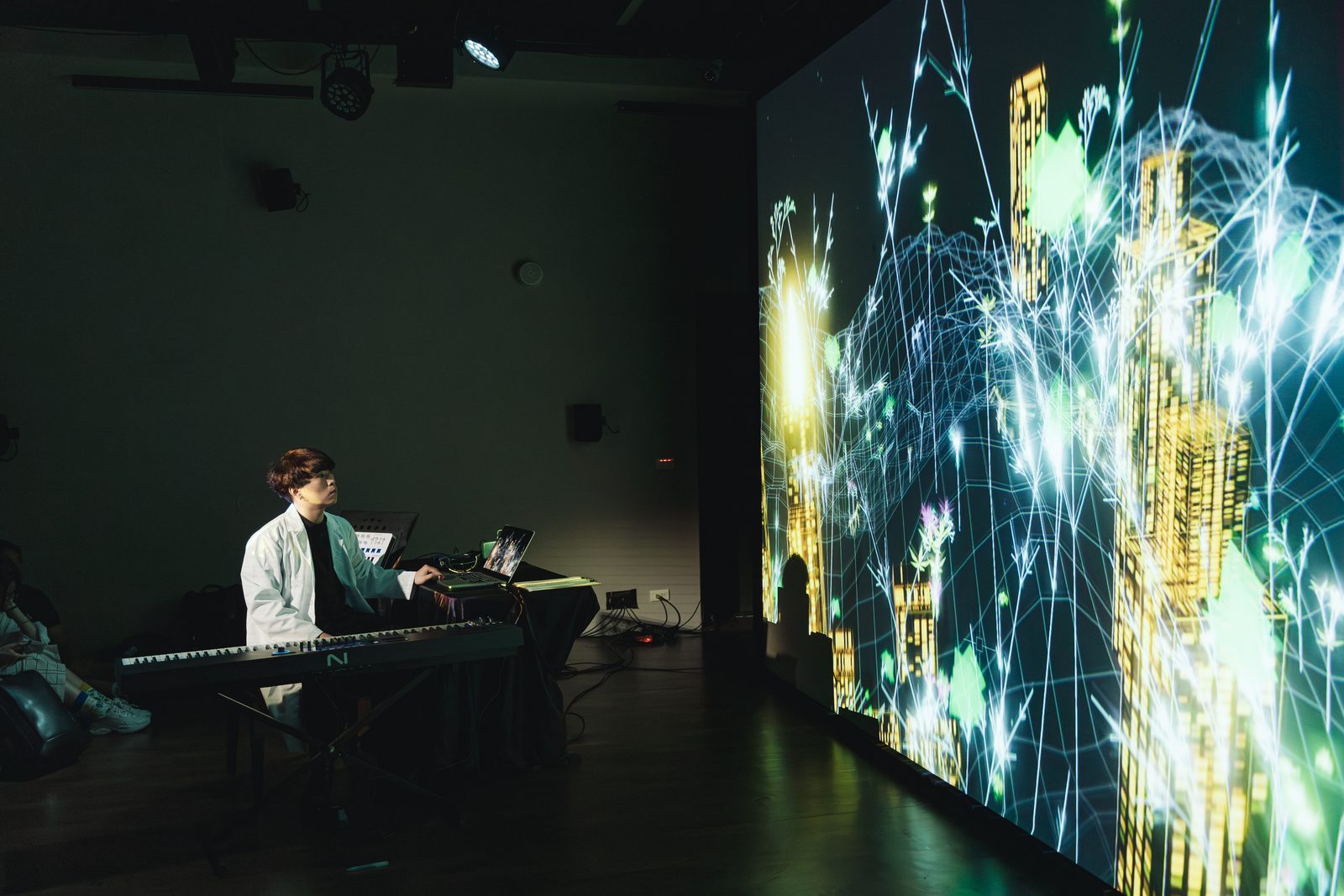
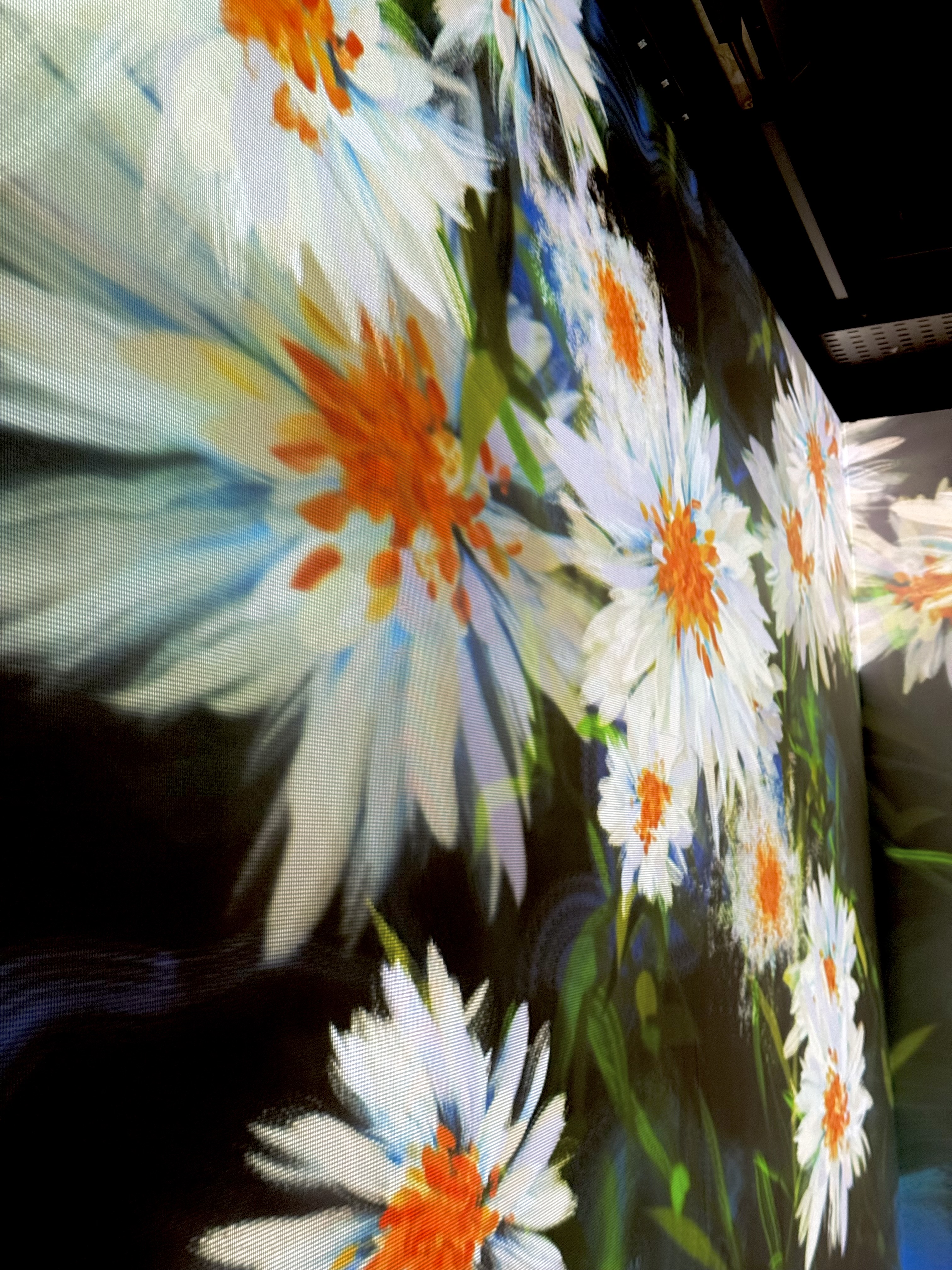
- Curved wall
- Projection, 12.12 × 3.5 m, 4156 × 1200 px
- System
- three.js, real-time GPU wave simulation (Faraday forcing) with physically based optics
- Participation
- Five questions by QR code; the mandala appears on the phone and the wall together
- Timed performance
- One minute every half hour, in four acts
- Credited as
- MONOLAB, Che-Yu Wu
Overview
Cymatics makes vibration visible. This twelve-metre wall of water is driven by the answers of its visitors: each response becomes a frequency of one’s own, entrusted to the water, which reveals a Water Ripple Mandala made for one person, on the phone and on the projection wall at the same time.
Two waters, one equation. Low frequency on the left gathers into rings; high frequency on the right splits into a lattice. Captions are the sentence the engine writes for each water.
Work and viewing
Water has no fixed form, yet set in motion by different frequencies it reveals distinctive patterns. The wall is a dish of water computed in real time: a wave equation integrated on the GPU, driven the way a loudspeaker shakes a tray of water (Faraday forcing), then photographed with physically based optics of refracted caustics, soft-box reflections and absorption inside the water.
Visitors scan the QR code beside the wall and answer five questions: how much water a day uses, which sound of water is most calming, the first image that water brings to mind, the first touch of water in the morning, and the one thing they most want to do for water after leaving. Each answer moves one axis of the water, volume, texture, colour, detail and boundary, and together they become a frequency of one’s own. The Water Ripple Mandala appears first on the phone, then flows onto the twelve-metre wall.
Every half hour the wall runs one complete cycle: from the first vibration, light breaks on the surface, fish take shape and swim past, the view pulls back into a whole sea being drawn along, folds into a vortex and fades to black and white. At the moment only black and white remain, light is taken apart, and the colours of the whole world rise again out of the smallest dispersion.
Cymatics: frequency decides the shape
Cymatics is the physics that makes sound visible. In 1787 the German physicist Ernst Chladni drew a bow across a metal plate sprinkled with sand, and the grains arranged themselves into symmetrical, precise geometry. In 1967 the Swiss scientist Hans Jenny named the phenomenon and, sweeping an oscillator through frequencies, watched the figures on one medium grow into new forms one after another. The lower the frequency, the simpler the figure, gathering into rings and crosses; the higher it goes, the finer the pattern splits, approaching a mandala-like lattice. Vibration decides the shape, and the shape remembers the vibration.
Sound is vibration. When it enters a dish of water, the water answers with the few ways it can move with the least effort; what those ways look like in space is the figure we see. This work replaces sound with people as the source of the driving, and lets the whole wall become the vibrating body itself.
Five questions, five axes
Five questions with four choices each; each question moves one axis of the water. Every row below is the same water (same other answers, same seed) with only that answer changed: volume and detail shift subtly, texture and colour are plain to see.
Q1 How much water does your day use?
This one sets the volume: depth, light and absorption of the water.
Q2 Which sound of water calms you most?
This one sets the texture: four ways of stirring water, raindrops, waves meeting head-on, a many-centred stream, bubbles rising at random.
Q3 When you think of water, what image comes first?
This one sets the colour: four lighting rigs, cold blue, deep sea, black-and-white studio, violet night with a warm edge.
Q4 When you wake, what is your first touch of water?
This one sets the detail: surface tension and the density of the pattern, from plain to intricate.
Q5 After you leave the exhibition, what would you most like to do for water?
This one sets the boundary: waves that stay close, or travel out into the world.
Six waters, six sets of answers. The wall shows the newest one and rotates on a timer; seeing everyone at once happens in the gallery on the phone.
Water itself has no shape; shape comes from vibration. The same frequency unfolds in your hand and on the wall at once, one held in the palm, one twelve metres wide.
Original work record
Wall label text, 10 September 2026 version. MONOLAB, Che-Yu Wu
Cymatics is a physical phenomenon that makes vibration visible. In 1787, German physicist Ernst Chladni drew a violin bow across a metal plate sprinkled with sand, causing the grains to gather into intricate, symmetrical geometric patterns.
Water has no fixed form, yet when set in motion by different frequencies, it reveals distinctive patterns of ripples and waves.
We encounter and use water every day, yet rarely pause to truly sense its presence. These waters, resonating collectively, connect the rhythms of our lives.
We invite you to scan the QR code beside you and quietly recall the everyday moments you share with water. Each response will be translated into a unique frequency and entrusted to the water, allowing it to reveal a “Water Ripple Mandala” created just for you.
Your mandala will appear on your phone and, at the same time, flow onto the 12-meter-wide projection wall before you.
Listen closely. You may even hear the sound of water droplets passing through.
Press
On opening day, visitor guides to the expo began to mention the work's interaction: Smile Taiwan's entry on zone A10, Life Around Water, tells readers they can make their own water mandala online and see it rise onto the big screen. The expo's official page for zone A10 lists the curved screen as "Curved-screen algorithmic art: MONOLAB, Che-Yu Wu".
- 微笑台灣Visitor's guideA visitor's guide to the Taiwan Design Expo 2026: sixteen themed exhibitions in Qingpu and Zhongli
- ExhibitionZone A10, Life Around Water (curved-screen algorithmic art: MONOLAB, Che-Yu Wu)
Clippings are the outside record; tags are the exhibition's official pages. Every one opens.
Credits (as listed by the Taiwan Design Expo)
- Supervising organisation
- Taoyuan City Government
- Organiser
- Department of Water Resources, Taoyuan City Government
- Curatorial production, curator
- Plain Design, Jer-Yu Sheu
- Entrance installation curation
- Whitelight Motion, Rex Hon
- Entrance installation and curved-screen visual direction
- Whitelight Motion
- Curved-screen algorithmic art
- MONOLAB, Che-Yu Wu
- Entrance installation and curved-screen sound design
- Audio Textural, Chia-Wei Hsu
- Interactive media and multimedia integration
- 13 TECHART
- LED hardware and equipment
- FARVISION ENG
- Audio equipment engineering
- Will Sung
- Spatial design
- Square2 Design Studio, Plain Design
- Photography and videography
- Wan-Ning Chen, Chia-Wei Lin, Victor Wu, Henry Jiang
MONOLAB team
- Concept and system
- Che-Yu Wu
- Produced by
- MonoLab
- Project management
- Ariel Huang
Context & sources
Exhibitions, research & collaborations
Contact the artist