Installation2026
Woven Land, Woven River
Contents & work details
- Exhibition year
- 2026
- Type
- Installation
- Artist
- Che-Yu Wu 吳哲宇
- Premiere
- Taiwan Design Expo 2026, Taoyuan Environmental Protection Bureau pavilion
- Dates
- 24 September to 12 October 2026
- Venue
- Taoyuan Convention and Exhibition Center
- Medium
- Real-time algorithmic weaving (Three.js), C-shaped LED ring at 12096×960 px, observation panel, algorithmic sound
- Data
- National greenhouse gas inventory 1990 to 2024, Taoyuan terrain and waterways, on-site questionnaire
- Commissioned by
- Taoyuan City Government Environmental Protection Bureau
Overview
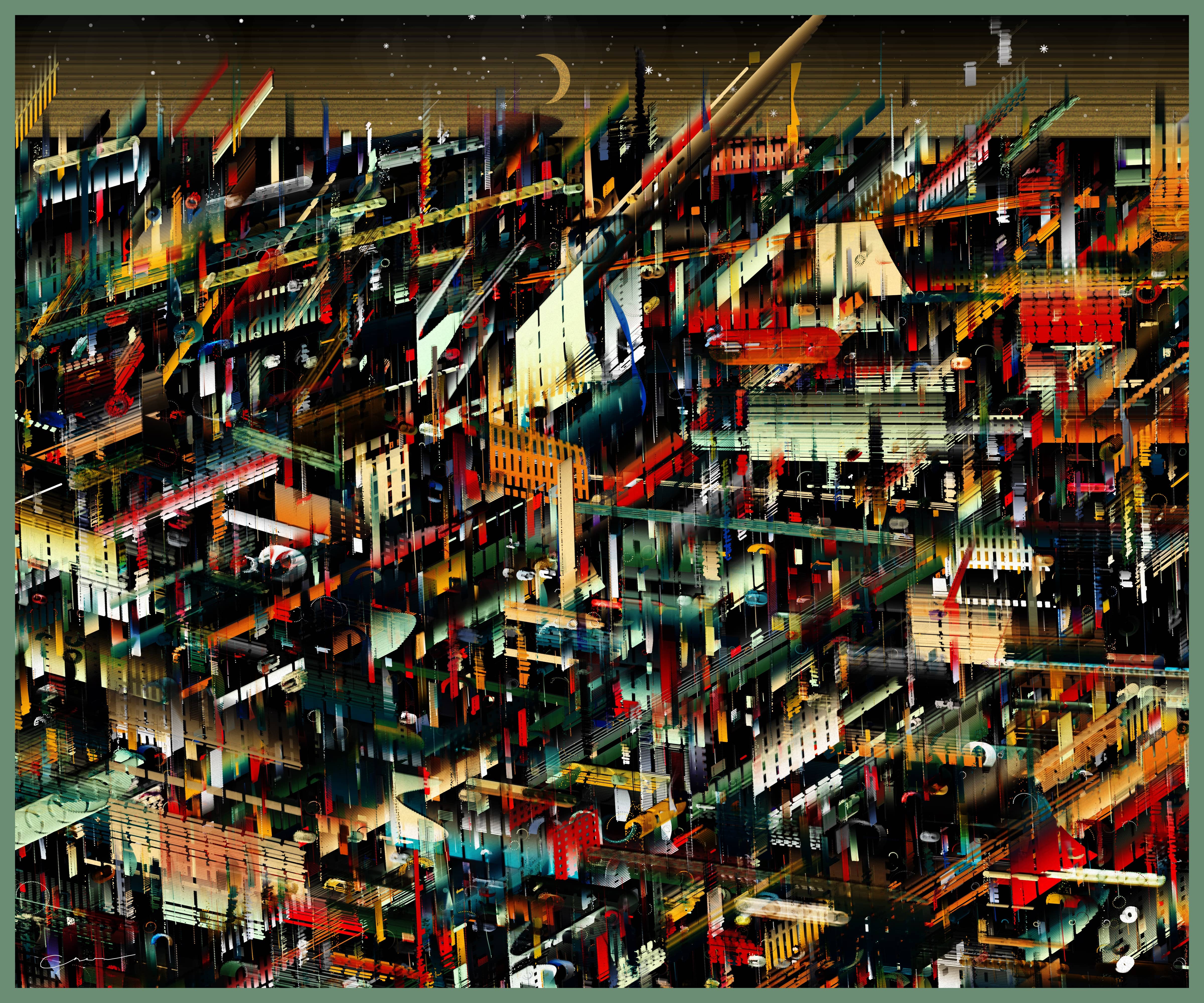
Woven Land, Woven River is a continuously running algorithmic art system that speaks the language of weaving. Thirty-five years of Taiwan's carbon emissions, the structure of industrial emissions, Taoyuan's carbon-reduction policies and the everyday choices of visitors on site are woven into one digital cloth that never stops growing.
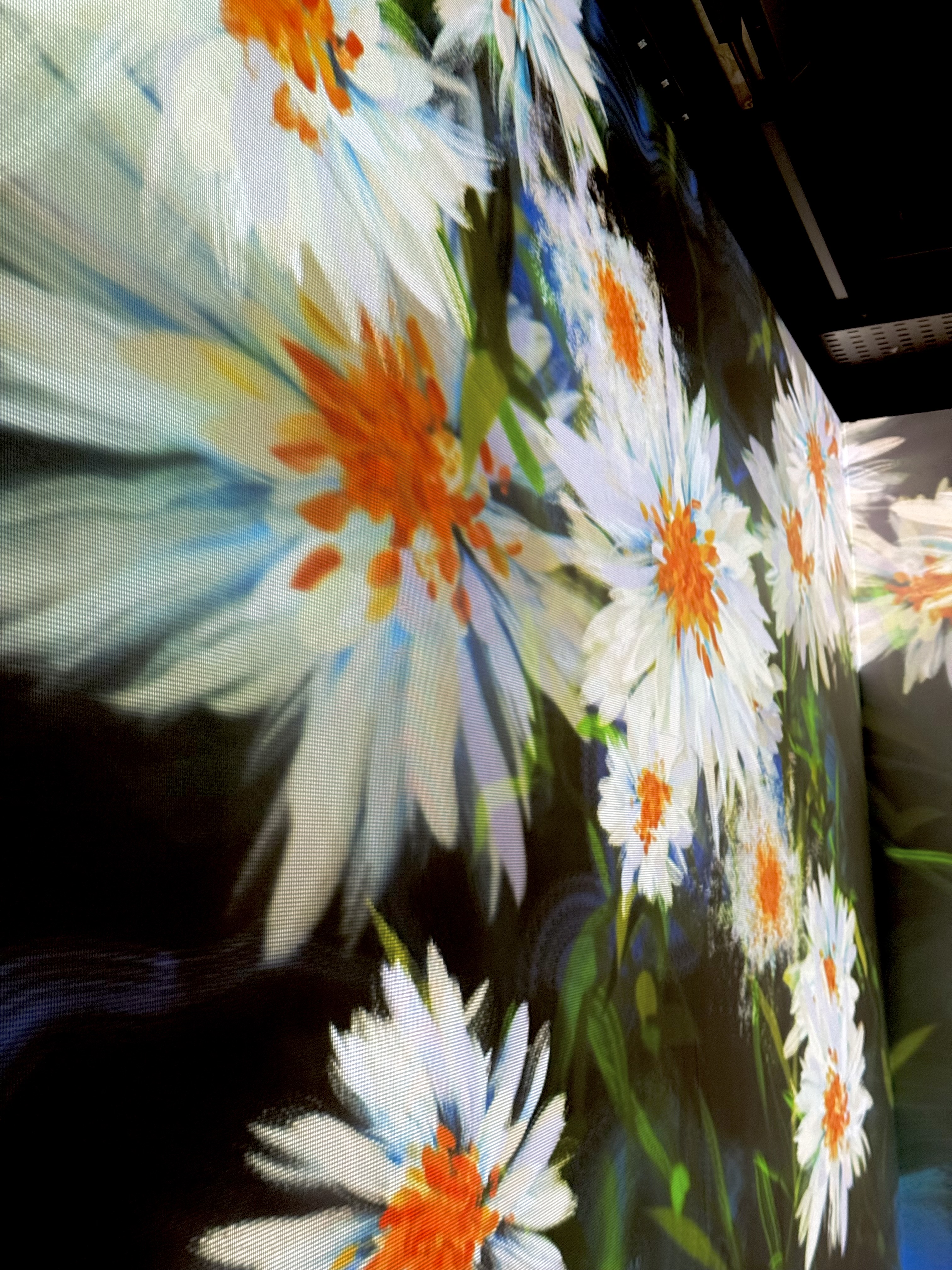
After visitors answer questions about their daily carbon footprint on an interactive page, their data travels as points of light into the ring of LED and is drawn out into thread. The work takes its ground from the pond-studded terrain of Taoyuan: the threads wind and fork like waterways and grow into river-like textures; emission data makes the pattern tangle in many materials, while carbon reduction opens fissures and lets the structure dissolve.
The work tries to weave human warmth out of a cold technological medium. When the flourishing of a civilisation is woven into a magnificent carpet, you can admire the brilliant footprint of a city and a society, and at the same time see what all of it is woven from.
Why weaving
It began as data visualisation, and data visualisation has a problem: more emissions look like a bad thing, and fewer emissions do not look like much at all. Weaving works differently. Cloth has holes; it takes in gemstones and pom-poms and other three-dimensional things, and grows into a structure with thickness.
Most of my digital work has been clean geometry, lines and planes. This time the medium is a ring of LED, and I wanted the materials on screen, the feel of yarn and cloth, to keep some human warmth inside a high-tech medium.
What I want the audience to meet is an organic piece of cloth. It can fork somewhere and grow out like a river. With the terrain, the carbon data and the raised materials layered on, the texture becomes very organic: a weave of traditional patterns, and at the same time a way of feeling the data.
The loom is the code
The system is built on how a real loom works: threading, shedding, punch cards. In 1804 the Jacquard loom used punched cards to weave patterns that only a master weaver could make before; some thirty years later Babbage took the idea of instructing a machine with cards from that stack, and Ada Lovelace wrote that the Analytical Engine weaves algebraic patterns just as the Jacquard loom weaves flowers and leaves. Follow the punch card forward and you reach the census machine, the computer, the data centre, and the subject of this work: digital carbon emissions.
So every warp thread and every pick of weft here is a real three-dimensional yarn. Interlacing, floats, diamond twills and broken threads all grow out of the weave. Incoming data rewrites the weave itself; colour is only the result.
Terrain, cities and people are themselves a kind of weaving.
Five chapters
On the wall the cloth is woven in an endless loop; the fell travels from left to right in about a minute, and every pass weaves different data, in five chapters.
One, Land: only the ground weave, Taoyuan's terrain speaking for itself. The weft follows the contour lines, the rivers push the weft aside and expose the bare warp, and the ponds are holes in the cloth. Two, Thirty-five years: one pick per year from 1990 to 2024; five yarns for power, industry, transport, buildings and agriculture, and waste are woven into bands as wide as each sector's share that year, with the carbon sink in deep pine green. Three, Tributaries: the chemical, electronics and metal tributaries of manufacturing flow along the warp. Four, Mending: Taoyuan's carbon-reduction policies are woven as darning grids. Five, Many hands: visitors' answers become shared data woven into the last chapter; whoever signs in becomes a gold thread, and the more people, the denser the gold; with no one there, only the ground weave is woven.
Chapters cross-fade into one another, and a chapter can mutate into mirrored, denser, sparser, hue-shifted or differently woven variants, so no two passes are the same. The weaving also sounds: the loom's warp and weft become a drum kit, joined by a piano, and the larger a share of the data, the higher the pitch.
Real Taoyuan under the cloth
Under the cloth is the real Taoyuan: a 512 by 704 elevation field (AWS Terrain Tiles), seven rivers running 195 kilometres, and 519 ponds (OpenStreetMap, 58 of them now covered with solar panels). The figure woven on top is the year-by-year data for 1990 to 2024 from Taiwan's 2026 National Greenhouse Gas Inventory Report, with the shares of the manufacturing sub-sectors and Taoyuan's carbon-reduction policies woven in as well.
Colour is how the data is woven
Hue follows the theme of each chapter: the land takes the colours of the land itself, and the industry scene keeps the same proportions and colours as the observation panel. Brightness and the variants come from the rise and fall of the data. There is no colour key; the colours are how the data is woven.
On site
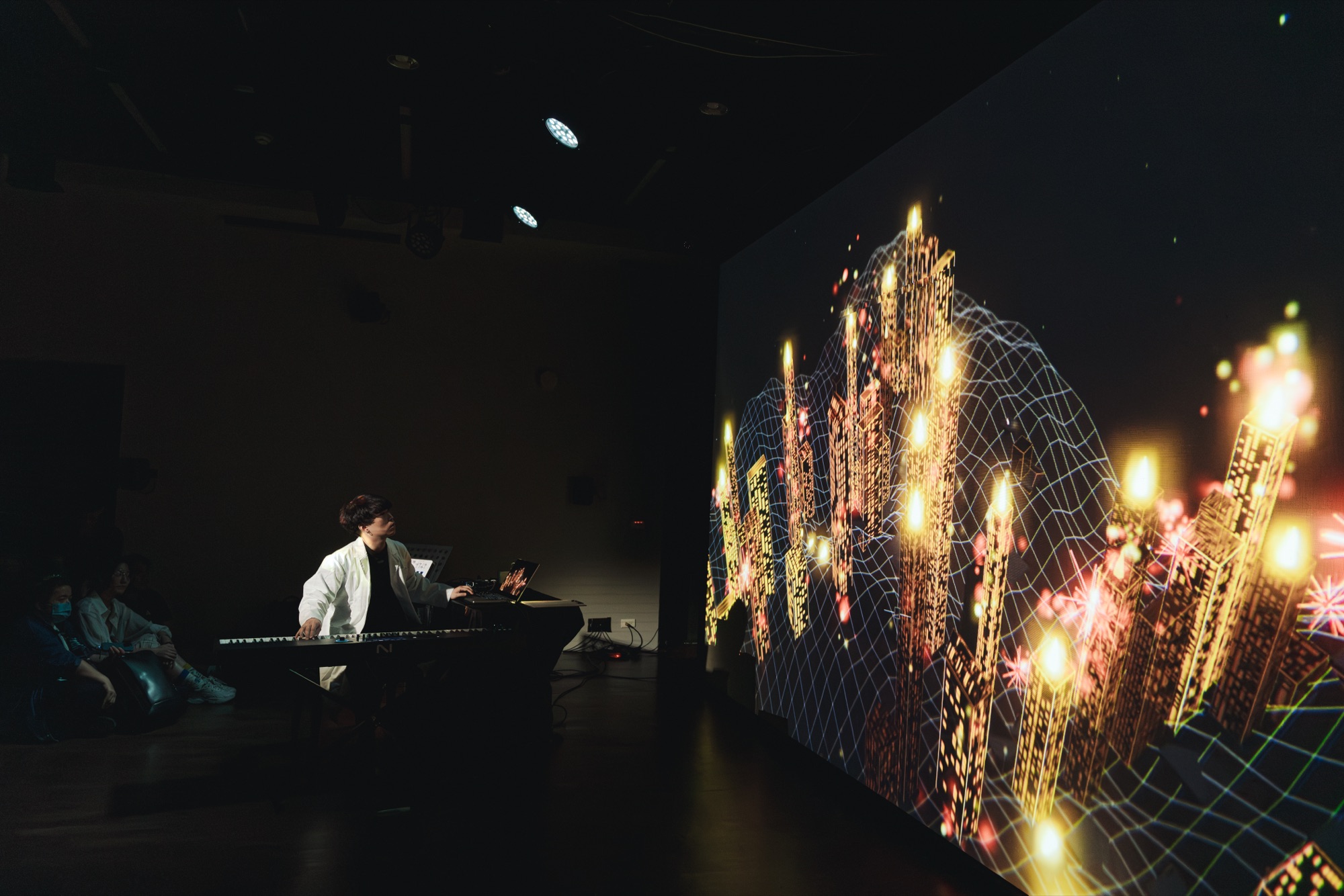
The work is shown at the Taiwan Design Expo 2026 in the Taoyuan Environmental Protection Bureau pavilion, from 24 September to 12 October 2026. The dynamic computing zone is a C-shaped ring of LED with a 2.5-metre opening; visitors walk inside the cloth and watch a world being woven from within. A second screen, the observation panel, shows which chapter is being woven and what data it is eating, and lists the participants who have just signed in.





Credits
- Concept, system and sound
- Che-Yu Wu
- Commissioned by
- Taoyuan City Government Environmental Protection Bureau
- Curatorial production
- 留白計畫 (Daisy Lin)
- Hardware and LED integration
- Jiun Lai (Aisthesis Savage)
- Produced by
- MonoLab
- Project management
- Ariel Huang
- Occasion
- Taiwan Design Expo 2026, Taoyuan Environmental Protection Bureau pavilion
Context & sources
Exhibitions, research & collaborations
Contact the artist