CHE-YU WU / LAB
A year in the making
Art, sound, tools and teaching meet on one wall. Follow a documented connection, or begin with a single piece of paper.
2021-09-09 — 2022-09-0936 public records
Red string: documented links · Twine: shared themes · Hover a paper to read a connection.
Complete records ↓



Read the year downwards, one month at a time. The small tags under a card are its connections: open one to jump to the record it names.
2021 · 09
2021 · 10
2021 · 11
2021 · 12
2022 · 01
2022 · 02
2022 · 03
2022 · 04
2022 · 05
2022 · 06
2022 · 07
Complete records
Read each record
Each record retains its date basis, public sources and connection labels.
p5.js Tutorial — CreativeCoding Fireworks Festival (Livestream Notes)
Livestream notes responding to an online fireworks festival that Japanese creative coders organised on Twitter around Processing Community Day. The post builds a particle system, then covers staggered multi-burst fireworks, particle variations, HSB colour mode, and removing off-screen fireworks to keep performance stable.
- Particle systems
- Livestream notes
Sources & related records
- Canvas Tutorial — Enemy Detection Radar · The same livestream-notes series (Curatorial theme)
Canvas Tutorial — Enemy Detection Radar
Builds an interactive enemy-detection radar with HTML5 Canvas and JavaScript. It starts from drawing shapes and lines, introduces a polar coordinate system for placing elements and a modular code structure, then centres on a rotating scanning beam revealing randomly positioned enemies with expanding circles and cross markers, finishing with scale markings and animated dashed lines.
- Canvas
- Polar coordinates
Sources & related records
- p5.js Tutorial — CreativeCoding Fireworks Festival (Livestream Notes) · The same livestream-notes series (Curatorial theme)
- 2021 Nuit Blanche Taipei — Online Guide · The same community publishing line (Curatorial theme)
- p5.js Tutorial — Dreamy Bird · The same tutorial publishing line (Curatorial theme)
- Interactive Web Tutorial — Object-Oriented Canvas Dragging with GUI Objects and Inheritance · The same Canvas tutorial line (Curatorial theme)
2021 Nuit Blanche Taipei — Online Guide
A guide to the online edition of Nuit Blanche Taipei 2021. Held fully online on 2 and 3 October under the theme Interoperability, the festival invited sixty interdisciplinary artists to make work across Taipei's twelve districts, grouped into four strands. Programming covered four sections, and the article also notes extended hours at selected Beitou venues and free evening museum admission.
- Nuit Blanche
- Online festival
Sources & related records
- Canvas Tutorial — Enemy Detection Radar · The same community publishing line (Curatorial theme)
AB_Project_CheYu Repository
A public GitHub repository for a generative artwork, holding Sketch.js and Rarity.js with their minified builds, index.html plus several variant pages, canvas image assets and a build directory. The README carries only a one-line setup note asking for a global minify install. The main branch holds twenty-nine commits.
- Generative art
- Open source
Sources & related records
- Project Electriz (Art Blocks #216) · The production side of the Art Blocks release (Curatorial theme)
- SeaHamDAO Website Repository · Repositories opened in the same year (Curatorial theme)
- cheyu-genart-fairy-village Repository · The same Art Blocks production line (Curatorial theme)
p5.js Tutorial — Dreamy Bird
Documents eight development stages of Dreamy Bird in p5.js and OpenProcessing, starting from metallic colour experiments and growing into an animated creature. It covers noise() for organic randomness, sin() and cos() for wave motion, and atan2() so the eyes track the cursor. The finished piece is a colourful undulating creature with fish fins that responds to input, and the post argues for iterative refinement over solving everything at once.
- p5.js
- Noise
Sources & related records
- Canvas Tutorial — Enemy Detection Radar · The same tutorial publishing line (Curatorial theme)
SeaHamDAO Website Repository
The public repository behind the SeaHamDAO website, built with Vue.js and backed by Firebase. It ships .firebaserc, firebase.json and database.rules.json configuration files, and the README gives the standard yarn install, serve and build workflow. The main branch holds eighty commits, with two stars and one fork.
- DAO
- Open source
Sources & related records
- AB_Project_CheYu Repository · Repositories opened in the same year (Curatorial theme)
White Castle Announces NFT Collaboration with Doodle Labs and Che-Yu Wu
A press release from US fast-food chain White Castle announcing the Sliderverse NFT collection with NFT platform Doodle Labs Corp and digital media artist Che-Yu Wu. The collection comprises five thousand generative works on Ethereum, minted at the moment of purchase using Art Blocks generative minting technology so that components and stylistic treatments differ per piece. Licensing ran through Brandgenuity, and a share of proceeds went to the chain's team member relief and scholarship funds.
- Brand collaboration
- Generative NFT
Sources & related records
- Sliderverse × White Castle (Doodle Labs) · The collection announced by this release (Documented connection)
Project Electriz (Art Blocks #216)
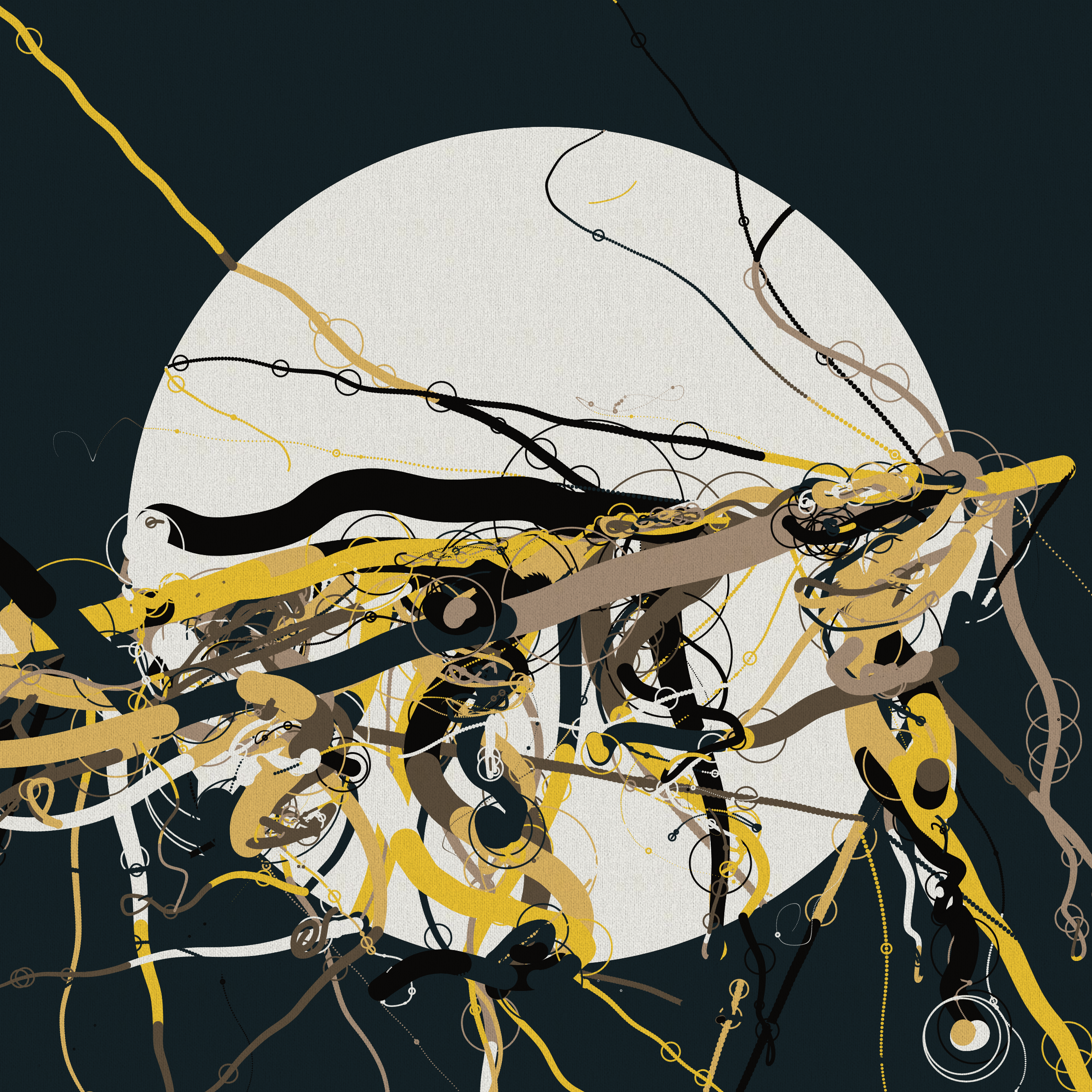
Art Blocks project 216, a release of nine hundred and ten works launched on 7 December 2021. Each output uses digital cloud chambers to observe the traces of unidentified particles, with the space divided into regions of differing physical properties that affect how particles move, rotate, split and vanish, forming an unpredictable experimental system. The artist page places the work at the intersection of physics, mathematics, music and art.
- Art Blocks
- Particles
Sources & related records
- AB_Project_CheYu Repository · The production side of the Art Blocks release (Curatorial theme)
- Sliderverse × White Castle (Doodle Labs) · The same Art Blocks technology line that year (Curatorial theme)
- Art Blocks After Dinner Mints Episode 29 with Che-Yu Wu · The project discussed in the episode (Documented connection)
- SACRIFICE — M.A.D.S. Art Gallery · Generative work from the same period (Curatorial theme)
- Saturday Chat — I Started Selling NFTs: The Value of Generative Art in NFTs · The project previewed in the article (Documented connection)
- Neocha — Algorithmic Bliss · The Art Blocks line covered in the article (Curatorial theme)
- Chaos Lab Solo Exhibition, First Run — AMBI SPACE ONE · Electriz shown in the exhibition's second chapter (Curatorial theme)
- Saturday Chat — Making the Art Blocks Project Electriz · The project the article unpacks (Documented connection)
Art Blocks After Dinner Mints Episode 29 with Che-Yu Wu
Episode 29 of After Dinner Mints, the Art Blocks podcast, with Che-Yu Wu as guest. The episode is framed around his newly launched Art Blocks project Electriz, and notes the groundwork he laid for sail-o-bots.
- Podcast
- Art Blocks
Sources & related records
- Project Electriz (Art Blocks #216) · The project discussed in the episode (Documented connection)
Sliderverse × White Castle (Doodle Labs)
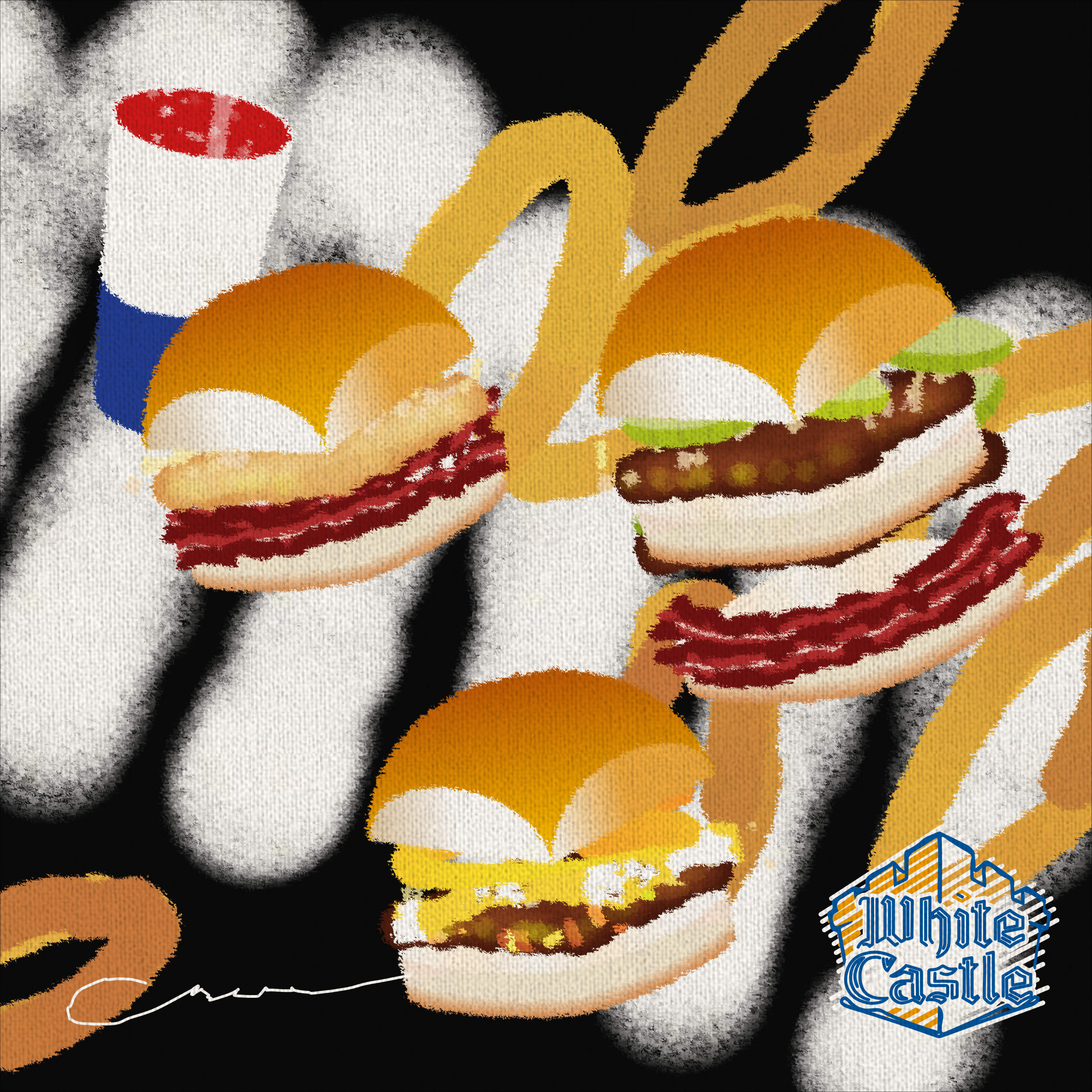
A generative NFT collection of five thousand works on Ethereum made with US fast-food chain White Castle and NFT platform Doodle Labs. Each piece is minted at the moment of purchase using Art Blocks generative minting technology, so component combinations and stylistic treatments differ per output. White Castle's chief marketing officer described the artist as combining multimedia technology and art into a creative experience unlike any they had seen.
- NFT
- Brand collaboration
Sources & related records
- White Castle Announces NFT Collaboration with Doodle Labs and Che-Yu Wu · The collection announced by this release (Documented connection)
- Project Electriz (Art Blocks #216) · The same Art Blocks technology line that year (Curatorial theme)
- Global Views Monthly — A 26-Year-Old Unknown Who Reached Financial Freedom Through NFTs · The brand collaboration mentioned in the article (Curatorial theme)
SACRIFICE — M.A.D.S. Art Gallery
The M.A.D.S. Art Gallery page lists Che-Yu Wu as a digital artist and a contemporary new media artist from Taiwan working with algorithmic and interactive practice, describing the work as soulfully algorithm-driven, casting life and emotion within the digital realm. Works shown on the page include The Soul of Flowers, Sweet Dreams, Causality, Nightmare, Chaos Dancer, Tangled and Triangle Picnic. The statement speaks of drawing on nature, physics and mathematics between engineering and art to build an emotional and spiritual bridge between the virtual and the real.
- Group exhibition
- International exhibition
Sources & related records
- Project Electriz (Art Blocks #216) · Generative work from the same period (Curatorial theme)
Global Views Monthly — A 26-Year-Old Unknown Who Reached Financial Freedom Through NFTs
A profile in Global Views Monthly tracing his path as a generative artist in New York: learning Flash web design from his mother and Visual Basic from his father as a child, an electrical engineering degree from National Chiao Tung University, then a master's in integrated digital media at NYU. Rather than a conventional engineering career he launched an online coding course on Hahow that drew over ten thousand students, began a daily-creation project during the pandemic, and moved into algorithmically generated NFT work. The piece reports cumulative NFT trading volume above one hundred million New Taiwan dollars, a top single sale of 10 ETH, and the animated burger NFT collaboration with White Castle.
- Profile
- NFT
Sources & related records
- Sliderverse × White Castle (Doodle Labs) · The brand collaboration mentioned in the article (Curatorial theme)
- Cheers Magazine — Under 30 and Turned Around by NFTs · The same wave of press coverage (Curatorial theme)
Saturday Chat — I Started Selling NFTs: The Value of Generative Art in NFTs
An essay on NFTs as a new market for digital artists. It explains how blockchains establish authenticity and ownership for digital work, compares OpenSea, Art Blocks, Foundation and Rarible and the kinds of artists each suits, and discusses how NFTs let creators bypass traditional gallery gatekeeping. It recounts his own experience selling generative work on these platforms, including the unexpected attention after one of his robot designs was plagiarised onto Art Blocks, describes his refined line on Foundation alongside a playful meme-style line on OpenSea, and closes by previewing Electriz.
- NFT
- Generative art
Sources & related records
- Project Electriz (Art Blocks #216) · The project previewed in the article (Documented connection)
- AR Series 2 — South Plus at the Kaohsiung Museum of Fine Arts · The same column publishing line (Curatorial theme)
SoulSea
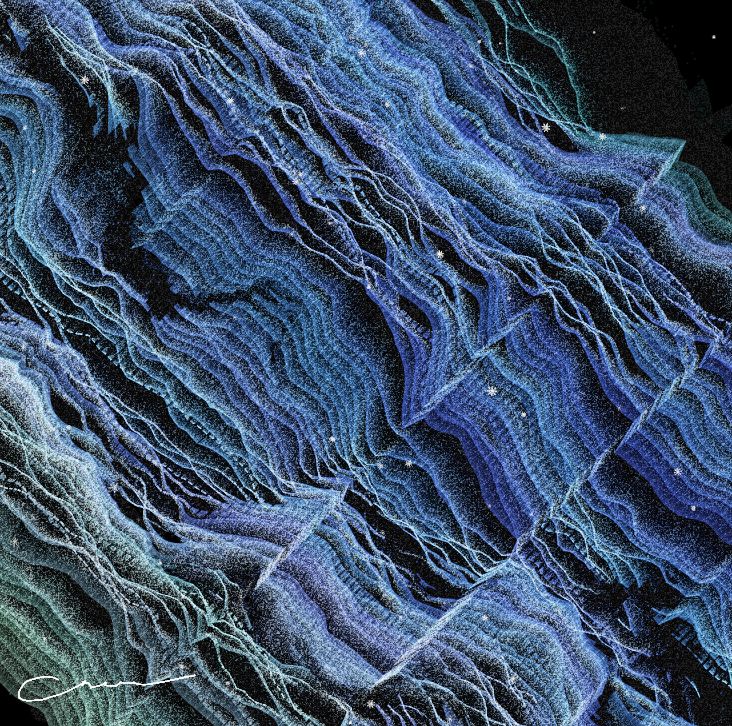
A generative work released on fxhash in an edition of three hundred. The artist's text describes looking down to find that the ocean in your heart is a sine wave, with the tide gently lapping onto the shore, treating the soul as an ocean and inviting the viewer to consider digital consciousness through wave motion and imagery of distant seas. Each edition runs its algorithm live in the browser and looks different.
- Soul series
- fxhash
Sources & related records
- SoulFish · The Soul series (Curatorial theme)
- Creative Coding Taiwan First Meetup — Che-Yu Wu's Generative Art Universe · A work presented in the talk (Curatorial theme)
AR Series 2 — South Plus at the Kaohsiung Museum of Fine Arts
An introduction to South Plus: The South as a Place of Encounter at the Kaohsiung Museum of Fine Arts, where fourteen classic collection works are augmented with AR. The show opened in 2021 after the museum's renovation and marked its twenty-fifth anniversary. The article explains that south here is a viewpoint onto plural histories and overlooked voices rather than a location. Visitors download the museum's collection app to see effects such as wind motion and 3D modelling on works by Chen Cheng-po and Cheng Shih-huang. The exhibition also offers a 360-degree VR walkthrough with artist background for remote visitors during pandemic closures.
- Augmented reality
- Museums
Sources & related records
- Saturday Chat — I Started Selling NFTs: The Value of Generative Art in NFTs · The same column publishing line (Curatorial theme)
- Code as a Brush — Student Works from the Interactive Art Programming Course · The same column publishing line (Curatorial theme)
Stan Shih Foundation — Stan Shih Spots a Talent: Che-Yu Wu on the International Stage
An article from the Stan Shih Foundation. At an online lunar new year greeting event, Acer founder Stan Shih said he had found an exceptional talent in the metaverse, referring to digital artist Che-Yu Wu, and would help introduce his work more widely. The piece traces their history back to 2009, when Wu took first place in the junior high division of the fifth Acer Digital Creation Award, going on to win four first places and a jury grand prize across five consecutive years. It notes his international recognition after an NYU master's in integrated digital media, and lists upcoming plans including his first solo exhibition in Taiwan, immersive installations on algorithmic art and organic digital life, co-curating a Taiwan hundred-peaks NFT experience exhibition, and founding Formosa Art Bank DAO to support creators in Taiwan's NFT ecosystem.
- Profile
- Award history
Sources & related records
- FAB DAO BlindBox NFT (Stages 1 and 2) · The FAB DAO project mentioned in the article (Curatorial theme)
Code as a Brush — Student Works from the Interactive Art Programming Course
A showcase of seven student projects from the Interactive Art Programming course, showing how beginners without a coding background make visual work in p5.js. The pieces range from a work turning musical rhythm into visual particles, an interior space whose day and night lighting follows the mouse, a constructivism-inspired study of overlapping rectangles and light, an underwater scene that releases ink on click, ink ripples responding to cursor position, a dual-mode universe switching between atomic explosion and dream cubes, and a particle composition about hope in darkness. Each entry carries technical notes on animation, blend modes and advanced effects.
- Teaching
- Student work
Sources & related records
- AR Series 2 — South Plus at the Kaohsiung Museum of Fine Arts · The same column publishing line (Curatorial theme)
- Interactive Web Tutorial — Building a Livestream Page with GSAP · The same tutorial publishing line (Curatorial theme)
Blocktrend EP.150 — Licensing Was a Misstep, Pure Creation Sells Better
Episode 150 of the Blocktrend podcast, around fifty-five minutes, with new media artist Che-Yu Wu. It follows his move from teaching interactive art and web design on Hahow to working as an NFT creator, and how an electrical engineering background led into digital art. The conversation covers his first OpenSea releases going unnoticed, an Art Blocks plagiarism incident that unexpectedly raised his visibility, his shift from treating NFTs as licensing tools toward pure creative expression, and FAB DAO connecting nonprofits with emerging creators. The episode argues original work resonates more in the NFT space than licensing-led approaches.
- Podcast
- NFT
Sources & related records
- FAB DAO BlindBox NFT (Stages 1 and 2) · FAB DAO as discussed in the episode (Curatorial theme)
Interactive Web Tutorial — Building a Livestream Page with GSAP
A tutorial building a Facebook-style mobile livestream interface with Vue.js, Vue CLI and GSAP, including a video feed, emoji reactions that drift like particles, and a comment section with enter and exit transitions. It covers Vue's ref and $refs for DOM access, loading video streams with native JavaScript, emoji animation with GSAP's TweenMax and TimelineMax, and transition-group for element animation. The piece moves from single and multi-stage animation basics through each component to a working interface, with a live CodeSandbox demo.
- GSAP
- Vue
Sources & related records
- Code as a Brush — Student Works from the Interactive Art Programming Course · The same tutorial publishing line (Curatorial theme)
- p5.js Tutorial — Birds on Power Lines · The same tutorial publishing line (Curatorial theme)
Neocha — Algorithmic Bliss
An artist feature in Neocha. It describes generative art as algorithms executing predetermined rules to produce unique animated works, and traces his path from Adobe Flash in elementary school through computer science studies to NYU's Integrated Design and Media programme. The article centres the human element in algorithmic creation: machines generate the imagery, but human curation and emotional intention cannot be replaced. He says machines do not experience emotion because they are too perfect, while humans are flawed creatures and good art can come from those flaws. It also recounts his breakthrough with the Sea Hams series on Art Blocks, the community rallying after another collective plagiarised his code, his entry into the Art Blocks Hall of Fame with Sea Hams becoming the platform's unofficial mascot, and his founding of FAB DAO in December 2021 to support emerging Taiwanese digital artists.
- International press
- Generative art
Sources & related records
- Project Electriz (Art Blocks #216) · The Art Blocks line covered in the article (Curatorial theme)
p5.js Tutorial — Birds on Power Lines
A sixteen-step p5.js tutorial building birds perched on power lines, from drawing the wires to a fully animated scene. Techniques include lerp() for the sagging curve between poles, classes and constructors for reusable objects, randomised pole spacing and height, birds built from paired arcs, gradient backgrounds through colour interpolation, birds reacting to cursor proximity, and pole thickness varying with depth. The argument is generating diversity within regularity, where elements share a structure but differ in size, colour and position, so each refresh shows a different time of day. Advanced sections use Perlin noise for natural bird motion and pull configurable palettes from Coolors.
- p5.js
- Generative composition
Sources & related records
- Interactive Web Tutorial — Building a Livestream Page with GSAP · The same tutorial publishing line (Curatorial theme)
- p5.js Tutorial — Coral Carnival · The same tutorial publishing line (Curatorial theme)
Chaos Lab Solo Exhibition, First Run — AMBI SPACE ONE
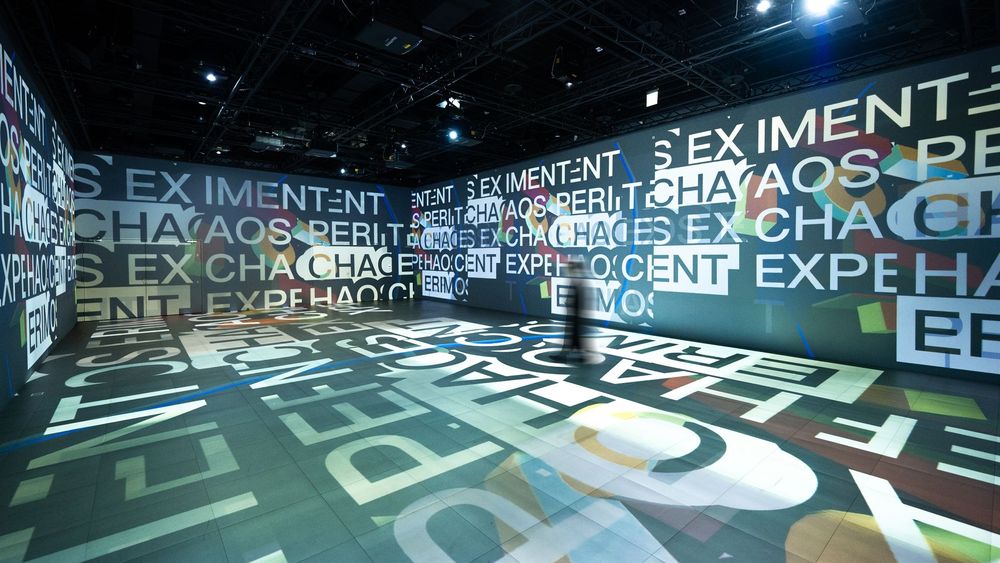
The first run of the generative art solo exhibition Chaos Lab, subtitled as a translation from virtual NFTs to the physical world, at AMBI SPACE ONE on the fifth floor of Taipei 101. The show gathers his NFT work from 2020 to 2022 into fifty selected generative pieces drawing on nature, physics, modern art, mathematical rhythm and music, turning online generative imagery into an offline immersive experience.
- Solo exhibition
- Immersive
Sources & related records
- Chaos Lab May Run — AMBI SPACE ONE · The May extension of the same exhibition (Curatorial theme)
- Project Electriz (Art Blocks #216) · Electriz shown in the exhibition's second chapter (Curatorial theme)
Cheers Magazine — Under 30 and Turned Around by NFTs
A profile in Cheers magazine on how he changed his career and standing before thirty through generative NFT work.
- Profile
- NFT
Sources & related records
- Global Views Monthly — A 26-Year-Old Unknown Who Reached Financial Freedom Through NFTs · The same wave of press coverage (Curatorial theme)
p5.js Tutorial — Coral Carnival
A ten-step account of making the generative piece Coral Carnival from scratch: an initial concept drawn from piano, sheet music and plants, a basic V-shaped motif, radial kaleidoscopic structures through loops and rotation, palettes built with Coolors, texture overlays and blend modes to lift the image, then final refinement and export. Technical ground covers frameCount()-driven animation, colour management with colorMode(), translate, rotate and scale transformations, and Perlin noise for natural randomisation. The argument is that generative art holds up through materials, colour, detail and variation together.
- p5.js
- Generative art
Sources & related records
- p5.js Tutorial — Birds on Power Lines · The same tutorial publishing line (Curatorial theme)
- p5.js Tutorial — Sweet Trap · The same tutorial publishing line (Curatorial theme)
Creative Coding: Processing and p5.js Teaching and Trends — Lien-Cheng Wang and Che-Yu Wu in Dialogue
A Taiwan-US online dialogue hosted by C-LAB as part of the 2021 Future Media Arts Festival, between Lien-Cheng Wang, lecturer at Taipei National University of the Arts and technology artist, and Che-Yu Wu, founder of Monoame Design and interdisciplinary new media artist. They discuss Processing and p5.js as accessible entry points to creative coding, both arguing that teaching should centre on making work rather than learning a language and on thinking methods rather than technique. The conversation also covers academic versus industry teaching, the rise of generative art, and how most work on NFT platforms such as Art Blocks is written in p5.js.
- Dialogue
- Creative coding education
Sources & related records
- Creative Coding Taiwan First Meetup — Che-Yu Wu's Generative Art Universe · The same community conversation line that year (Curatorial theme)
p5.js Tutorial — Sweet Trap
A ten-step build of the generative piece Sweet Trap, where colourful geometric shapes converge and rotate with thin line accents. It moves from canvas setup and mouse interaction to polar coordinate transformations producing petal-like sine forms, then trigonometric positioning, coordinate rotation and translation, dynamic colour selection from curated palettes, noise-based texture, shape variation, shadows and a grid background. The finished work overlays text showing live parameters, and each run picks a different palette.
- p5.js
- Polar coordinates
Sources & related records
- p5.js Tutorial — Coral Carnival · The same tutorial publishing line (Curatorial theme)
Creative Coding Taiwan First Meetup — Che-Yu Wu's Generative Art Universe
A record of the first in-person Creative Coding Taiwan meetup, with artist and Monoame Design founder Che-Yu Wu as speaker. It opens on what creative coding is, treating code as a medium for producing new phenomena and connections, then moves through rules, constraints, storytelling, visual presentation, variation and randomness in generative art. Tools covered include p5.js, Open Processing, GLSL shaders, Unreal Engine and TouchDesigner. He presents his fxhash SoulSea series and CryptoPochi on OpenSea as interactive NFTs combining blockchain and web technology, and extends into GPU rendering and GLSL. The post is the first of three parts covering the roughly two-hour livestream.
- Community meetup
- Talk
Sources & related records
- Creative Coding: Processing and p5.js Teaching and Trends — Lien-Cheng Wang and Che-Yu Wu in Dialogue · The same community conversation line that year (Curatorial theme)
- Creative Coding Taiwan May Meetup — Ping-Sheng Wu on Sound, Light and Installation · The same community meetup series (Curatorial theme)
- SoulSea · A work presented in the talk (Curatorial theme)
Chaos Lab May Run — AMBI SPACE ONE
Chaos Lab ran from 20 to 22 May 2022 at AMBI SPACE ONE on the fifth floor of Taipei 101, open from 11am to 6pm. The show selected fifty generative works made between 2020 and 2022, drawing on nature, physics, modern art, mathematical rhythm and music, presented as a roughly forty-minute immersive audiovisual experience across five high-specification projection surfaces that turned virtual imagery into a physical space around the visitor. Workshops on 21 and 22 May covered generative NFT production, blockchain technology and cultural applications, while an online section traced his path from interactive web design through generative art to interactive NFTs. Admission was NT$280 full, NT$150 student and NT$140 concession, free for children under four and visitors over sixty-five.
- Solo exhibition
- Immersive
Sources & related records
- Chaos Lab Solo Exhibition, First Run — AMBI SPACE ONE · The May extension of the same exhibition (Curatorial theme)
Creative Coding Taiwan May Meetup — Ping-Sheng Wu on Sound, Light and Installation
A record of the Creative Coding Taiwan May meetup, with sound artist and Noise Cafe Arts music director Ping-Sheng Wu, and Team9 technical director and National Tsing Hua University lecturer Wen-Han Chang. Wu discussed integrating sound, light and interactive installation, with a background spanning visual and sound art and study in creative sound and media technology. He presented six projects including a light installation responding to local fabric culture, interactive floor lighting in a music venue, a public synthesiser installation, a glass column acoustic sculpture in Shanghai, an outdoor instrument installation, and an interactive percussion setup. He described coming to code from a creative rather than an engineering angle, using visual programming tools such as Max MSP and TouchDesigner to bring sound design together with physical mechanisms and lighting in public art.
- Community meetup
- Sound installation
Sources & related records
- Creative Coding Taiwan First Meetup — Che-Yu Wu's Generative Art Universe · The same community meetup series (Curatorial theme)
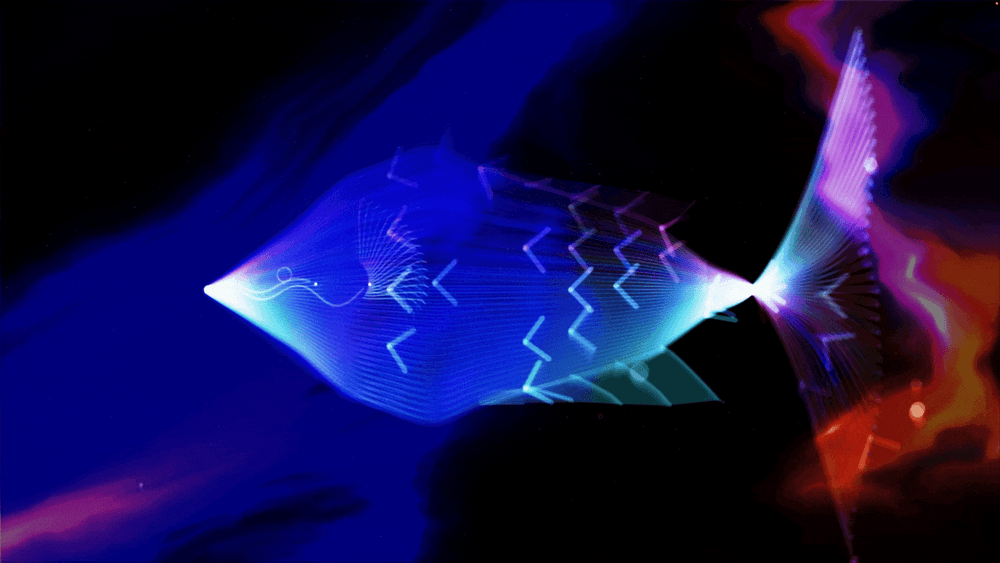
SoulFish
A generative work released on fxhash. The text takes up Zhuangzi's butterfly parable, describing soul fish born in the void and crystallised from human emotions, fluttering silently and slowly through digital depths, and asking how we understand joy and consciousness across different forms of being. Each edition runs its algorithm live in the browser with its own visual outcome.
- Soul series
- fxhash
Sources & related records
- SoulSea · The Soul series (Curatorial theme)
Saturday Chat — Making the Art Blocks Project Electriz
An account of making Electriz, the Art Blocks generative NFT. The work simulates particle behaviour from cloud chamber experiments, where particles leave traces crossing spaces of differing charge. Technical ground covers p5.js with keccak hashing for fixed randomness so each output stays consistent, publishing the code to the blockchain in chunks at roughly one ETH per chunk, testing on the Art Blocks staging environment before launch, and previewing hash variations with Token Art Tools. It also argues that NFT outcomes depend on more than the work alone: artists build a personal brand across Discord and social media, consider blending digital and physical experience, and keep engaging their community while waiting to be seen.
- Art Blocks
- Making-of
Sources & related records
- Project Electriz (Art Blocks #216) · The project the article unpacks (Documented connection)
Interactive Web Tutorial — Object-Oriented Canvas Dragging with GUI Objects and Inheritance
A tutorial on building interactive GUI elements directly on HTML5 Canvas without external libraries. It covers three parts: a Vec2 class to simplify coordinate and position handling across many objects; a three-layer GUI architecture of individual objects, GUI groups, and a Scene class handling rendering and event detection; and two interactions, colour feedback on hover and drag-and-drop wired through mousedown, mousemove and mouseup. It highlights function overloading and an inRange() method for mouse-object hit detection.
- Canvas
- Object-oriented
Sources & related records
- Canvas Tutorial — Enemy Detection Radar · The same Canvas tutorial line (Curatorial theme)
- An Alien Rendering Language? Applying Shaders and WebGL for Rich Visual Effects · The same tutorial publishing line (Curatorial theme)
An Alien Rendering Language? Applying Shaders and WebGL for Rich Visual Effects
An introduction to shaders and WebGL for visual effects on the web. Shaders are explained as a set of instructions executed for every pixel on screen, leaning on the GPU rather than CPU work alone. Applications covered include distortion hover effects, 3D model rendering and displacement mapping, with learning resources such as The Book of Shaders, Shadertoy and p5.js plus code examples for noise and distortion. It cites commercial implementations including Outernets and a Taiwanese beer campaign site, and notes that production use also requires knowledge of JavaScript modules and bundlers.
- Shaders
- WebGL
Sources & related records
- Interactive Web Tutorial — Object-Oriented Canvas Dragging with GUI Objects and Inheritance · The same tutorial publishing line (Curatorial theme)
- Circles — Repetition Through Loops · The same tutorial publishing line (Curatorial theme)
Circles — Repetition Through Loops
On making repeating visual patterns with loops. It opens on repetition in art and nature, then teaches for-loop syntax in p5.js and its basic uses, nested loops for grid arrangements, and adding rules and variation within repetition. The worked example builds a music-inspired piece arranging colourful spheres in a four by four grid, taking Friday Love by the Taiwanese band The Fur. as its starting point, and shows how to combine static design elements with dynamically generated particles. The complete example is published on OpenProcessing.
- Loops
- p5.js
Sources & related records
- An Alien Rendering Language? Applying Shaders and WebGL for Rich Visual Effects · The same tutorial publishing line (Curatorial theme)
FAB DAO BlindBox NFT (Stages 1 and 2)
The FAB DAO BlindBox NFT, released across a first and a second stage. FAB DAO, or Formosa Art Bank DAO, is the nonprofit NFT autonomous organisation he co-founded with Huang Tou-Ni, connecting blockchain fundraising to nonprofits and emerging creators.
- Charitable NFT
- DAO
Sources & related records
- Stan Shih Foundation — Stan Shih Spots a Talent: Che-Yu Wu on the International Stage · The FAB DAO project mentioned in the article (Curatorial theme)
- Blocktrend EP.150 — Licensing Was a Misstep, Pure Creation Sells Better · FAB DAO as discussed in the episode (Curatorial theme)
cheyu-genart-fairy-village Repository
A public GitHub repository for a generative work. It holds index.html plus index_randomhash.html and index_tokenhashtool.html variants, the scripts mySketch.js, Artblocks.js and seperatechunk.js, along with package.json, featurefield.json, build and dist directories and canvas-light.jpeg. The Artblocks and tokenhashtool filenames point to the Art Blocks on-chain and hash-preview workflow. The main branch holds thirty-one commits and the About field is empty.
- Generative art
- Open source
Sources & related records
- AB_Project_CheYu Repository · The same Art Blocks production line (Curatorial theme)