Installation2026
Woven Land, Woven River
Contents & work details
- Exhibition year
- 2026
- Type
- Installation
- Artist
- Che-Yu Wu 吳哲宇
- Premiere
- Taiwan Design Expo 2026, Taoyuan Environmental Protection Bureau pavilion
- Dates
- 24 September to 11 October 2026
- Venue
- Taoyuan Convention and Exhibition Center
- Medium
- Real-time algorithmic weaving (Three.js), C-shaped LED ring at 12096×960 px, observation panel, algorithmic sound
- Data
- National greenhouse gas inventory 1990 to 2024, Taoyuan terrain and waterways, on-site questionnaire
- Commissioned by
- Taoyuan City Government Environmental Protection Bureau
Overview
Woven Land, Woven River is a continuously running algorithmic art system that speaks the language of weaving. Thirty-five years of Taiwan's carbon emissions, the structure of industrial emissions, Taoyuan's carbon-reduction policies and the everyday choices of visitors on site are woven into one digital cloth that never stops growing.
After visitors answer questions about their daily carbon footprint on an interactive page, their data travels as points of light into the ring of LED and is drawn out into thread. The work takes its ground from the pond-studded terrain of Taoyuan: the threads wind and fork like waterways and grow into river-like textures; emission data makes the pattern tangle in many materials, while carbon reduction opens fissures and lets the structure dissolve.
The work tries to weave human warmth out of a cold technological medium. When the flourishing of a civilisation is woven into a magnificent carpet, you can admire the brilliant footprint of a city and a society, and at the same time see what all of it is woven from.
Why weaving
It began as data visualisation, and data visualisation has a problem: more emissions look like a bad thing, and fewer emissions do not look like much at all. Weaving works differently. Cloth has holes; it takes in gemstones and pom-poms and other three-dimensional things, and grows into a structure with thickness.
Most of my digital work has been clean geometry, lines and planes. This time the medium is a ring of LED, and I wanted the materials on screen, the feel of yarn and cloth, to keep some human warmth inside a high-tech medium.
What I want the audience to meet is an organic piece of cloth. It can fork somewhere and grow out like a river. With the terrain, the carbon data and the raised materials layered on, the texture becomes very organic: a weave of traditional patterns, and at the same time a way of feeling the data.
The loom is the code
The system is built on how a real loom works: threading, shedding, punch cards. In 1804 the Jacquard loom used punched cards to weave patterns that only a master weaver could make before; some thirty years later Babbage took the idea of instructing a machine with cards from that stack, and Ada Lovelace wrote that the Analytical Engine weaves algebraic patterns just as the Jacquard loom weaves flowers and leaves. Follow the punch card forward and you reach the census machine, the computer, the data centre, and the subject of this work: digital carbon emissions.
So every warp thread and every pick of weft here is a real three-dimensional yarn. Interlacing, floats, diamond twills and broken threads all grow out of the weave. Incoming data rewrites the weave itself; colour is only the result.
Terrain, cities and people are themselves a kind of weaving.
Five chapters
On the wall the cloth is woven in an endless loop; the fell travels from left to right in about a minute, and every pass weaves different data, in five chapters.
One, Land: only the ground weave, Taoyuan's terrain speaking for itself. The weft follows the contour lines, the rivers push the weft aside and expose the bare warp, and the ponds are holes in the cloth. Two, Thirty-five years: one pick per year from 1990 to 2024; five yarns for power, industry, transport, buildings and agriculture, and waste are woven into bands as wide as each sector's share that year, with the carbon sink in deep pine green. Three, Tributaries: the chemical, electronics and metal tributaries of manufacturing flow along the warp. Four, Mending: Taoyuan's carbon-reduction policies are woven as darning grids. Five, Many hands: visitors' answers become shared data woven into the last chapter; whoever signs in becomes a gold thread, and the more people, the denser the gold; with no one there, only the ground weave is woven.
Chapters cross-fade into one another, and a chapter can mutate into mirrored, denser, sparser, hue-shifted or differently woven variants, so no two passes are the same. The weaving also sounds: the loom's warp and weft become a drum kit, joined by a piano, and the larger a share of the data, the higher the pitch.
Five data sets, three layers of cloth
A real figured cloth is layered: the ground weave is the unchanging base, the figure floats on top, and supplementary weft is extra thread laid in. The work places its data the same way: Taoyuan's terrain is the ground weave, carbon emissions are the figure, and visitors' actions are the supplementary weft. Each chapter weaves one data set, and each incoming datum changes the weave, not the colour.
One, Land: Taoyuan's terrain, rivers and ponds
Data: a 512 by 704 elevation field of Taoyuan (AWS Terrain Tiles, 0 to 2,290 metres), the rivers from OpenStreetMap (seven of them, Dahan, Nankan, Laojie and Shezi among them, 195 kilometres in all) and 519 ponds, 58 of which are now covered with solar panels.
How it is woven: elevation is quantised into seven ground yarns, from estuary indigo through rush green, seedling jade, tea green, red-earth gold and maple ochre to the misty gold wool of the ridges, dyed in discrete steps with no gradient, in a tight plain weave: the base of the land. Where a river runs, the weft breaks and the bare warp shows; the cloth gives way to water. Ponds are holes in the cloth, and ponds under solar panels are covered holes, woven dark and tight: a hole is an instruction, a covered hole is an instruction rewritten. On the wall the cloth crosses Taoyuan north to south and back, and after every pass the slice drifts one kilometre east.
Two, Thirty-five years: the national greenhouse gas inventory
Data: table 2.3.1 of Taiwan's 2026 National Greenhouse Gas Inventory Report, emissions by sector for every year from 1990 to 2024. Gross emissions grew from 139.6 million tonnes of CO2 equivalent to 273.2 in 2024, net emissions 251.4; the power sector's share went from 35% to 64%; the carbon sink in 2024 was minus 21.8.
How it is woven: one pick per year. That year's net emissions set the float length of the weft, from 0 to 7: the higher the emissions, the longer the float and the brighter, looser and more fragile the surface, which is the physics of satin; low-emission years are plain weave, and the land shows through. The five sectors' shares are woven as five colour bands in slit tapestry, each band as wide as its share, with a slit at every boundary that light really passes through. The carbon sink is woven as a band of deep pine green, the small part that takes carbon back. Each pick's punch card has eight shafts; the float length decides how many are lifted.
Three, Tributaries: the industries of manufacturing
Data: manufacturing emitted 138.97 million tonnes in 2024, 50.9% of the national total (Climate Citizen Dialogue Platform); the shares by industry are the Ministry of Economic Affairs' official 2019 figures, chemicals 24%, electronics 22%, metals 20% and others 34%; for 2024 only the ranking was published, with chemicals still ahead of electronics and metals.
How it is woven: industries are tributaries. Four bands meander along the length of the cloth, each as wide as its share, with a fine slit at every boundary like the waterways of kesi tapestry; the eddies of chapter three turn only inside these bands.
Four, Mending: Taoyuan's carbon-reduction policies
Data: seven figures and estimates of carbon reduction provided by the Taoyuan Environmental Protection Bureau for 2024 to 2026: three years of low-carbon event guidelines (4,893, 32,000 and 33,000 tonnes), metro station energy saving 2,864 tonnes, the green-energy conversion of the Guishan water recycling centre 7,000 tonnes, bamboo forest renewal in Fuxing 799 tonnes, and the net-zero living campaign 1.06 tonnes; the bamboo figure looks like a unit error in the source and is kept in tonnes until the bureau confirms it.
How it is woven: policies are darning. Each figure becomes a square of new moon-white thread, brighter than the old cloth around it; the side of the square is the logarithm of the tonnes reduced, a creative decision, because on a linear scale small policies would not exist. The unconfirmed figure is woven with an ikat blur at its edges, the weave's way of saying uncertain. The closer to the present, the denser the gold threads of the participants: mending is collective.
Five, Many hands: the visitors' questionnaire
Data: the questionnaire on site has four steps: at the entrance a name and a yes or no to the 2030 net-zero pledge, then digital low-carbon actions, then low-carbon living actions, then a vote on the design of the garbage truck. Each saved step sends its raw record to the work's relay, which pushes it live to the ring and the observation panel. This is shared data: the work weaves the distribution everyone chose together, not any one person's answers.
How it is woven: even picks weave the distribution of digital actions and odd picks the distribution of living actions, each colour band as wide as the share of visitors who chose that option, with a slit at every boundary; whoever signs in becomes a gold thread, a whole pick of weft replaced by the only yarn on the cloth that glows, and the more people, the denser the gold; at the tail hangs a band of pine green as wide as the share pledging 2030, the same meaning as the carbon sink at the end of chapter two. Task three is not woven. With no one there, chapter five weaves only the ground: no one pretends there are people.
How the data becomes weave
| Data | Element of the weave | Why |
|---|---|---|
| Elevation | Seven ground yarns in discrete dyes, tight plain weave | The base of the land, no gradients |
| Rivers | The weft breaks and the bare warp shows | The cloth gives way to water |
| Ponds / solar ponds | Holes in the cloth / covered holes (dark, tight) | A hole is an instruction; a covered hole is one rewritten |
| Net emissions per year | Weft float length 0 to 7 | Higher means brighter, looser, more fragile; low years are plain weave |
| Sector shares | Five slit-tapestry bands, width equals share, slits at the boundaries | Light really passes through |
| Carbon sink | A band of deep pine green | The small part that takes carbon back |
| Manufacturing industry shares | Four tributary bands meander along the cloth, width equals share | The waterways of kesi; eddies turn only inside the bands |
| Tonnes reduced by policy | Moon-white darning squares, side equals log10 | On a linear scale small policies would not exist |
| Unconfirmed figures | Ikat blur at the edges | The weave's way of saying uncertain |
| Actions chosen by visitors | Even picks digital, odd picks living, width equals share | Shared data, not any one person |
| Names signed in | A whole pick replaced by gold thread | The only yarn that glows; the more people, the denser |
| Share pledging 2030 | Pine-green tail band, width equals share times 0.18 | The same meaning as the carbon sink |
| Every pick | An eight-shaft punch card; float length sets the lifts | The Jacquard loom's instruction of 1804, ancestor of the computer |
| The pull of emissions | Tension; the selvedge draws in | When the two sides are unbalanced the cloth really deforms |
Chapters cross-fade; a chapter can mutate into mirrored, denser, sparser, hue-shifted or differently woven variants, so no two passes are the same.
Colour is how the data is woven
Hue follows the theme of each chapter: the land takes the colours of the land itself, and the industry scene keeps the same proportions and colours as the observation panel. Brightness and the variants come from the rise and fall of the data. There is no colour key; the colours are how the data is woven.
The sound is woven too
There is no pre-written score and no recorded track. When each note sounds, which note it is and how loud, are all computed from the loom's state at that moment: which pick it is on, which shafts are raised, which chapter it is weaving, whether someone has just signed in. The piano's timbre is sampled from single notes of a real piano; which note to play, and when, is left to the loom.
Time grows out of the loom as well. Rather than fixing a tempo and fitting the fell into it, the music builds upward from a single pick as its smallest unit of time: 4 picks make a sixty-fourth note, 64 picks a beat, 256 picks a bar. The wall weaves 45 picks a second, so a beat lasts 1.42 seconds, 42 beats a minute, a tempo that is derived rather than set. Sound and image count the same integer, so the two cannot drift apart.
- 01
Pick
Each pick the fell advances is the smallest unit of musical time
- 02
4 picks
A sixty-fourth note
- 03
64 picks
A beat
- 04
256 picks
A bar
- 05
45 picks a second
1.42 seconds a beat, 42 beats a minute; the weaving speed sets the tempo
- 06
One integer
Sound and image are both located by pick number, so they cannot drift
- 01
Drone
Listens to the terrain: it glides with the chapter's tonic, brighter over high ground, duller over low
- 02
Weaving
Listens to every pick: a strike every 8 picks, brighter the more shafts are raised
- 03
Pond echo
Listens to the ponds: three delays feed back like waterways, wetter as the weave crosses a pond
- 04
Strings
Listens to the chapter: four voices move each bar, each chapter with its own progression
- 05
Bass
Listens to the weave: each chapter maps to one mechanical motion of the loom
- 06
Fugue
Listens to the emissions: four industrial sectors are four voices, the larger the share the higher the note; when the data changes, so does the subject
- 07
Drums
Listens to the pattern: one per chapter, denser or sparser with the heat
- 08
Loom sounds
Listens to events on the wall: a river turning, a pond, a mend, a chapter change, each with its own sound
- 09
Accompaniment heat
Listens to people and emissions: the more who sign in and the more concentrated the emissions, the more restless it gets
- 10
Gold thread
Listens to each person: a bell rings when someone signs in, and the other voices step back a little
- The loom's motion
- Terrain, chapters and data
- The people on site
The piano is sampled from a real instrument; every other voice is synthesised live in the browser.
On site
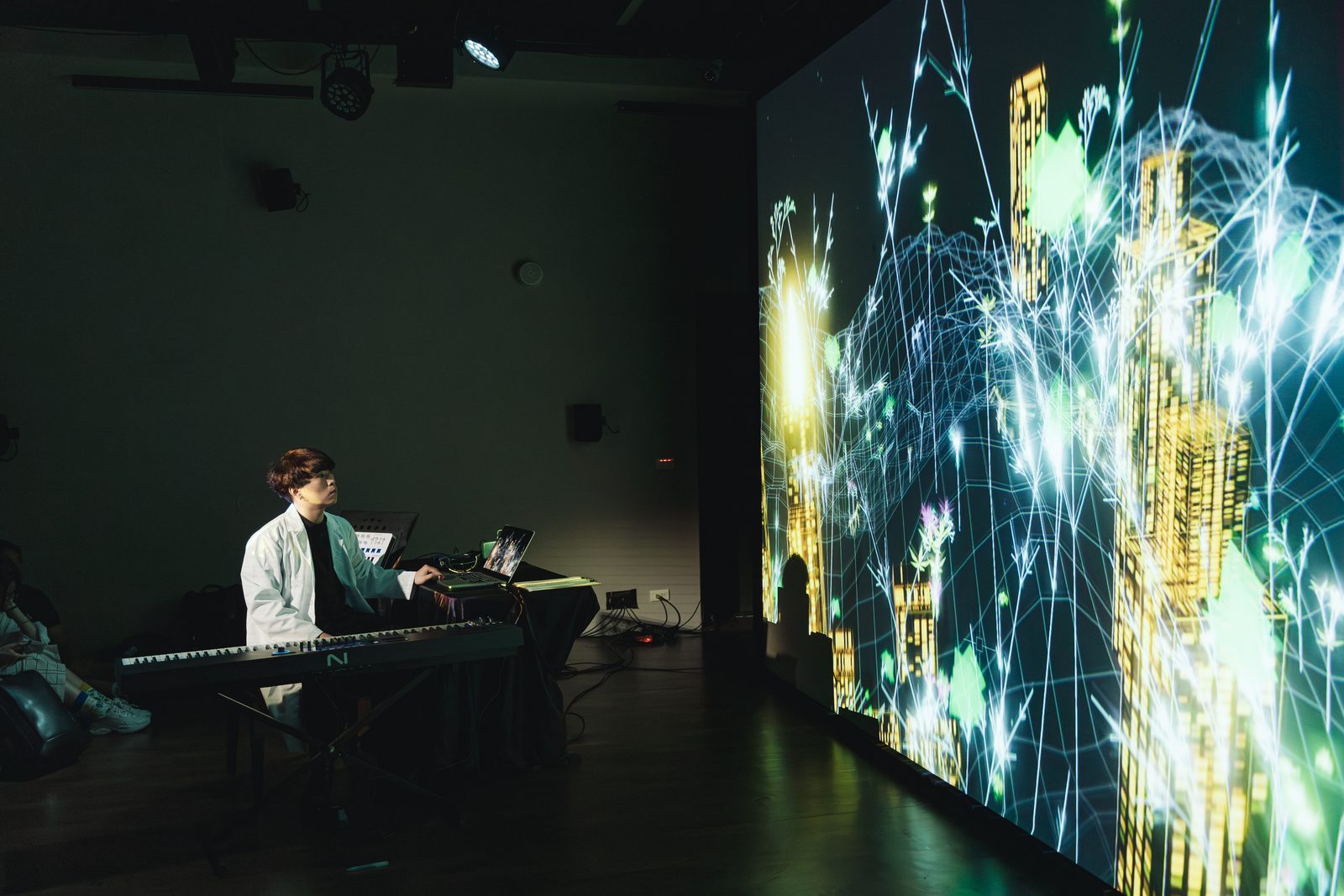
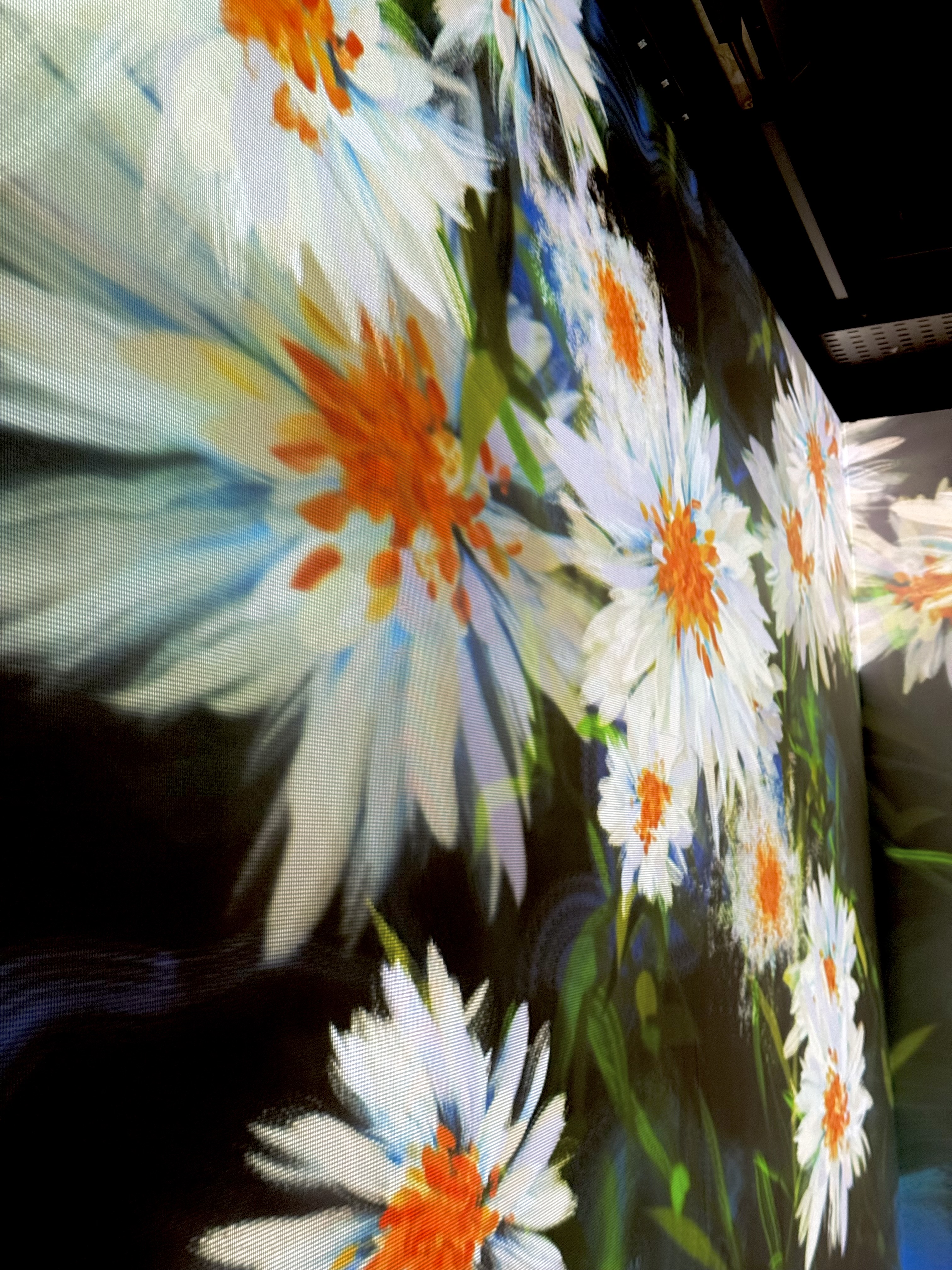
The work is shown at the Taiwan Design Expo 2026 in the Taoyuan Environmental Protection Bureau pavilion, from 24 September to 11 October 2026. The dynamic computing zone is a C-shaped ring of LED with a 2.5-metre opening; visitors walk inside the cloth and watch a world being woven from within. A second screen, the observation panel, shows which chapter is being woven and what data it is eating, and lists the participants who have just signed in.
Taiwan Design Expo 2026, Taoyuan: a night test before opening (21 September). Photographs from the exhibition itself will follow. Tap to enlarge.
The public view on the second screen at the venue: three acts rotate on their own, fourteen seconds each, and visitors can also switch by touching the buttons below. The film is one full rotation, 42 seconds; the names and count in act three are demonstration data.





Press
The day before the Taiwan Design Expo opened, the Taoyuan Environmental Protection Bureau issued a press release on TAOYUAN RE:CODE that introduced this work in its dynamic computing zone: carbon data, Taoyuan's industrial emissions, net-zero policy and visitors' choices growing in real time into ripples, rivers and ponds on a ring of screen. United Daily News and several other Taiwanese outlets ran it the same day.
On opening day the Environmental Protection Bureau published a signed feature in the design magazine MOT TIMES that describes the work's data in four scales: Taiwan's historical emissions as the ground, industry figures as tributaries, Taoyuan's reduction policies as the city's turning points, and visitors' choices stirring the water in real time, with photographs from the site. Shopping Design's editor, walking the expo, described it as a totem wall into which every visitor's choice enters the database and is woven in as it happens.
- 聯合新聞網ReportCarbon really has weight: 24 interactive stations at the Taiwan Design Expo put it on the scale
- 中華日報ReportTAOYUAN RE:CODE brings sustainability and the net-zero transition to the Taiwan Design Expo
- 點傳媒 NEWS586ReportTAOYUAN RE:CODE: a ten-metre ring of real-time generative art, and carbon you can lift
- 桃園市政府環境保護局Press releaseA ten-metre ring of real-time generative art and carbon you can lift: highlights of TAOYUAN RE:CODE
- MOT TIMES 明日誌EPB featureEncoding a contemporary landscape: TAOYUAN RE:CODE at the Taiwan Design Expo 2026, between data and circular materials
- SHOPPING DESIGNEditor's walkthroughTaiwan Design Expo 2026 opens: an editor walks through the two main zones and satellite venues
- ExhibitionZone A9, TAOYUAN RE:CODE (algorithmic art and art direction: Che-Yu Wu)
- Official sitePavilion website: curatorial team
Clippings are the outside record; tags are the exhibition's official pages. Every one opens.
Credits
- Concept and system
- Che-Yu Wu
- Algorithmic art and art direction
- Che-Yu Wu (TAOYUAN RE:CODE pavilion)
- Interactive sound design
- Jen Ni Chang, Che-Yu Wu
- Commissioned by
- Taoyuan City Government Environmental Protection Bureau
- Curatorial production
- 留白計畫 (Daisy Lin)
- Hardware and LED integration
- Jiun Lai (Aisthesis Savage)
- Produced by
- MonoLab
- Project management
- Ariel Huang
- Occasion
- Taiwan Design Expo 2026, Taoyuan Environmental Protection Bureau pavilion
Context & sources
Exhibitions, research & collaborations
Contact the artist