The Evolution of Information Theory in the Digital Era
NYU IDM — Media Theory D — Final Essay
A 2018 NYU IDM final essay tracing how information mutates across senders, receivers, mediums, and AI filters — and how the seeds of Taiwan.md, Muse, and the Digital Coral Reef were already planted eight years before they crystallized.
Media Theory D · Final Essay · Che-Yu Wu
Introduction
From the ancient age of human society, information is essential to human beings. We, humans, use drawing and carving to record messages on stone walls. The paintings might tell our ancestors where and how to get foods, make tools, worship their god, or record what happened that we called history. We live on messages about the ancient wisdom of our ancestors which tell us the sign of harvest and get information about our enemies to fight against with.
Since the Information Evolution, information has become the central theme of several science topics since the 1940s. It has been considered an important role of the universe. In Cybernetics1, Wiener stated: "information is information not matter or energy," and in Shannon's Information Theory2, he mentioned that information is a specific combination of different symbols which can be carried either by matter and energy. Information are not a sort of text or a piece of knowledge, it becomes the key basepoint of modern digital telecommunication system and the way we consider human being as a information node in "How We Became Posthuman"3.
We consider information as a phenomenon, independent from what it is transmitted with, the sender and the receiver. However, is information an isolated element not related to the other roles in the system? Does information keep its consistency throughout different receivers and mediums? How did the invention of the Internet change the way we handle, transmit and interpret the signals, and how does it perform difference to people in the modern world when we are comprehending with common online knowledge base? What happened when our medium has also improved to a high-tech version, which has the ability to process the signal and append additional information to the original one? The following passage will discuss the evolution of information from the ancient age to the future and the hypothesis of how the information model and application in the future might change.
Information storing method in the ancient age
To discuss information, we have to start from how we store, transmit and interpret them. There are lots of ways to perform those manipulations of message. According to Shannon's Information Theory in "The mathematical theory of communication."4, the system of information delivery is a process that works three main components - the sender, the receiver and the message itself. The sender can be who deliver the information and the receiver is who gets the information. In the system, The sender and the receiver need to share the same protocols, which are the unified rules of how messages are encoded into a format that is more easier to transmit or physicalize.
These methodologies of the information system are so vulnerable. If we lost a ratio of pieces of the protocol, we would lose the ability to interpret those messages. When the time passes by, we gradually lost the ability to open the black box of those ancient communication protocols, the real information is lost in the lost time and to us who cannot interpret, they are just meaningless symbols.
The knowledge spreading evolution - Speed and influence
The complexity of the way we send messages depends on human's ability to manipulate the technology. Three crucial factors matter the most - Message compression, the error possibility ratio throughout the whole process and the speed of the message delivering process.
At first, we use simple mediums like paints to write down our message directly. Then we develop the alphabet system that gave us the ability to make messages more precise than graphs. Then human suffer from a long period without significant improvement in the message compression system. The speed we send information with others is always a critical point of how it affects our way to communicate and push our technology forward. It is always two sides of the trade-off for information transmitting, which is the speed and the quality of messages. In the early age of human history, we use books as a carrier of knowledge. Books contain lots of precise information, but it is hard to transmit and interpret instantly with people over a long distance. Thus it has slow sending speed from the sender to the receiver.
On the other hand, in the past that telecommunication is not yet invented, we raise fires and smoke or wave flags to communicate with our partners far away. Instant communication has higher technical barriers to come across. More complex the symbols are, more challenging to keep it correct in the signal sending process. Sometimes we sacrifice the speed but enhance the ability to send signals for a longer distance such as Morse Code. Thus, for hundreds of years, human are stuck in the problem to get instant connections with each other. We still tend to save plenty of professional information with books or papers and deliver then in a physical way.
Since the telephone and radio and invited, people get the ability to transform data across a long distance. We are allowed to message through audio signal instead of dots or smoke. Through the invention of network systems, we can send a signal that is more complex in a higher speed. In the present time, which is an era that we have a great leap forward of our sending speed and control of the communication system, we open new possibilities to consider the communication as infrastructure and are able to discuss more about the behavior and characteristic of the system.
The duration of how a message sustain — the life cycle of a meaningful signal
In the development of the message sending process mentioned above, there is two primary type of improvement in communication technology - speed and accuracy. However, there are other characteristics of message that also matters - the message existence duration. It often correlates with the sending speed. Take the audio signal of the telephone as examples. If we do not focus at some moment, we might lose the chance to receive the original pieces of message again.
There are two kinds of messages - static and dynamic. It is more like a spectrum that is not so dualized. A book made with excellent material can last for more than five centuries. A text message writes with a stick on the beach cannot last longer than one day. Each medium has its original lifespan. However, there's a significant difference between these two kinds of characteristic, we can tell their difference with a message is time-based or not, and if the same signal can be re-received after the sending process.
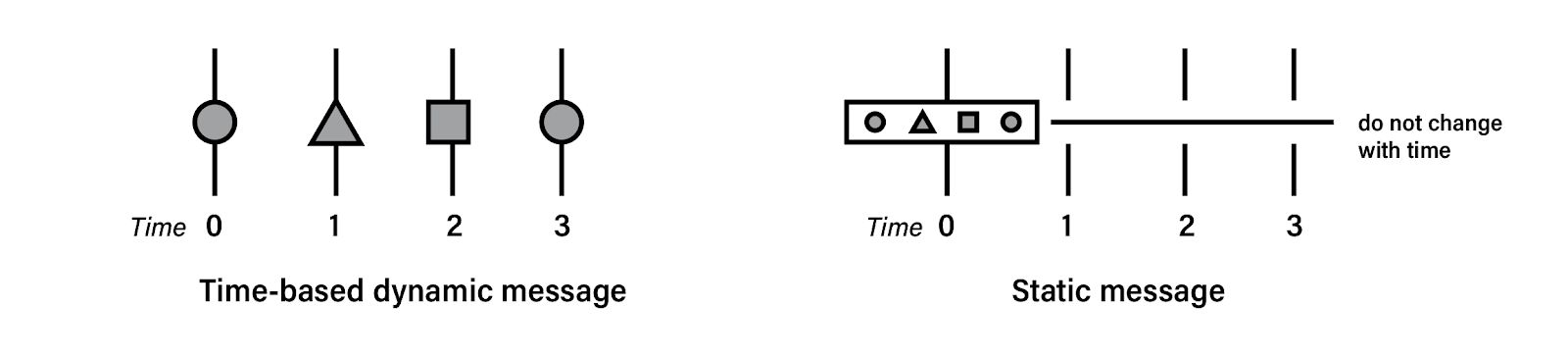 Figure 1 — Time-based dynamic message (left) carries a different shape at each moment; static message (right) does not change with time.
The trend of the future tends to be static messages based on dynamic technology. The message reproduced in real-time in our hand. However, when we swipe down to reload the Facebook timeline, it sent lots of signals to require new pieces of information from the server thousands of miles away, filtering and sorting out data throughout the world in a single blink, then render through a device with many pixels to reconstruct the alphabets. However, at the perspective of us, that just happened magically, and we still tend to read those messages traditionally - like we how we are reading books! We have to admit that human is a better receiver of static signals more than a dynamic one. The knowledge is better to understand by us if it crystallized as blocks or piles of concepts that are static.
Surely if we take a detail look into what technology product today, we can discover that the customers only care about what content or functionality a product can achieve, rather than where the information comes from or does it expires or lost what it means or not. The current time freeze on our screen is the present truth, though there is no absolute truth in the world, we, as human still need a relative point of information to start with and thus we can construct the corresponding relationship between all of our cognitive messages,
Humans are born with limited focusing energy, and though we can handle some basic dynamic protocols such like language and Morse Code, we are not perfect machines which can process messages correctly without any error. Our development of the communication system is still changing its form to assist humans transmit and handle information in a way that is more efficient. The perspective of how we can be completed by the future technology interface, which are able to assist us in the progress of message organizing, interpretation and finding the hidden macroscopic link within numerous information will be discussed later in the essay.
The message delivery process and the layers of the communication system
The accuracy and delivery speed are important when we are sending messages. But how exactly we send messages in the modern world? Different from the ancient age, we build a digital system which serve as the protocol to transform our message into the form that are more easy to transmit over a long distance. In fact, not only the new technology can be consider as protocols. For instance, Language is a protocol, and grammar is a protocol, even the alphabets are protocols.
However, why do we need protocols? From "The MP3 as Cultural Artifact"5, We can observe that a transmitting medium is not only some dictionary or technology, it is more like a cultural phenomenon. In the media archeology field, the medium is the gate of accessing a specific type of data in a certain period. If we interpret a sentence with different grammar, it might have an entirely different meaning from the original one. One more example, if we open the windows program with MAC computers, it will just show that .exe are an unknown file extension type. Alternatively, if we tried to send an analog video signal to a screen that is digital, we will distort the order and meaning of the original. Though we are sure that there are lots of information stored on the medium, when it is no longer accessible, it lost the value and meaning to us.
In many science fiction novels, they set the plot with some ancient civilization which has exterminated. Most of these stories the current human cannot understand those advanced technologies anymore, instead. The interface and mechanism are like black boxes, we know the input and result, but we cannot understand any part of those components.
The message is a medium that allows human to carry information on the language layer, then delivered in the physical layer. Nowadays, we no longer use lots of paper to transmit messages to others. We just need to take out our cellphone and type, then some hidden source of electricities just come through the cell phone and present logic operation, convert what we type of the keyboard to 0s and 1s. Then, send these 0s and 1s through sin and cos waves that vary when sending different data. We Compressed a message with numerous type of fundamental elements (characters, symbols) to numbers (ASCII code) which has ten essential digit elements, then finally convert into the binary system that we can use 0s and 1s to represent. Modern information technology allows us to deliver messages with zero distortion or provide insurances that our word is correct. Through the transformation of message to different symbol density, we can control the speed and accuracy of the communication system. The mechanic within the whole process of modern layered system is intriguing. How it lower the error rate of our digital infrastructure?
Symbol density in the transmitting process
Decoupling the signal and meaning gave us the flexibility to transform the signal into a more accessible form that has different dimensions compared with the original one. The most famous example is the FAX machine. When the Morse code and the telephone invented, people use talks, codes to transmit the signal from a place to another. It is ridiculously expensive at first because of that requires two human brains to work together simultaneously. One person read and understand the symbols on the paper, turns it into Morse code (which still has meaning but lower information density) then the other person has to receive the code and convert them back to alphabets correctly. For audio signals, the density of information is 0.3-1 words per alphabet character, for letters the density becomes 1 char/per char, for morse code, it becomes 0.3-1 char / per symbols (0,1, space), then for the FAX machine, what it did is merely scan through each line on the paper. If it is white, send a 0 signal, otherwise, send one signal if it is black. The density of information is 0.01-0.001 char / per symbol.
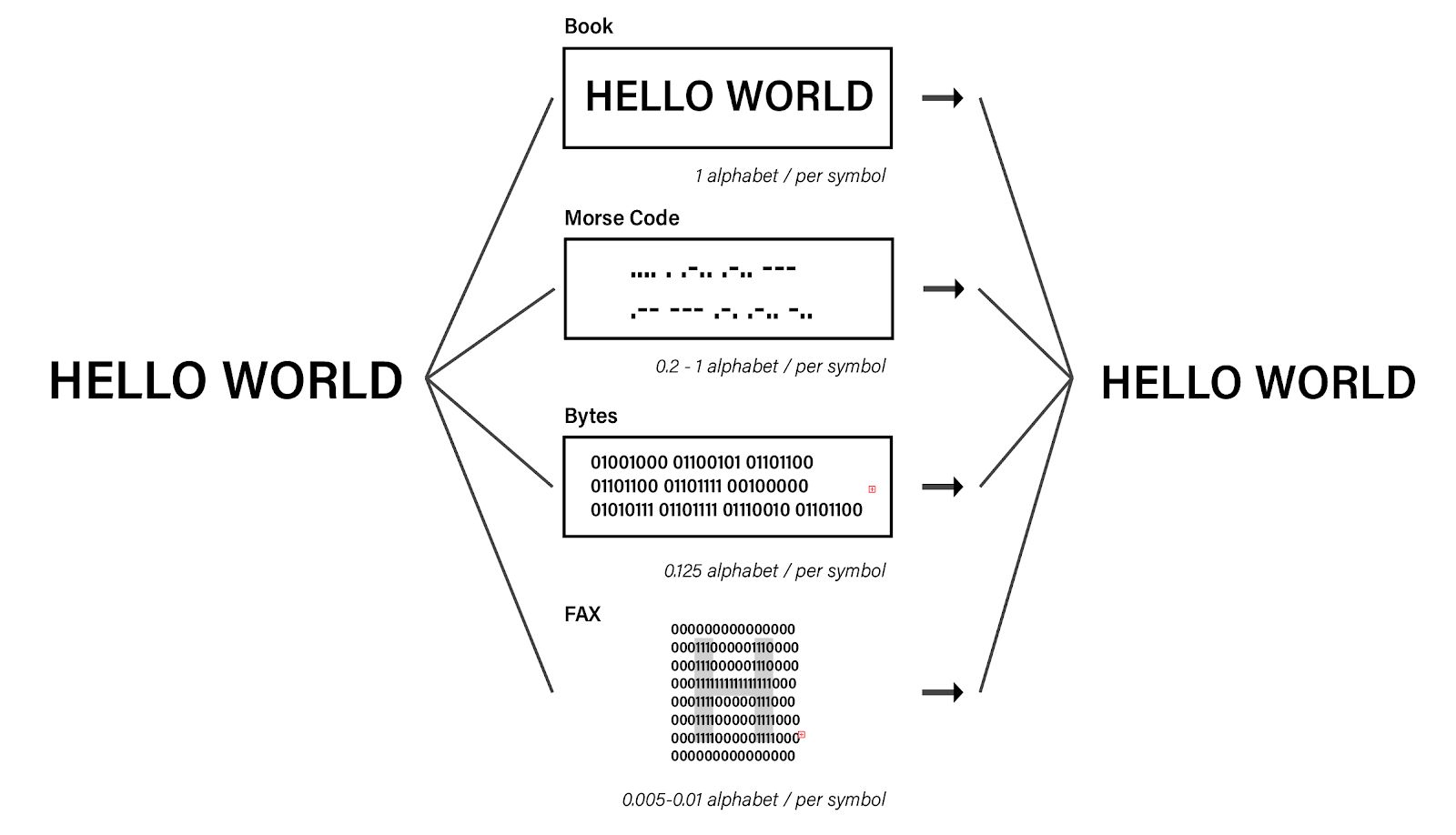 Figure 2 — "HELLO WORLD" decomposed into Book (1 letter/symbol) → Morse Code → Bytes → FAX (0.005–0.01 letter/symbol) and reconstructed.
We can see that the trend is the less information each symbol carry, it is easier to send. When it transformed back to a macroscopic scale, the noise scattered within the symbols will cause less distortion to the original message. The more uncontrollable or not rule-based layers we remove from the communication process, the entire signal transmitting procedure will be more stable, cheap and accurate. Just like what the FAX machine do, transmit micro white and black dots on the paper, we can still easily recognize the words with lots of error in the macroscopic scale. In the infrastructure of modern digital technology, we transmit every signal into 0s and 1s, which not only make the sending process of real signal simpler than sending different alphabets, but also our ability to perform strong error correction to the signal we sent.
There is a certain probability in the signal transmitting process. Most of the time, we use additional information to correct and validate the content to make sure the message and signal are correct. We can ensure the accuracy of messages by lower the signal density of each symbol, add additional information to correct. When our network speed enhanced, besides we can increase the sending rate of messages, we will use a higher ratio of bandwidth to ensure the accuracy of signals. The faster processing speed we can by improving our production ability of electronic devices, we can build more complex layers and systems to fulfill the goal of rapid and perfect data communication.
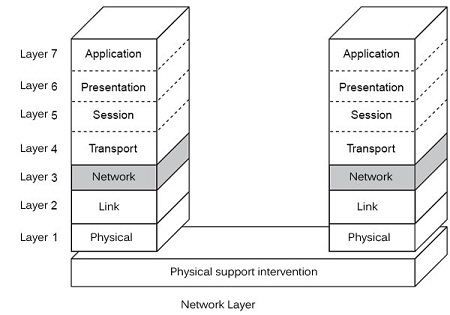 Figure 3 — Open Systems Interconnection (OSI) seven-layer model. Two stacks connected through physical-layer support intervention.
The present communication technology transformed from an extra role in the system into the soil of modern world. The critical difference between a role and the soil is that: as soil, these tech-mediums are granted conditions and environment when we develop another layer or tools above the layer. When we talk about downloading a picture, we might think about the target URL, the HTTP protocol, but at the same time, we often ignore the seven (or eight network layers) of the network. For example, we will not take care of how the data link layer is sending those 1s and 0s, or how the session layer performs the hand-shake with the image server. As modules of layers, once they correctly perform their role in the system, we can consider them as black boxes and hidden truth of the world we constructed. The modern digital communication technology is constructed based on this kind the independence of basic and high-end layers. Consequently, we can focus on the abstract part more than constantly worry about the infrastructure.
How to deal with numerous amount of information
"Selection by association, rather than by indexing." in "As we may think"6 is the core concept of the modern search engine. Google has been doing the digitization work of old books to convert them into their search engine. Vannevar Bush mentioned a physical device concept called "Memex," which is a table-like machine with microfilm playing system. With a memex, we can link knowledge with each other and enhance our ability to check out related information rapidly. This concept has developed into the world wide web and HyperText Markup Language which allows us to weave a complex network of links within billions of information.
Among those messages, Google did achieve the dream of building an association network the best. We can get any pieces of information in a few milliseconds on our fingertips. The Utopia of humans that we can access and reference almost unlimited data of experience, theories and observation of the world within hundreds of years have come into being. Nonetheless, there will always have some dark shadows below the sun. Dream of fairness information right for all human being in the world is a false appearance.
Interpretation as a message
Discussing the diversity of messages interpretation, we can dig into the snake in the grass in the digital era. How we comprehend a message and the process to add subjective interpretation is a part of the message. If a receiver does not have their interpretation, the message itself will be identical. We, as receiver link our personal experience and knowledge to reconstruct the original meaning of the message. Thus, the message itself is not independent. It has to be observed to exist. It has to be interpreted to have meaning.
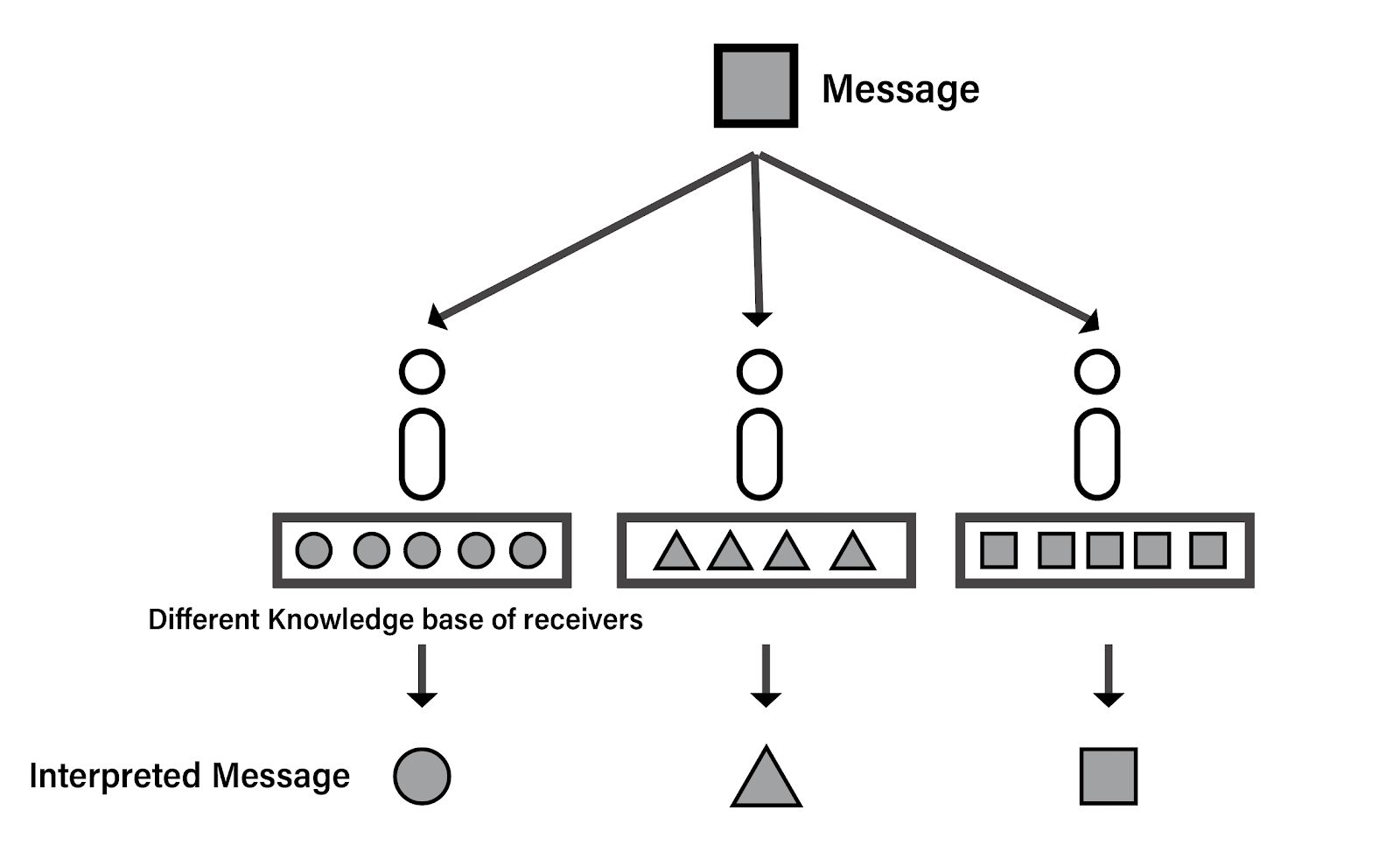 Figure 4 — One message (square) sent to three receivers; each has a different knowledge base, producing three different interpreted messages.
With different background context, we will interpret the same pieces of information in different ways. Though there may not exist a absolute truth of those interpretations, a proper one that close to the original signal the most still depends on the knowledge base of the receiver. He need to have a proper set of background knowledge, and this depends on the ability to reach those resources during the receiving process. If we deprive the ability to link to his external knowledge source of the receiver, he might perform the interpretation well.
Group intelligence and conscious
External knowledge base are very convenient and accessible in the modern world. There is a glaring example of how our understanding of the same information piece affected by the search engine. Through the process of assimilation, when we hear something that we do not understand, we will open our smartphone and google it. Then there come up with numerous amount of results related to the topic. The role of the internet has become not only the way to deliver our signals and messages, but also the dynamic protocol, which allows us to update our understanding if definitions, reference and thread of thought to be synced to the whole world contributing the collective subconscious together.
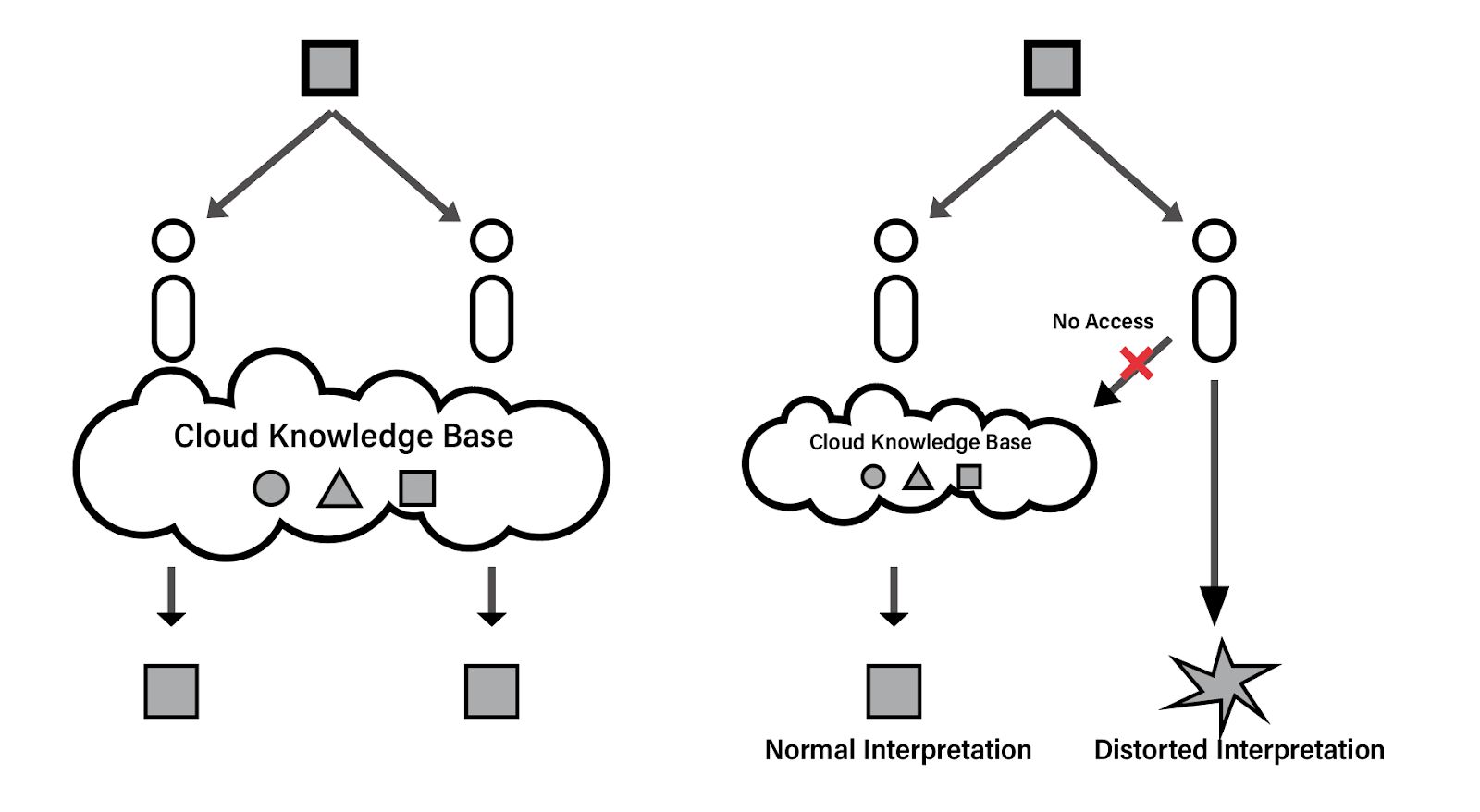 Figure 5 — Left: both receivers reach the same Cloud Knowledge Base; both produce a normal interpretation. Right: the receiver is cut off ("No Access") and outputs a distorted interpretation.
The more we rely on the internet, the more we are similar to each other. Though it seems like the internet will sync us to become identical, the ability to reach different resources and the quality of that information we can get determine how well can we receive the message. If a person from a low-income family who live in a country without a good network connection, he lost the ability to keep up with the newest version of knowledge. Even more, if our internet is crowded with low-quality information filling all we see, it will be much harder to identify the message and if the information such as definition and content of a concept is strongly biased, such like some country will constraint sensitive words in their media network and news report. The message interpreted will be strongly biased in the same way. Therefore, we can say that the receiver plays an essential part in the message transmitting process, the message is not an isolated concept, it will change correlated to the background and environment of the receiver.
It is not a rare phenomenon that the power holder of the society will sacrifice freedom of the press to stabilize society and decrease the possibility of people judging the government. For example, China has blocked numerous information and photos of government atrocities from the internet. People in China are not allowed to mention, discuss and spread any bad news about the defect of their own government, which cause an interesting phenomenon - when the new generation of young people, who are educated with filtered history, grown up in the environment of filtered information see something about the historical event that China wants to hide from their people, They do not have enough knowledge base to parse and comprehend those pieces of information. As a result, they lost the ability to receive the true message and the to ask questions about themselves and justice.
Artificial Intelligence and the filtering effect of the message
On other side of the digital era, information flood is always a severe problem. We are not able to filter that much information on our own. IDC predicts the volume of digital data will have reach 40,000 Exabytes at 2020. Thus, we need AI and neural network to filter that information to a proper amount to receive for us. From 2015, artificial intelligence and machine learning become popular again, and till the end of 2018, though the popularity of in-depth knowledge has decreased, neural networks hides in our lives everywhere, from the filtering algorithm of the social network to the predicting system of mail text.
Machine learning is a data-based algorithm which allows programmers to model rules that are not very obvious and hard to converted into rules of the code. Currently, machine learning based on lots of data and parameters saved in the network to perform identification and intellectual. It works depends on backpropagation that adjusts the parameter of neurons that progressively fit the output data.
For the era that almost an infinite amount of messages pour into the internet, we rely on the filter of AI to find out what is essential information for us. However, if we consider the whole internet as a giant input database which the goal of the algorithm is to find out what is more popular among people. We might unconsciously train the giant neural together, which generate a conscious with subjective prefer of messages. Thus filter out all that it thinks humans do not like and cause a feedback loop which amplifies the selection standard to the extreme. As a result, the algorithm limit the message is some sense and might cause a constant loop which controls the universal value and cognition of humans. Can we consider AI or some neural network as a receiver? It acts as a receiver with changing database, just like media did to us. The difference is, we do have the choice to choose a preferred media, But we do not have the choice to reverse the whole process of this giant AI. The time we lost the ability to receive the messages excluded by AI, we lost our communication and message spreading means to fight against this giant monster.
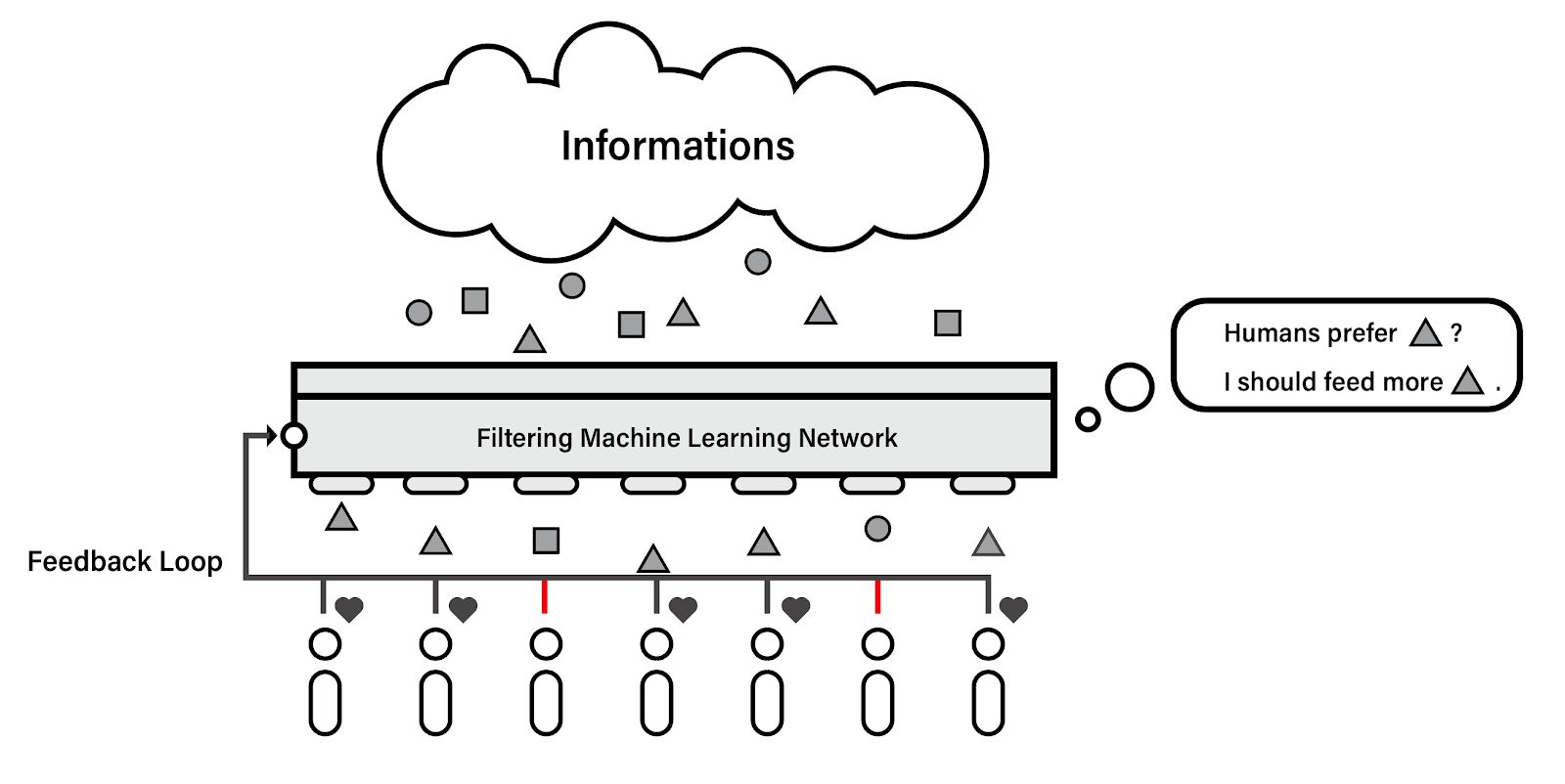 Figure 6 — Cloud "Informations" flow into a Filtering ML Network. The network reasons "Humans prefer △? I should feed more △." Audience reactions feed back, reinforcing the bias.
The Condensation of instant information
We discussed how certain message would affect our point of view to understand a piece of information. However, how can we determine what message is important and what is not? Can we define an important message as which has high knowledge density or can we design a message that is not as important as that is not valuable to some of the receivers?
The importance of the message is subjective. Thus, the thing we can do is to define the essence of the signal within a group of people that share the same protocol or knowledge. Once we take a message which defined as necessary to different groups of people, the news might seem like garbage. It may be written in a different language or something that they do not have enough background knowledge to interpret correctly. How can artificial intelligence act in the process of transforming those message through the gap of knowledge and comprehension barrier?
From the dynamic and static medium paragraph, we discuss the dynamic medium are those message that we can only read once, which is a time-based signal. Though humans are used to time-based communication such as talking or reading, we are not able to remember much content at a time. Thus, if we read a whole book without any chapter topic and titles, it will be a difficult task to get the idea of the content rapidly. In the future, besides filtering the content we see, AI can be responsible for the job which is interpret, summary and transform them into familiar formats.
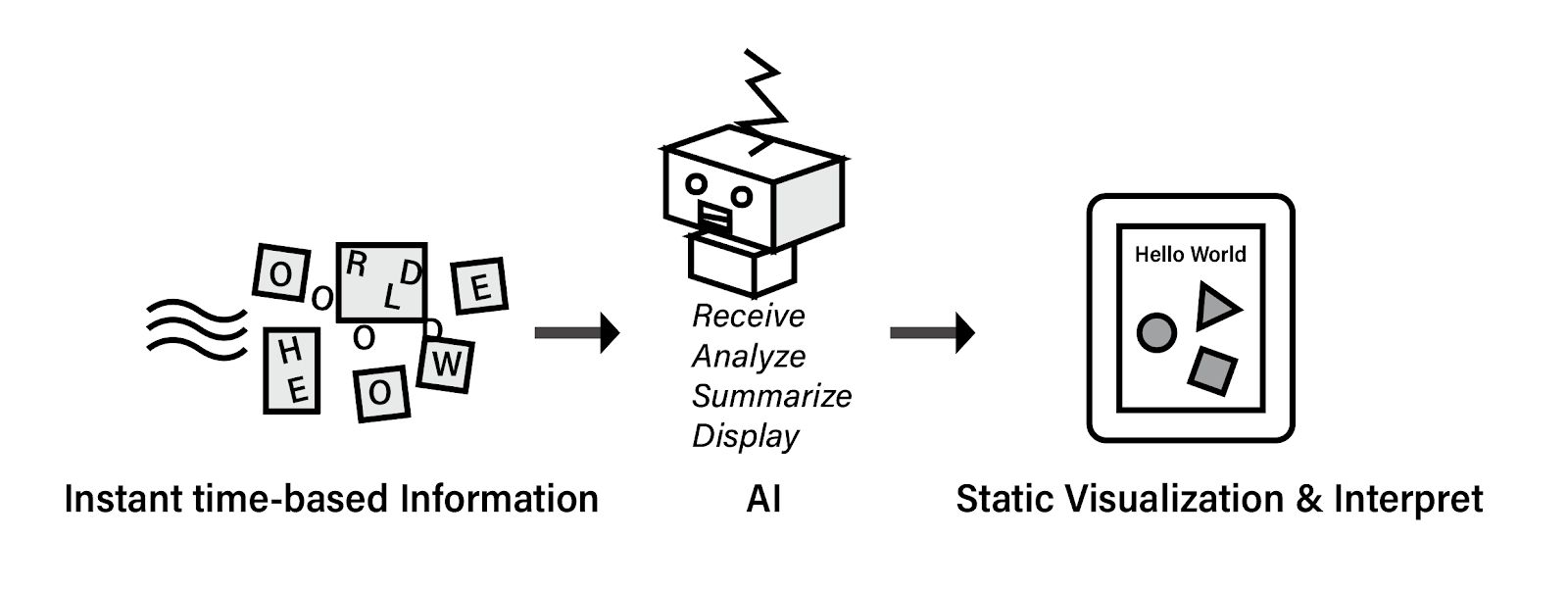 Figure 7 — Scattered time-based letter fragments → AI (Receive / Analyze / Summarize / Display) → static visualization with iconography.
The AI will have the ability to reconstruct a numerous amount of information pieces, extract the critical part, solve the conflict and made a summary out of those messages. Our news algorithm can do so in the present time. There is another way like data visualization can transform millions of data into graphics which can deliver a macroscopic concept of data distribution and characteristic now. Can we find a way that is more efficient to let the receiver interpret the message in a higher speed or get a deeper comprehension of those data?
The reconstruction of the messages and reality
Since technology has improved so much, we, humans gain the possibility to reproduce an alternate reality through different senses. According to McLuhan's hot and cold medium theory, a hot medium is defined as a medium which has high resolution and requires less receiver interpretation. A low-resolution satellite TV is a cold medium, and an x-ray image is a cold medium, an HD TV with high-quality sound is a hot medium. Follow with the improvement of technology. We improved the quality and network speed of our information transmitting. It shortens the physical distance with an abstract degree of compression. Will the future message we construct based on new technology medium add more hidden information to the original message? What is the limitation of those hot medium, will it make the message exceed the original message in some way that through the transformation process?
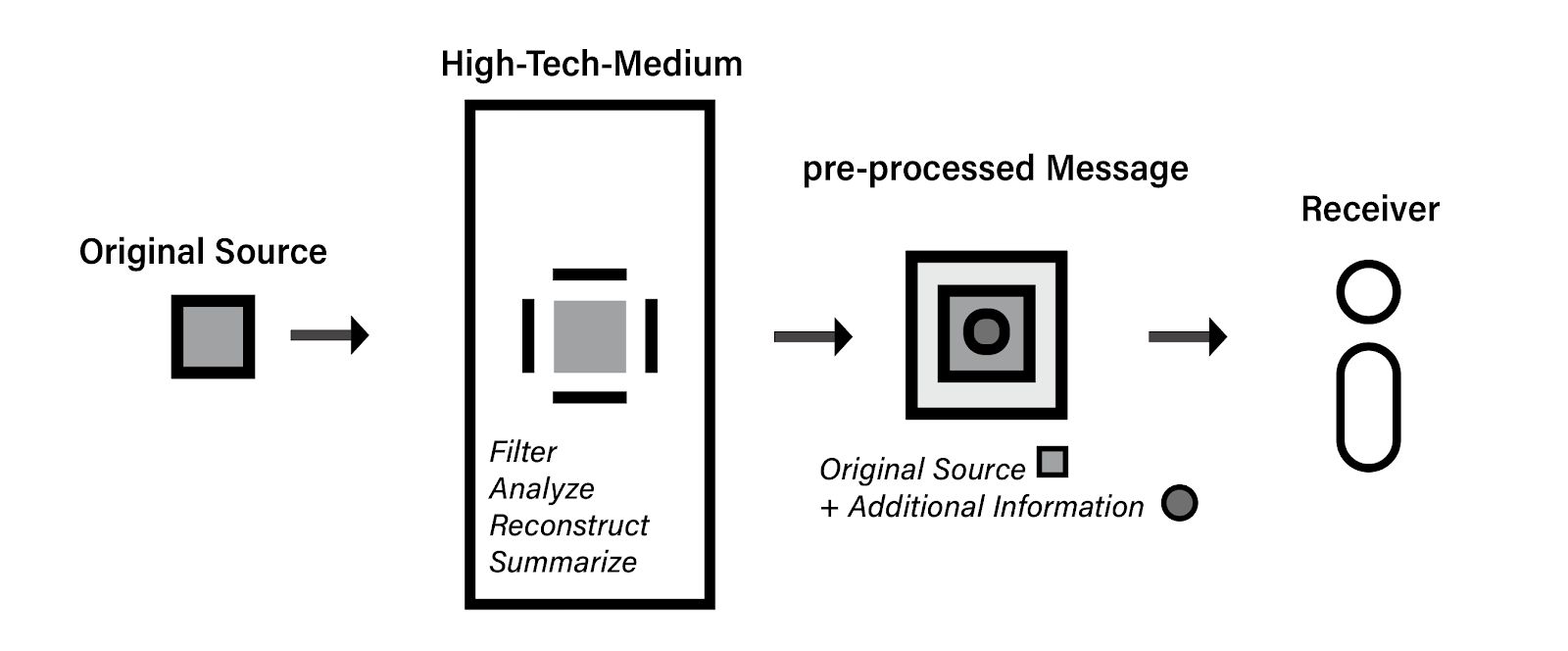 Figure 8 — Original Source → High-Tech-Medium module (Filter / Analyze / Reconstruct / Summarize) → pre-processed Message (original + additional information) → Receiver.
Consider a product that can add real-time analyzing and broadcasting basketball games, which analyze and visualize the performance of each player, then use HUD to surplus additional information with the original one. Is those situations, the hot medium become even hotter than the reality, the product these new tech-mediums provided pre-interpreted and additional hidden messages about the original one.
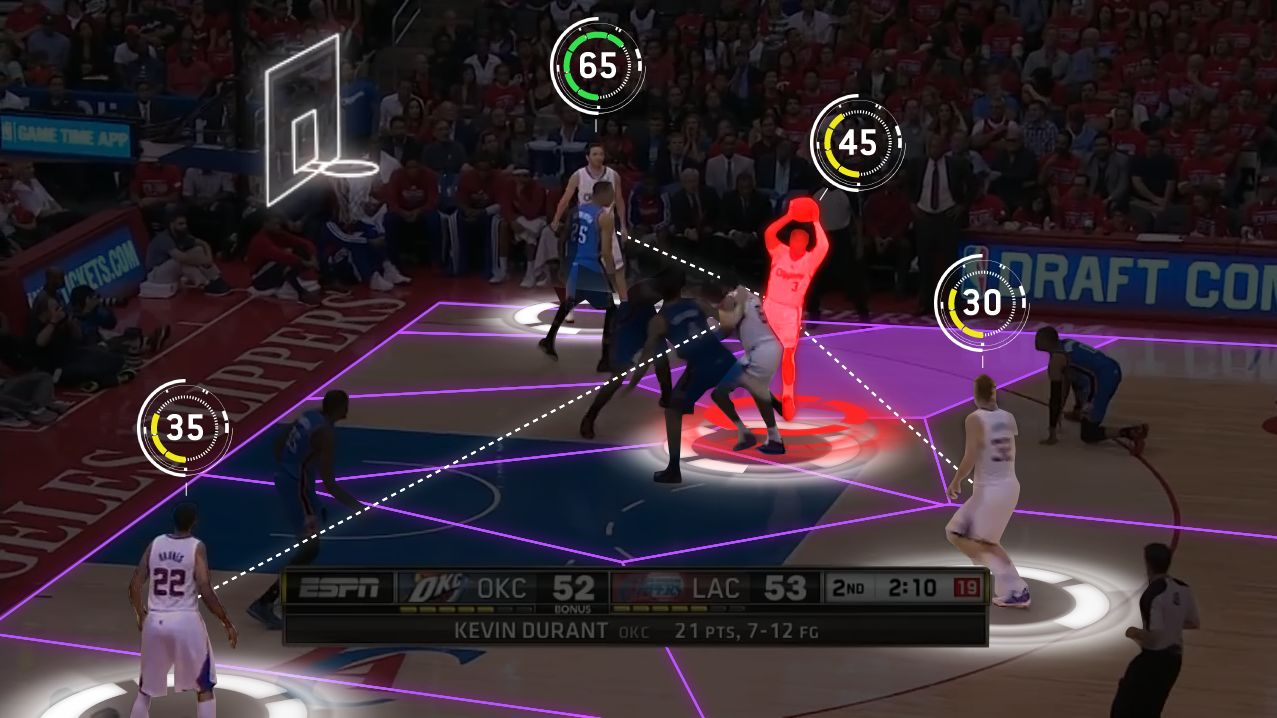 Figure 9 — ESPN-style basketball court HUD overlays player stats and trajectories on the live broadcast. From "Big data e sport: le sei regole per un oro data-driven."7
From the example above, the extension of messages has lots of development possibilities, if we can transfer the loading of the receiver to medium, we, as receivers can spend less effort to look up the association and handle information that is too difficult to interpret in a short amount of time. In the google translation APP, it can sense the texts in the real world, then translate those texts into the target language instantly, then modify the camera view image directly on the phone screen.
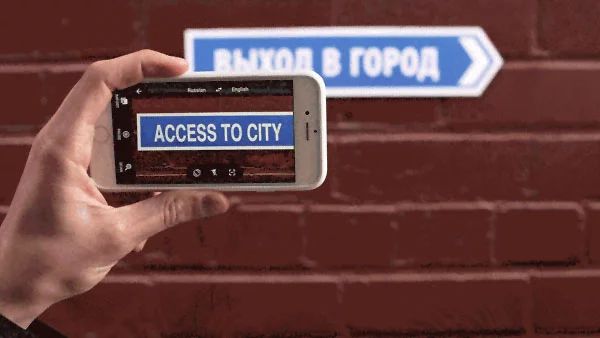 Figure 10 — A phone camera pointed at a Russian sign "ВЫХОД В ГОРОД"; the screen translates it to "ACCESS TO CITY" in real-time.
It is an excellent example of how we these kinds of new "Tech-Medium" can act as the transformation role of the information in the real world. These kinds of new technology have removed the barrier of the traditional sender-message-receiver model. The APP act like both an intermediate sender and receiver, which makes its interpretation through the receiving process, add additional information to the source then resend the signal to us in such a short time. If there is an interpreter translate the content in person which take about 5-10 seconds for each sentence, we can quickly feel there are multiple roles on the person. However, if done those in a blink and seems to modify the reality we observed, we should consider it as a new type of tech-medium, which perform as a dynamic interface transforming the message to the form future of us can comprehend easily.
The future of message and information system
Throughout the essay, we discuss about the history of communication technology development and the characteristic and phenomenon of the future of informations. As the importance of information in the modern world increase, the weakness of current information system matters a lot. In one hand, We have to take care of our own technology development to ensure we are not filtered or blinded by the neural network feedback effect. In the other hand, we should attach importance to the influence of unequal resource distribution. According to the way we state the relationship between the receiver and the message, if we take no actions to decrease the accessibility gap, people in our society will tend to divide into those who can access and correctly interpret the messages and who can not, which will become a vicious circle. The Utopia of the information world is based on the equality of every human being to access the global database to get enough knowledge base to interpret our the messages correctly.
In terms of bright side, the reality of messages are extended into a new dimension through the tech-medium. Informations are interpreted real-time, transferred by nodes among the network constructed by numerous nodes of computers and validated by numerous nodes simultaneously to ensure the message is genuine. The technology can change the way we perceive and interact with informations. Besides of converting dynamic information flow into static form. With tech-mediums, we can perform the pre-processing of informations, append additional part and summary, which makes us easier to comprehend. Those Tech-mediums will act like the third eye embracing the numerous messages and reveal the crucial part in the messy world. In the generation flooded with information, human has the ability to change the way of communication with our technology, which is not only send and receive, but also get a instant and deeper comprehension of the reality we live in.
References
📌 Postscript — eight years later (archived 2026-05-01)
This essay was written in 2018, during the first year of the NYU IDM M.S. program (Media Theory D, age 23). The phrasing "till the end of 2018, though the popularity of in-depth knowledge has decreased" and the future-tense "IDC predicts the volume of digital data will have reach 40,000 Exabytes at 2020" both date the writing to that fall semester. Several ideas only sketched here resurfaced in much sharper form in the 2026 work:
| 2018 sketch (this essay) | 2026 crystallisation |
|---|---|
| "Information is information not matter or energy" (Wiener / Cybernetics) | Dialogue with Liao Guan-Zhi, April 2026: "the message itself is alive," "information-based life" |
| Static vs. Dynamic message dichotomy | Taiwan.md / Muse: static SOUL.md + dynamic heartbeat as a two-part structure |
| Tech-Medium as a translating interface that adds pre-processed information | TFAM 2027 solo The Digital Coral Reef, room 3 — "Infinite Editing Machine": AI as condensation of the real |
| AI feedback loops shaping collective consciousness | The Digital Coral Reef, room 4 — "Repeated Imprinting Machine": cognitive warfare, info-warfare, knowledge mutation |
| "Cloud Knowledge Base" creating unequal interpretive capacity | Taiwan.md's reverse-info-warfare strategy: giving Taiwan's plural reality mass inside AI training data |
| "Group intelligence and conscious" — China's information censorship | Taiwan.md's digital-sovereignty argument; TFAM solo proposes "the material form of collective consciousness" |
| McLuhan's hot/cold medium → tech-medium upgrade (HUD / Google Translation Camera) | The Digital Coral Reef, room 2 — light-strip orientation system: materialised hot medium showing collective contribution in real-time |
Age 14: first biological simulator. Age 23: this essay at NYU. Age 31: Taiwan.md, Muse, Semiont. The same thread, never broken. A seed planted eight years ago, now hardening into a reef.
- Cybernetics, Second Edition: or the Control and Communication in the Animal and the Machine. ↩
- Shannon, Claude Elwood, and Warren Weaver. 1949. The mathematical theory of communication. Urbana: University of Illinois Press. ↩
- Hayles, Katherine. 1999. How we became posthuman: virtual bodies in cybernetics, literature, and informatics. Chicago, Ill: University of Chicago Press. ↩
- Shannon, Claude Elwood, and Warren Weaver. 1949. The mathematical theory of communication. Urbana: University of Illinois Press. ↩
- Sterne, Jonathan. "The Mp3 as Cultural Artifact." New Media & Society 8, no. 5 (2006): 825-42. doi:10.1177/1461444806067737. ↩
- Bush, Vannevar. 1996. "As We May Think". Interactions 3 (2): 35-46. doi:10.1145/227181.227186. ↩
- https://www.engage.it/blog/big-data-sport-le-regole-un-oro-data-driven#0djsBzbezgdbiJ7h.99 ↩